Results by title
237 books match the query 'Religion, Politics & State' and 6 start with h
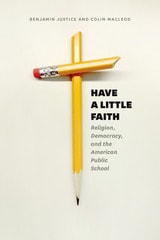
Have a Little Faith
Religion, Democracy, and the American Public SchoolBenjamin Justice and Colin Macleod
University of Chicago Press, 2016
From Bible readings and school prayer to teaching evolution and cultivating religious tolerance, Justice and Macleod consider the key issues and colorful characters that have shaped the way American schools have attempted to negotiate religious pluralism in a politically legitimate fashion. While schools and educational policies have not always advanced tolerance and understanding, Justice and Macleod point to the many efforts Americans have made to find a place for religion in public schools that both acknowledges the importance of faith to so many citizens and respects democratic ideals that insist upon a reasonable separation of church and state. Finally, they apply the lessons of history and political philosophy to an analysis of three critical areas of religious controversy in public education today: student-led religious observances in extracurricular activities, the tensions between freedom of expression and the need for inclusive environments, and the shift from democratic control of schools to loosely regulated charter and voucher programs.
Altogether Justice and Macleod show how the interpretation of educational history through the lens of contemporary democratic theory offers both a richer understanding of past disputes and new ways of addressing contemporary challenges.
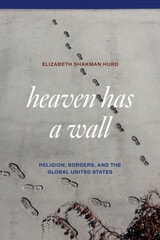
Heaven Has a Wall
Religion, Borders, and the Global United StatesElizabeth Shakman Hurd
University of Chicago Press, 2025
Our national conversation about the border has taken a religious turn. When televangelists declare, “Heaven has a wall,” activists shout back, “Jesus was a refugee.” For Elizabeth Shakman Hurd, the standoff makes explicit a longstanding truth: borders are religious as well as political objects.
In this book, Hurd argues that Americans share a bipartisan border religion, complete with an array of beliefs and practices, including a reverence for national security, a liturgy for immigration, and an eschatological foreign policy. Through an analysis of the many ways the United States creates, enforces, and ignores borders at home and abroad, Hurd offers a bold new perspective on the ties that bind American religion, politics, and public life.
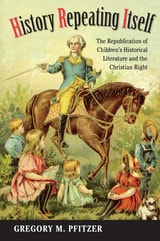
History Repeating Itself
The Republication of Children's Historical Literature and the Christian RightGregory M. Pfitzer
University of Massachusetts Press, 2014
Recently publishers on the Christian Right have been reprinting nineteenth-century children's history books and marketing them to parents as “anchor texts” for homeschool instruction. Why, Gregory M. Pfitzer asks, would books written more than 150 years ago be presumed suitable for educating twenty-first-century children? The answer, he proposes, is that promoters of these recycled works believe that history as a discipline took a wrong turn in the early twentieth century, when progressive educators introduced social studies methodologies into public school history classrooms, foisting upon unsuspecting and vulnerable children ideologically distorted history books.
In History Repeating Itself, Pfitzer tests these assertions by scrutinizing and contextualizing the original nineteenth-century texts on which these republications are based. He focuses on how the writers borrowed from one another to produce works that were similar in many ways yet differed markedly in terms of pedagogical strategy and philosophy of history. Pfitzer demonstrates that far from being non-ideological, these works were rooted in intense contemporary debates over changing conceptions of childhood.
Pfitzer argues that the repurposing of antiquated texts reveals a misplaced resistance to the idea of a contested past. He also raises essential philosophical questions about how and why curricular decisions are shaped by the “past we choose to remember” on behalf of our children.
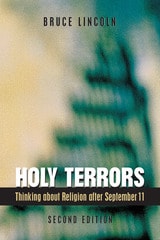
Holy Terrors, Second Edition
Thinking About Religion After September 11Bruce Lincoln
University of Chicago Press, 2006
Holy Terrors begins with a gripping dissection of the instruction manual given to each of the 9/11 hijackers. In their evocation of passages from the Quran, we learn how the terrorists justified acts of destruction and mass murder “in the name of God, the most merciful, the most compassionate.” Lincoln then offers a provocative comparison of President Bush’s October 7, 2001 speech announcing U.S. military action in Afghanistan alongside the videotaped speech released by Osama bin Laden just a few hours later. As Lincoln authoritatively demonstrates, a close analysis of the rhetoric used by leaders as different as George W. Bush and Osama bin Laden—as well as Mohamed Atta and even Jerry Falwell—betrays startling similarities. These commonalities have considerable implications for our understanding of religion and its interrelationships with politics and culture in a postcolonial world, implications that Lincoln draws out with skill and sensitivity.
With a chapter new to this edition, “Theses on Religion and Violence,” Holy Terrors remains one of the essential books on September 11 and a classic study on the character of religion.
“From time to time there appears a work . . . that serves to focus the wide-ranging, often contentious discussion of religion’s significance within broader cultural dynamics. Bruce Lincoln’s Holy Terrors is one such text. . . . Anyone still struggling toward a more nuanced comprehension of 9/11 would do well to spend time with this book.”—Theodore Pulcini, Middle East Journal
How Political Parties Mobilize Religion
Lessons from Mexico and TurkeyLuis Felipe Mantilla
Temple University Press, 2021
Political mobilization tends to take different forms in contemporary Catholic- and Sunni-majority countries. Luis Felipe Mantilla attributes this dynamic to changes taking place in religious communities and the political institutions that govern religious political engagement.
In How Political Parties Mobilize Religion, Mantillaevenhandedly traces the emergence and success of religious parties in Mexico and Turkey, two countries shaped by assertive secular regimes. In doing so, he demonstrates that religious parties are highly responsive to political institutions, such as electoral laws, as well as to the structure of broader religious communities.
Whereas in both countries, the electoral success of religious mobilizers was initially a boon for democracy, in Mexico it was marred by political mismanagement and became entangled with persistent corruption and escalating violence. In Turkey, the democratic credentials of religious mobilizers were profoundly eroded as the government became increasingly autocratic, concentrating power in very few hands and rolling back basic liberal rights.
Mantilla investigates the role religious mobilization plays in the evolution of electoral politics and democratic institutions, and to what extent their trajectories reflect broader trends in political Catholicism and Islam.
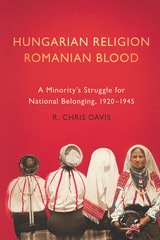
Hungarian Religion, Romanian Blood
A Minority's Struggle for National Belonging, 1920–1945R. Chris Davis
University of Wisconsin Press, 2019
Davis's highly illuminating example is the case of the little-known Moldavian Csangos, a Hungarian- and Romanian-speaking community of Roman Catholics in eastern Romania. During World War II, some in the Romanian government wanted to expel them. The Hungarian government saw them as Hungarians and wanted to settle them on lands confiscated from other groups. Resisting deportation, the clergy of the Csangos enlisted Romania's leading racial anthropologist, collected blood samples, and rewrote a millennium of history to claim Romanian origins and national belonging—thus escaping the discrimination and violence that devastated so many of Europe's Jews, Roma, Slavs, and other minorities. In telling their story, Davis offers fresh insight to debates about ethnic allegiances, the roles of science and religion in shaping identity, and minority politics past and present.