Results by title
58 books match the query 'Representative government and representation' and 2 start with h
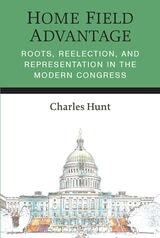
Home Field Advantage
Roots, Reelection, and Representation in the Modern CongressCharles Hunt
University of Michigan Press, 2022
Although partisan polarization gets much of the attention in political science scholarship about Congress, members of Congress represent diverse communities around the country. Home Field Advantage demonstrates the importance of this understudied element of American congressional elections and representation in the modern era: the local, place-based roots that members of Congress have in their home districts. Charles Hunt argues that legislators’ local roots in their district have a significant and independent impact on their campaigns, election outcomes, and more broadly on the relationship between members of the U.S. House of Representatives and their constituents. Drawing on original data, his research reveals that there is considerable variation in election outcomes, performance relative to presidential candidates, campaign spending, and constituent communication styles that are not fully explained by partisanship, incumbency, or other well-established theories of American political representation. Rather, many of these differences are the result of the depth of a legislator’s local roots in their district that predate their time in Congress. Hunt lays out a detailed “Theory of Local Roots” and their influence in congressional representation, demonstrating this influence empirically using multiple original measures of local roots over a full cross-section of legislators and a significant period of time.
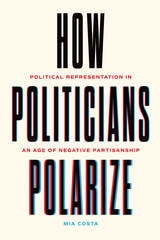
How Politicians Polarize
Political Representation in an Age of Negative PartisanshipMia Costa
University of Chicago Press, 2025
A fresh examination of political representation in an era of negative partisanship.
What does representation look like when politicians focus on "othering" the opposing party rather than the policy interests of their constituents? How do voters react to negative partisan rhetoric? And is policy responsiveness still the cornerstone of American representative democracy?
In How Politicians Polarize, Mia Costa draws on survey experiments, analysis of congressional newsletters and tweets, and data on fundraising and media coverage to examine how and why politicians rely so often on negative partisan attacks. Costa shows that most Americans do not like negative rhetoric, and politicians know this. Nonetheless, these kinds of attacks can reap powerful rewards from national media, donors, and party elites. Costa’s findings challenge the popular notion that Americans are motivated more by their partisan identities than by policy representation. Her research illuminates how the political ecosystem rewards negative representation and how this affects the quality of American democracy.