Results by title
164 books match the query 'Revolution' and 3 start with h
History of Political Ideas, Volume 6 (CW24)
Revolution and the New ScienceEric Voegelin, Edited & Intro by Barry Cooper
University of Missouri Press, 1999
Volume VI of Voegelin's account of the history of Western political ideas continues from the point reached in the previous volume with the study of the mystic-philosopher Jean Bodin. Voegelin begins with a discussion of the conflict between Bishop Bossuet and Voltaire concerning the relationship between what is conventionally identified as sacred history and profane history. Bossuet maintained the traditional Christian position, the origin of which may be traced to Saint Augustine's City of God. Voegelin shows, however, that while Bossuet may have been heir to an adequate understanding of human existence, Voltaire drew attention to a series of historical facts, such as the comparative size of the Russian and Roman empires, the existence of Chinese civilization, and the discovery of the New World, that could be incorporated into Bossuet's account only with great difficulty or not at all.
For the first time, the theoretical problem of the historicity of evocative symbols of political order becomes the focus of Voegelin's analysis. This major problem, which found a provisional solution in the New Science of Vico, was intertwined with several additional ones that may be summarized in terms of an increasing closure toward what Voegelin calls the world- transcendent ground of reality. Voegelin traces the consequences of the new attitudes and sentiments in terms of an increasing disorientation in personal, social, and political life, a disorientation that was expressed in increasingly impoverished experiences and accounts of history and of nature.
Vico represents the great exception to this decline in the intellectual adequacy of modern political ideas and modern self- understanding. Readers familiar with Voegelin's New Science of Politics will find in the long, challenging, and brilliant chapter on Vico and his New Science one of the major textual analyses that sustained Voegelin's entire intellectual enterprise. Indeed, the chapter on Vico, along with similarly provocative and insightful chapters on Bodin and on Schelling in other volumes, may almost be read as an element of Voegelin's own spiritual autobiography.
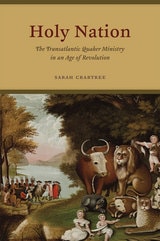
Holy Nation
The Transatlantic Quaker Ministry in an Age of RevolutionSarah Crabtree
University of Chicago Press, 2015
Holy Nation convincingly shows that ideals and actions were inseparable for the Society of Friends, yielding an account of Quakerism that is simultaneously a history of the faith and its adherents and a history of its confrontations with the wider world. Ultimately, Crabtree argues, the conflicts experienced between obligations of church and state that Quakers faced can illuminate similar contemporary struggles.
How to Make a Revolution
Raymond Postgate
Westholme Publishing, 2018
The first third of the twentieth century saw a seismic upheaval in global politics and society that still reverberates today. Communism and fascism toppled both traditional monarchies and representative democracies, while trade unions and other factions effectively challenged existing governments to adopt reforms or face crippling economic or social upheaval. Given these extraordinary events, Raymond Postgate set forth in How to Make a Revolution to objectively discuss revolutionary methods, and which tactics or strategies are the most effective. Drawing on his own idealistic experience as a young labor agitator and editor of a communist newspaper and more than fifteen years of close study of past revolutionary history and theories, the author dispassionately discusses Marxism, fascism, anarchism, and Blanquism (a doctrine within socialism), as well as syndicalism and industrial unionism. He then reviews revolutionary practice, including general strikes, financial pressure, armed revolution, and communist tactics, and ends with a prescient and frightening conclusion: without general consensus and determination, a peaceful revolution is impossible, and “if no action is taken, action of another kind will be taken for us. . . . The continuance of uncertainty will mean that the disillusioned will drift steadily across to a Fascist organization. Fascism means war; the character of a Fascist State is fairly well known. Once it is established, those who read, who write, who publish or who print, books like this are likely to be dead or in concentration camps.” Originally published in 1934, Postgate’s book was heralded for its clarity and scholarship.