Results by title
74 books match the query 'Russian literature' and 4 start with h
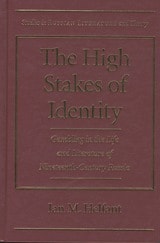
High Stakes of Identity
Gambling in the Life and Literature of Nineteenth-Century RussiaIan M. Helfant
Northwestern University Press, 2002
Russian life and literature of the nineteenth century abounded with scenes of gambling--nowhere more prominently than in the lives and work of three of Russia's greatest writers: Pushkin, Tolstoi, and Dostoevskii. Focusing on the intersection of gambling performances in society and in literature, this book reveals the significance of gambling as an index of character in nineteenth-century Russia and traces its role in the fate of the gentry over the course of the century.
During the reigns of Alexander I and Nicholas I, Ian Helfant argues, gambling became an essential proving-ground and symbolic locus for noble identity in Russia--a way for the nobility to assert its values (fearlessness, disdain for money, implacable self-possession, deification of whim and will, and stylish performance) against nineteenth-century economics and bourgeois sentimentality. In <i>The High Stakes of Identity</i> Helfant's twin concerns are to analyze the structural components of the myth of the noble "beau joueur" and to show how gambling performances in society and in literature reciprocally reinforced, complicated, and eventually disintegrated its mystique.
Using a broad variety of sources--memoiristic, epistolary, journalistic, legal, fictional, theatrical--Helfant reconstructs both the prevalence and the particular codes of gambling's cultural system in the first few decades of the nineteenth century. These codes allow him to interpret the iconoclastic performances of truly legendary gamblers and to assess the importance and purpose of gambling in works ranging from Pushkin's "Queen of Spades" to Lermontov's "Masquerade." Throughout, Helfant gives voice to the rich variety of discourses, from tsarist laws to moralistic tracts, that came to bear on the culture of gambling in the 1830s and eventually led to its displacement as the key marker of nobility.
[more]

History of Nineteeth-Century Russian Literature
Volume I: The Romantic PeriodDmitrij Tschizewskij
Vanderbilt University Press, 1974
[more]
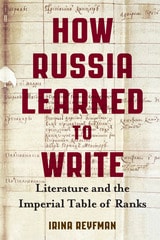
How Russia Learned to Write
Literature and the Imperial Table of RanksIrina Reyfman
University of Wisconsin Press, 2021
In the eighteenth century, as modern forms of literature began to emerge in Russia, most of the writers producing it were members of the nobility. But their literary pursuits competed with strictly enforced obligations to imperial state service. Unique to Russia was the Table of Ranks, introduced by Emperor Peter the Great in 1722. Noblesse oblige was not just a lofty principle; aristocrats were expected to serve in the military, civil service, or the court, and their status among peers depended on advancement in ranks.
Irina Reyfman illuminates the surprisingly diverse effects of the Table of Ranks on writers, their work, and literary culture in Russia. From Sumarokov and Derzhavin in the eighteenth century through Pushkin, Gogol, Dostoevsky, and poets serving in the military in the nineteenth, state service affected the self-images of writers and the themes of their creative output. Reyfman also notes its effects on Russia’s atypical course in the professionalization and social status of literary work.
Irina Reyfman illuminates the surprisingly diverse effects of the Table of Ranks on writers, their work, and literary culture in Russia. From Sumarokov and Derzhavin in the eighteenth century through Pushkin, Gogol, Dostoevsky, and poets serving in the military in the nineteenth, state service affected the self-images of writers and the themes of their creative output. Reyfman also notes its effects on Russia’s atypical course in the professionalization and social status of literary work.
[more]
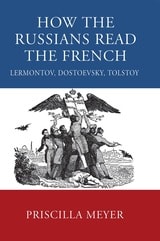
How the Russians Read the French
Lermontov, Dostoevsky, TolstoyPriscilla Meyer
University of Wisconsin Press, 2008
Russian writers of the nineteenth century were quite consciously creating a new national literary tradition. They saw themselves self-consciously through Western European eyes, at once admiring Europe and feeling inferior to it. This ambivalence was perhaps most keenly felt in relation to France, whose language and culture had shaped the world of the Russian aristocracy from the time of Catherine the Great.
In How the Russians Read the French, Priscilla Meyer shows how Mikhail Lermontov, Fyodor Dostoevsky, and Lev Tolstoy engaged with French literature and culture to define their own positions as Russian writers with specifically Russian aesthetic and moral values. Rejecting French sensationalism and what they perceived as a lack of spirituality among Westerners, these three writers attempted to create moral and philosophical works of art that drew on sources deemed more acceptable to a Russian worldview, particularly Pushkin and the Gospels. Through close readings of A Hero of Our Time, Crime and Punishment, and Anna Karenina, Meyer argues that each of these great Russian authors takes the French tradition as a thesis, proposes his own antithesis, and creates in his novel a synthesis meant to foster a genuinely Russian national tradition, free from imitation of Western models.
Winner, University of Southern California Book Prize in Literary and Cultural Studies, American Association for the Advancement of Slavic Studies
[more]