Results by title
111 books match the query 'Science Fiction' and 6 start with h
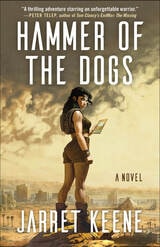
Hammer of the Dogs
A NovelJarret Keene
University of Nevada Press, 2023
Set in the wasteland of post-apocalyptic Las Vegas, Hammer of the Dogs is a literary dystopian adventure filled with high-octane fun starring twenty-one-year-old Lash. With her high-tech skill set and warrior mentality, Lash is a master of her own fate as she helps to shield the Las Vegas valley’s survivors and protect her younger classmates at a paramilitary school holed up in Luxor on the Las Vegas Strip. After graduation, she’ll be alone in fending off the deadly intentions and desires of the school’s most powerful opponents.
When she’s captured by the enemy warlord, she’s surprised by two revelations: He’s not the monster her headmaster wants her to believe and the one thing she can’t safeguard is her own heart. Hammer of the Dogs celebrates the courageousness of a younger generation in the face of authority while exploring the difficult choices a conscionable young woman must make with her back against a blood-spattered wall. It’s a story of transformation and maturity, as Lash grapples with her own identity and redefines the glittering Las Vegas that Nevada is known for.
Hammer of the Dogs
A NovelJarret Keene
University of Nevada Press, 2023
Set in the wasteland of post-apocalyptic Las Vegas, Hammer of the Dogs is a literary dystopian adventure filled with high-octane fun starring twenty-one-year-old Lash. With her high-tech skill set and warrior mentality, Lash is a master of her own fate as she helps to shield the Las Vegas valley’s survivors and protect her younger classmates at a paramilitary school holed up in Luxor on the Las Vegas Strip. After graduation, she’ll be alone in fending off the deadly intentions and desires of the school’s most powerful opponents.
When she’s captured by the enemy warlord, she’s surprised by two revelations: He’s not the monster her headmaster wants her to believe and the one thing she can’t safeguard is her own heart. Hammer of the Dogs celebrates the courageousness of a younger generation in the face of authority while exploring the difficult choices a conscionable young woman must make with her back against a blood-spattered wall. It’s a story of transformation and maturity, as Lash grapples with her own identity and redefines the glittering Las Vegas that Nevada is known for.

Hard Science Fiction
George E Slusser
Southern Illinois University Press, 1986
These 16 essays from the fifth annual J.Lloyd Eaton Conference at the University of California, Riverside, seek to come to grips with science fiction’s core, the core at which “science must ultimately seem to outweigh the fiction.”
Never before has hard SF been the topic of such extended discussion by such qualified people. The dialogue constitutes new (and potentially shocking to a traditional literary critic) modes of literary criticism, modes that take into account the impact of scientific speculation and method on our culture and on the ways our culture invents stories and myths.
Essayists include writer/scientist professors Robert L. Forward, David Brin, and Gregory Benford. Noted critics and writers with scientific backgrounds or interests include: James Gunn, Frank McConnell, George Guffey, John Huntington, Paul Carter, Patricia Warrick, Paul Alkon, Robert M. Philmus, David Clayton, Eric S. Rabkin, Herbert Sussman, Michael Collings, and George E. Slusser.
His Master's Voice
Stanislaw Lem
Northwestern University Press, 1999

Honeymoons in Temporary Locations
Ashley Shelby
University of Minnesota Press, 2024
Eclectic, experimental, and wildly imaginative climate fictions from a familiar world hauntingly transformed
Climate disaster–induced fugue states, mutinous polar bears, support groups for recently displaced millionaires, men who hear trees, and women who lose their wives on environmental refugee resettlement trips. In these dispatches from a weirding world, the absurd and fantastic are increasingly indistinguishable from reality. Exploring this liminal moment, Ashley Shelby’s collection of climate fictions imagines a near future that is both unnervingly familiar and subversively strange.
Set in the same post-climate-impact era, these stories range from playfully satirical to poignantly humane, bending traditional narrative forms and coming together into a brilliant and unusual contemplation of our changing world. Featuring the Hugo-nominated novelette “Muri,” Honeymoons in Temporary Locations processes the unthinkable through riotous inventions like guided tours of submerged cities, Craigslist ads placed by climate refugees, and cynical pharmaceutical efforts to market a drug to treat solastalgia, the existential distress caused by environmental change.
Shelby reengineers the dystopic bleakness that characterizes so much climate fiction by embracing an eclectic experimentalism leavened with humor, irony, and the inevitable bathos that characterizes the human experience. Unexpected and clever, this innovative collection confirms her status as a visionary writer whose work expands the forms, attitudes, and possibilities of climate fiction.
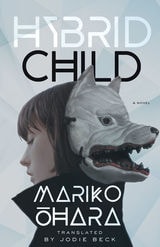
Hybrid Child
A NovelMariko Ohara
University of Minnesota Press, 2018
A classic of Japanese speculative fiction that blurs the line between consumption and creation when a cyborg assumes the form and spirit of a murdered child
Until he escaped, he had been called “Sample B #3,” but he had never liked this name. That would surprise them—that he could feel one way or another about it. He was designed to reshape himself based on whatever life forms he ingested; he was not made to think, and certainly not to assume the shape of a repair technician whose cells he had sampled and then simply walk out of the secure compound.
Artificial Intelligence is all too real in this classic of Japanese science fiction by Mariko Ōhara. Jonah, a child murdered by her mother, has become the spirit of an AI-controlled house where the rogue cyborg once known as Sample B #3 takes refuge and, making a meal of the dead girl buried under the house, takes Jonah’s form. On faraway Planet Caritas, an outpost of human civilization, the female AI system that governs society has become insane. Meanwhile, the threat of the Adiaptron Empire, the machine race that #3 was built to fight, remains.
With the familiar strangeness of a fairy tale, Ōhara’s novel traverses the mysterious distance between body and mind, between the mechanics of life and the ghost in the machine, between the infinitesimal and infinity. The child as mother, the mother as monster, the monster as hero: this shape-shifting story of nourishment, nurture, and parturition is a rare feminist work of speculative fiction and received the prestigious Seiun (Nebula) Award in 1991. Hybrid Child is the first English translation of a major work of science fiction by a female Japanese author.