Results by title
546 books match the query 'Semiotics & Theory' and 13 start with h
HAVING A GOOD CRY
Effeminate Feelings and Pop-Culture FormsRobyn R. Warhol
The Ohio State University Press, 2003
Robyn R. Warhol’s goal is to investigate the effects of readers’ emotional responses to formulaic fiction of the nineteenth and twentieth centuries on gendered subjectivity. She argues that modern literary and cultural studies have ignored nonsexual affectivity in their inquiries. The book elaborates on Warhol’s theory of affect and then focuses on sentimental stories, marriage plots, serialized novels, and soap operas as distinct genres producing specific feelings among fans.
Popular narrative forms use formulas to bring up familiar patterns of feelings in the audiences who love them. This book looks at the patterns of feelings that some nineteenth- and twentieth-century popular genres evoke, and asks how those patterns are related to gender. Soap operas and sentimentalism are generally derided as “effeminate” forms because their emotional range is seen as hyperfeminine. Having a Good Cry presents a celebration of effeminate feelings and works toward promoting more flexible, less pejorative concepts of gender. Using a psychophysiological rather than a psychoanalytic approach to reading and emotion, Warhol seeks to make readers more conscious of what is happening to the gendered body when we read.
Here Is a Figure
Grounding Literary FormSarah Dowling
Northwestern University Press, 2025
A study of supine, prone, and recumbent figures in contemporary literature
The prostitute, the protester, the murder victim, the invalid, the layabout, the depressive: all are associated with lying down. Skewing and flattening the perpendicular axis that defines the human in Western philosophy, art, and humanist inquiry, these downward-directed figures’ refusals or failures to hew to the moral and postural logics of uprightness enable a reassessment of subjectivity, ecological relation, and representation—that last of which is, after all, a process of standing-in-for. Here Is a Figure: Grounding Literary Form works across an array of well-known and counter-canonical texts, showing that recumbent figures saturate the literary arts of the present and respond to the proliferation of contemporary forms of grounding, in all its meanings. Reading these figures in dialogue with critical Indigenous studies, disability studies, and horizontalist feminisms, Sarah Dowling reveals the potential in thinking with and through a position stretched out across, dependent on, and undetachable from the earth.
Heterologies
Discourse on the OtherMichel De Certeau
University of Minnesota Press, 1986
Historic Structures
The Prague School Project, 1928–1946By F. W. Galan
University of Texas Press, 1985
In this first book-length study of Czech structuralism and semiotics in English, F. W. Galan explores one of the most important intellectual currents of the twentieth century, filling the gap between what has been written of the Russian formalism of the twenties and the French structuralism of the sixties and seventies. He records the evolution within the Prague Linguistic Circle of those theories which concern literature's change in time and the place of literature in society. In doing so, he reveals how the work of the Prague Linguistic Circle in the years 1928 to 1946 vindicate structuralism against its critics' charges that the structuralist approach—in linguistics, literary theory, film studies, and related fields—is inherently unhistorical. Overcoming this apparent methodological impasse was the main challenge confronted by the scholars of the Prague School–Roman Jakobson and Jan Mukarovsky, in particular.
History 4° Celsius
Search for a Method in the Age of the AnthropoceneIan Baucom
Duke University Press, 2020
History, the Human, and the World Between
R. Radhakrishnan
Duke University Press, 2008
Radhakrishnan develops his rationale of the “between” through three linked essays where he locates the terms “world,” “history,” “human,” and “subject” between phenomenology and poststructuralism, and in the process sets forth a nuanced reading of the politics of a gendered postcolonial humanism. Critically juxtaposing the works of thinkers such as Friedrich Nietzsche, Adrienne Rich, Frantz Fanon, Edward Said, Michel Foucault, Maurice Merleau-Ponty, Martin Heidegger, David Harvey, and Ranajit Guha, Radhakrishnan examines the relationship between systems of thought and their worldly situations. History, the Human, and the World Between is a powerful argument for a theoretical perspective that combines the existential urgency of phenomenology with the discursive rigor of poststructuralist practices.
Hooked
Art and AttachmentRita Felski
University of Chicago Press, 2020
How does a novel entice or enlist us? How does a song surprise or seduce us? Why do we bristle when a friend belittles a book we love, or fall into a funk when a favored TV series comes to an end? What characterizes the aesthetic experiences of feeling captivated by works of art? In Hooked, Rita Felski challenges the ethos of critical aloofness that is a part of modern intellectuals’ self-image. The result is sure to be as widely read as Felski’s book, The Limits of Critique.
Wresting the language of affinity away from accusations of sticky sentiment and manipulative marketing, Felski argues that “being hooked” is as fundamental to the appreciation of high art as to the enjoyment of popular culture. Hooked zeroes in on three attachment devices that connect audiences to works of art: identification, attunement, and interpretation. Drawing on examples from literature, film, music, and painting—from Joni Mitchell to Matisse, from Thomas Bernhard to Thelma and Louise—Felski brings the language of attachment into the academy. Hooked returns us to the fundamentals of aesthetic experience, showing that the social meanings of artworks are generated not just by critics, but also by the responses of captivated audiences.
Hooked
Art and AttachmentRita Felski
University of Chicago Press, 2020
This is an auto-narrated audiobook edition of this book.
How does a novel entice or enlist us? How does a song surprise or seduce us? Why do we bristle when a friend belittles a book we love, or fall into a funk when a favored TV series comes to an end? What characterizes the aesthetic experiences of feeling captivated by works of art? In Hooked, Rita Felski challenges the ethos of critical aloofness that is a part of modern intellectuals’ self-image. The result is sure to be as widely read as Felski’s book, The Limits of Critique.
Wresting the language of affinity away from accusations of sticky sentiment and manipulative marketing, Felski argues that “being hooked” is as fundamental to the appreciation of high art as to the enjoyment of popular culture. Hooked zeroes in on three attachment devices that connect audiences to works of art: identification, attunement, and interpretation. Drawing on examples from literature, film, music, and painting—from Joni Mitchell to Matisse, from Thomas Bernhard to Thelma and Louise—Felski brings the language of attachment into the academy. Hooked returns us to the fundamentals of aesthetic experience, showing that the social meanings of artworks are generated not just by critics, but also by the responses of captivated audiences.

Hot Property
The Stakes and Claims of Literary OriginalityFrançoise Meltzer
University of Chicago Press, 1994
Freud, inventor of "dream work," turns a blind eye upon the dreams that were the starting point of his predecessor Descartes's famous methode, the one man's obsession with originality mirroring the other's fear of plagiarism. The Holocaust poet Paul Celan, whose sense of identity and place resided in his work, is devastated by a charge of plagiarism. Colette's husband Willy outdoes himself, and his "lazy" wife as well, with his enactment of literary seriousness. Walter Benjamin's early interpreters, notably Hannah Arendt and Theodor Adorno, insidiously undermine the originality of his project . In each of these cases, Meltzer shows how a threat to a writer's status as creator betrays the larger fraud of the originality myth itself.
Fascinating for its insights into the ways originality is both at risk and at work in Western literary culture, Hot Property will engage all those who have an interest in questions of authorship, textual soveriegnty, and the legitimacy of the critical establishment.
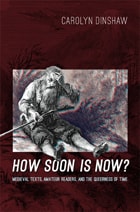
How Soon Is Now?
Medieval Texts, Amateur Readers, and the Queerness of TimeCarolyn Dinshaw
Duke University Press, 2012
Whether discussing Victorian men of letters who parodied the Book of John Mandeville, a fictionalized fourteenth-century travel narrative, or Hope Emily Allen, modern coeditor of the early-fifteenth-century Book of Margery Kempe, Dinshaw argues that these and other medievalists outside the academy inhabit different temporalities than modern professionals operating according to the clock. How Soon Is Now? clears space for amateurs, hobbyists, and dabblers who approach medieval worlds from positions of affect and attachment, from desires to build other kinds of worlds. Unruly, untimely, they urge us toward a disorderly and asynchronous collective.
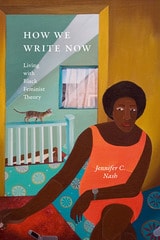
How We Write Now
Living with Black Feminist TheoryJennifer C. Nash
Duke University Press, 2024

How to Read Barthes' Image-Music-Text
Ed White
Pluto Press, 2012
Roland Barthes remains one of the most influential cultural theorists of the postwar period and Image-Music-Text collects his most influential essays. Ed White provides students with a clear guide to this essential but difficult text.
As students are increasingly expected to write across a range of media, Barthes' work can be understood as an early mapping of what we now call interdisciplinary or multidisciplinary study. The book's detailed section-by-section readings makes Barthes' most important writings accessible to undergraduate readers.
This book is a perfect companion for teaching and learning Barthes' ideas in cultural studies and literary theory.
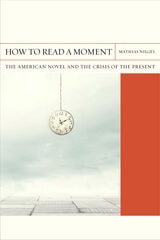
How to Read a Moment
The American Novel and the Crisis of the PresentMathias Nilges
Northwestern University Press, 2021
“Time is a thing that grows scarcer every day,” observes one of Don DeLillo’s characters. “The future is gone,” The Baffler argues. “Where’s my hoverboard!?” a meme demands. Contemporary capitalism, a system that insists that everything happen at once, creates problems for social thought and narrative alike. After all, how does one tell the time of instantaneity? In this moment of on-demand service and instant trading, it has become difficult to imagine the future.
The novel emerged as the art form of a rapidly changing modern world, a way of telling time in its progress. Nilges argues that this historical mission is renewed today through works that understand contemporaneity as a form of time shaping that props up our material world and cultural imagination. But the contemporary American novel does not simply associate our present with a crisis of futurity. Through analyses of works by authors such as DeLillo, Jennifer Egan, Charles Yu, and Colson Whitehead, Nilges illustrates that the novel presents ways to make sense of the temporality that controls our purportedly fully contemporary world. In so doing, the novel recovers a sense of possibility and hope, forwarding a dazzling argument for its own importance today.