Results by title
66 books match the query 'Sex differences' and 4 start with h
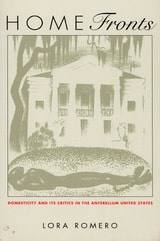
Home Fronts
Domesticity and Its Critics in the Antebellum United StatesLora Romero
Duke University Press, 1997
Romero remaps the literary landscape of the last century by looking at the operations of domesticity on the frontier as well as within the middle-class home and by reconsidering such crucial (if sometimes unexpected) sites for the workings of domesticity as social reform movements, African-American activism, and homosocial high culture. In the process, she indicts theories of the nineteenth century based on binarisms and rigidity while challenging models of power and resistance based on the idea that "culture" has the capacity to either free or enslave. Through readings of James Fenimore Cooper, Catherine Beecher, Harriet Beecher Stowe, Maria Stewart, and Nathaniel Hawthorne, Romero shows how the politics of culture reside in local formulations rather than in essential and ineluctable political structures.
Hommes, encore un effort…
Anthropogenèse, christianisme, sexuationThierry de Duve
Diaphanes, 2023

Hot Property
The Stakes and Claims of Literary OriginalityFrançoise Meltzer
University of Chicago Press, 1994
Freud, inventor of "dream work," turns a blind eye upon the dreams that were the starting point of his predecessor Descartes's famous methode, the one man's obsession with originality mirroring the other's fear of plagiarism. The Holocaust poet Paul Celan, whose sense of identity and place resided in his work, is devastated by a charge of plagiarism. Colette's husband Willy outdoes himself, and his "lazy" wife as well, with his enactment of literary seriousness. Walter Benjamin's early interpreters, notably Hannah Arendt and Theodor Adorno, insidiously undermine the originality of his project . In each of these cases, Meltzer shows how a threat to a writer's status as creator betrays the larger fraud of the originality myth itself.
Fascinating for its insights into the ways originality is both at risk and at work in Western literary culture, Hot Property will engage all those who have an interest in questions of authorship, textual soveriegnty, and the legitimacy of the critical establishment.
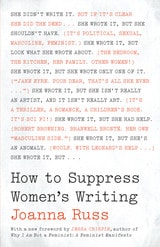
How to Suppress Women's Writing
By Joanna Russ; foreword by Jessa Crispin
University of Texas Press, 2018
Are women able to achieve anything they set their minds to? In How to Suppress Women’s Writing, award-winning novelist and scholar Joanna Russ lays bare the subtle—and not so subtle—strategies that society uses to ignore, condemn, or belittle women who produce literature. As relevant today as when it was first published in 1983, this book has motivated generations of readers with its powerful feminist critique.
“What is it going to take to break apart these rigidities? Russ’s book is a formidable attempt. It is angry without being self-righteous, it is thorough without being exhausting, and it is serious without being devoid of a sense of humor. But it was published over thirty years ago, in 1983, and there’s not an enormous difference between the world she describes and the world we inhabit.”
—Jessa Crispin, from the foreword
“A book of the most profound and original clarity. Like all clear-sighted people who look and see what has been much mystified and much lied about, Russ is quite excitingly subversive. The study of literature should never be the same again.”
—Marge Piercy
“Joanna Russ is a brilliant writer, a writer of real moral passion and high wit.”
—Adrienne Rich