Results by title
151 books match the query 'Sign Language' and 3 start with h
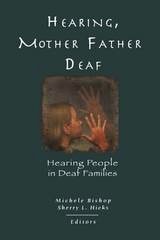
HEARING, MOTHER-FATHER DEAF
Hearing People in Deaf FamiliesMichele Bishop
Gallaudet University Press, 2009
The 14th Volume in the Sociolinguistics in Deaf Communities Series
The newest entry in the Sociolinguistics in Deaf Communities series explores the richness and complexity of the lives of hearing people in deaf families. Along with their own contributions, volume editors Michele Bishop and Sherry L. Hicks present the work of an extraordinary cadre of deaf, hearing, and Coda (children of deaf adults) researchers: Susan Adams, Jean Andrews, Oya Ataman, Anne E. Baker, Beppie van den Bogaerde , Helsa B. Borinstein, Karen Emmorey, Tamar H. Gollan, Mara Lúcia Masutti, Susan Mather, Ronice Müller de Quadros, Jemina Napier, Paul Preston, Jennie E. Pyers, Robin Thompson, and Andrea Wilhelm. Their findings represent research in a number of countries, including Australia, Brazil, England, Germany, the Netherlands, and the United States.
Hearing, Mother^Father Deaf: Hearing People in Deaf Families includes a comprehensive description of the societal influences at work in the lives of deaf people and their hearing children, which serves as a backdrop for the essays. The topics range from bimodal bilingualism in adults to cultural and linguistic behaviors of hearing children from deaf families; sign and spoken language contact phenomena; and to issues of self-expression, identity, and experience. A blend of data-based research and personal writings, the articles in this sociolinguistic study provide a thorough understanding of the varied experiences of hearing people and their deaf families throughout the world.
[more]
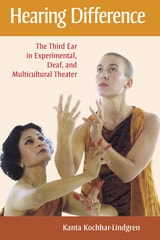
Hearing Difference
The Third Ear in Experimental, Deaf, and Multicultural TheaterKanta Kochhar-Lindgren
Gallaudet University Press, 2006
This engrossing studyinvestigates the connections between hearing and deafness in experimental, Deaf, and multicultural theater. Author Kanta Kochhar-Lindgren focuses on how to articulate a Deaf aesthetic and how to grasp the meaning of moments of “deafness” in theater works that do not simply reinscribe a hearing bias back into one’s analysis. She employs a model using a device for cross-sensory listening across domains of sound, silence, and the moving body in performance that she calls the “third ear.”
Kochhar-Lindgren then charts a genealogy of the theater of the third ear from the mid-1800s to the 1960s in examples ranging from Denis Diderot, the Symbolists, the Dadaists, Antonin Artaud, and others. She also analyzes the work of playwright Robert Wilson, the National Theatre of the Deaf, and Asian American director Ping Chong. She shows how the model of the third ear can address not only deaf performance but also multicultural performance, by analyzing the Seattle dance troupe Ragamala’s 2001 production of Transposed Heads, which melded classical South Indian use of mudras, or hand gestures, and ASL signing.
The shift in attention limned in Hearing Difference leads to a different understanding of the body, intersubjectivity, communication, and cross-cultural relations, confirming it as a critically important contribution to contemporary Deaf studies.
[more]
Here or There
Research on Interpreting via Video LinkJemina Napier
Gallaudet University Press, 2018
The field of sign language interpreting is undergoing an exponential increase in the delivery of services through remote and video technologies. The nature of these technologies challenges established notions of interpreting as a situated, communicative event and of the interpreter as a participant. As a result, new perspectives and research are necessary for interpreters to thrive in this environment. This volume fills that gap and features interdisciplinary explorations of remote interpreting from spoken and signed language interpreting scholars who examine various issues from linguistic, sociological, physiological, and environmental perspectives.
Here or There presents cutting edge, empirical research that informs the professional practice of remote interpreting, whether it be video relay service, video conference, or video remote interpreting. The research is augmented by the perspectives of stakeholders and deaf consumers on the quality of the interpreted work. Among the topics covered are professional attitudes and motivations, interpreting in specific contexts, and adaptation strategies. The contributors also address potential implications for relying on remote interpreting, discuss remote interpreter education, and offer recommendations for service providers.
Here or There presents cutting edge, empirical research that informs the professional practice of remote interpreting, whether it be video relay service, video conference, or video remote interpreting. The research is augmented by the perspectives of stakeholders and deaf consumers on the quality of the interpreted work. Among the topics covered are professional attitudes and motivations, interpreting in specific contexts, and adaptation strategies. The contributors also address potential implications for relying on remote interpreting, discuss remote interpreter education, and offer recommendations for service providers.
[more]