Results by title
216 books match the query 'Social' and 10 start with h

Health Issues in Latino Males
A Social and Structural ApproachAguirre-Molina, Marilyn
Rutgers University Press, 2010
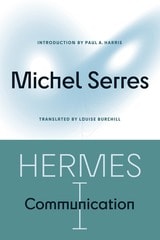
Hermes I
CommunicationMichel Serres
University of Minnesota Press, 2023
For the first time in English, the introductory volume in a major French philosopher’s groundbreaking series of poetic transdisciplinary works
Michel Serres is recognized as one of the giants of postwar French philosophy of knowledge, along with Gilles Deleuze, Jacques Derrida, Michel Foucault, and Gilbert Simondon. His early five-volume series Hermes, which appeared in the 1960s and 1970s, was an intellectual supernova in its proposition that culture and science shared the same mythic and narrative structures. Hermes I: Communication marks the start of a major publishing endeavor to introduce this foundational series into English.
Building on the figure of the Greek god Hermes, who presides over the realms of communication and interpretation, Hermes I embarks on a reflection concerning the history of mathematics via Descartes and Leibniz and culminates by way of a Bachelardian logoanalytic reading of Homer, Dumas, Molière, Verne, and the story of Cinderella. We observe a singular poetic philosopher seeking to bridge the gap between the liberal arts and the sciences through a profound mathematical and poetic fable regarding information theory, history, and art, establishing a new way to think about the production of knowledge during the late twentieth century. In these pages, students and scholars of philosophy will discover an extraordinary project of thought as vital to critical reflection today as it was fifty years ago.
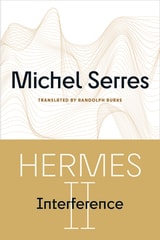
Hermes II
InterferenceMichel Serres
University of Minnesota Press, 2025
Unveiling the hidden connections in the network of knowledge
Hermes II: Interference is the second in a series of works by philosopher Michel Serres using Hermes, god of communication, as an archetypal symbolic figure for reflecting on philosophy and the arts and sciences. Serres delves into the concept of interreferentiality, proposing that every node—whether it be knowledge, objects, or people—exists within a network where it both receives and transmits information. He argues against the existence of a dominant center or pole within these networks, emphasizing that each node can temporarily serve as a focal point depending on context.
Serres presents unique insights into topics such as the nature of knowledge, the world of objects, intersubjectivity, the origins of geometry, the interplay of music and background noise, and empiricism. By identifying parallel structures across these areas, Serres unifies them into a comprehensive theoretical framework, revealing hidden connections and potential future influences. Additionally, this work includes a critique of Gaston Bachelard’s The Formation of the Scientific Mind and concludes with an analysis of communication in Hergé’s The Castafiore Emerald.
Hermes II is a unique blend of ancient and modern perspectives, combining rigorous analysis with an optimistic outlook and highlighting the interconnectedness of knowledge and its implications for fostering peaceful relations within the network of life.
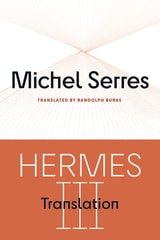
Hermes III
TranslationMichel Serres
University of Minnesota Press, 2026
Unlocking the hidden patterns of knowledge—where science, art, and philosophy speak a common language
Hermes III: Translation is the third volume in Michel Serres’s renowned Hermes series, an ambitious exploration of the deep interconnections among disparate fields of knowledge. While Hermes II: Interference traced the overlapping echoes of ideas across realms, Hermes III moves to translate the structural logics of one field—be it genetics, painting, or philosophy—into the language of another. Revealing how the humanities, science, and art share hidden combinatory architectures, Serres exposes the underlying unity of knowledge systems typically thought distinct.
Through an array of examples—from Monod’s Chance and Necessity to works by Descartes, Leibniz, Comte, Turner, and Roumain—Serres shows how translation uncovers informational and mathematical patterns that shape both ancient and modern thought. This illuminating methodology leads Serres to issue a stark warning: when knowledge is detached from its guiding purpose, it becomes vulnerable to appropriation by destructive political forces.
Yet Serres’s vision remains ultimately hopeful. By tracing knowledge systems back to their mythic and structural roots, Hermes III: Translation gestures toward more harmonious relationships between fields. A rare synthesis of philosophy, science, art, and literature, this work will engage readers interested in the interdependence of disciplines and the possibilities for a more unified, humane understanding of knowledge.
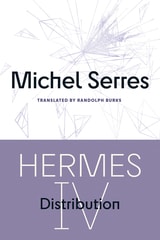
Hermes IV
DistributionMichel Serres
University of Minnesota Press, 2026
How order, meaning, and knowledge emerge from noise across science, literature, and philosophy
Hermes IV: Distribution is the fourth and penultimate volume in Michel Serres’s landmark series on knowledge and communication across disciplines. This collection of essays investigates how order emerges from noise, using thermodynamics and information theory as structural models applicable to science, literature, and culture alike. Moving beyond the themes of interference and translation developed in earlier volumes, Serres focuses on distribution: the processes by which systems take shape, endure, and eventually disperse.
At the core of the book is a dynamic vision of knowledge as an unstable formation. Systems arise from chance encounters or deviations that, through repetition, harden into law. They resist entropy by remaining open to external inputs, forming temporary pockets of negentropy within a wider field of chaos. Space, time, energy, language, and meaning are all shown to emerge from such conditions of mixture and imbalance.
Serres develops his argument through a striking range of materials, including fables, myths, literary texts, philosophy, and the history of science. The result is an uncommon synthesis of hard science and the humanities that reveals shared structures across domains while affirming the irreducible plurality of their laws and methods.
Retail e-book files for this title are screen-reader friendly with images accompanied by short alt text and/or extended descriptions.

History as They Lived It
A Social History of Prairie du Rocher, IllinoisMargaret Kimball Brown, Foreword by Carl J. Ekberg
Southern Illinois University Press, 2005
“History as They Lived It deserves to be placed within the rich context of Illinois Country historiography going back more than a century. . . . It brings together the fully ripened thoughts of a mature scholar at the very moment that students of the Illinois Country need such a book.”—from the foreword by Carl J. Ekberg
Settled in 1722, Prairie du Rocher was at the geographic center of a French colony in the Mississippi Valley, which also included other villages in what is now Illinois and Missouri: Cahokia, Kaskaskia, Fort de Chartres, St. Philippe, Ste. Genevieve, and St. Louis. Located in an alluvial valley near towering limestone bluffs, which inspired the village’s name—French for “prairie of the rock”— Prairie du Rocher is the only one of the seven French colonial villages that still exists today as a small compact community.
The village of Prairie du Rocher endured governance by France, Great Britain, Virginia, and the Illinois territory before Illinois became a state in 1818. Despite these changes, the villagers persisted in maintaining the community and its values. Margaret Kimball Brown looks at one of the oldest towns in the region through the lenses of history and anthropology, utilizing extensive research in archives and public records to give historians, anthropologists, and general readers a lively depiction of this small community and its people.
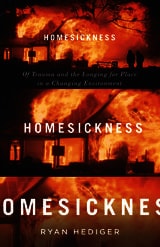
Homesickness
Of Trauma and the Longing for Place in a Changing EnvironmentRyan Hediger
University of Minnesota Press, 2019
Introducing a posthumanist concept of nostalgia to analyze steadily widening themes of animality, home, travel, slavery, shopping, and war in U.S. literature after 1945
In the Anthropocene, as climate change renders environments less stable, the human desire for place underscores the weakness of the individual in the face of the world. In this book, Ryan Hediger introduces a distinctive notion of homesickness, one in which the longing for place demonstrates not only human vulnerability but also intersubjectivity beyond the human. Arguing that this feeling is unavoidable and characteristically posthumanist, Hediger studies the complex mix of attitudes toward home, the homely, and the familiar in an age of resurgent cosmopolitanism, especially eco-cosmopolitanism.
Homesickness closely examines U.S. literature mostly after 1945, including prominent writers such as Annie Proulx, Marilynne Robinson, and Ernest Hemingway, in light of the challenges and themes of the Anthropocene. Hediger argues that our desire for home is shorthand for a set of important hopes worth defending—serious and genuine relationships to places and their biotic regimes and landforms; membership in vital cultures, human and nonhuman; resistance to capital-infused forms of globalization that flatten differences and turn life and place into mere resources. Our homesickness, according to Hediger, is inevitable because the self is necessarily constructed with reference to the material past. Therefore, homesickness is not something to dismiss as nostalgic or reactionary but is rather a structure of feeling to come to terms with and even to cultivate.
Recasting an expansive range of fields through the lens of homesickness—from ecocriticism to animal studies and disability studies, (eco)philosophy to posthumanist theory—Homesickness speaks not only to the desire for a physical structure or place but also to a wide range of longings and dislocations, including those related to subjectivity, memory, bodies, literary form, and language.

How Lifeworlds Work
Emotionality, Sociality, and the Ambiguity of BeingMichael Jackson
University of Chicago Press, 2017
In How Lifeworlds Work, Jackson draws on years of ethnographic fieldwork in West Africa to highlight the dynamic quality of human relationships and reinvigorate the study of kinship and ritual. How, he asks, do we manage the perpetual process of accommodation between social norms and personal emotions, impulses, and desires? How are these two dimensions of lived reality joined, and how are the dual imperatives of individual expression and collective viability managed? Drawing on the pragmatist tradition, psychology, and phenomenology, Jackson offers an unforgettable, beautifully written account of how we make, unmake, and remake, our lifeworlds.
How to Think like a Philosopher
Twelve Key Principles for More Humane, Balanced, and Rational ThinkingJulian Baggini
University of Chicago Press, 2023
By now, it should be clear: in the face of disinformation and disaster, we cannot hot take, life hack, or meme our way to a better future. But how should we respond instead? In How to Think like a Philosopher, Julian Baggini turns to the study of reason itself for practical solutions to this question, inspired by our most eminent philosophers, past and present.
Baggini offers twelve key principles for a more humane, balanced, and rational approach to thinking: pay attention; question everything (including your questions); watch your steps; follow the facts; watch your language; be eclectic; be a psychologist; know what matters; lose your ego; think for yourself, not by yourself; only connect; and don’t give up. Each chapter is chockful of real-world examples showing these principles at work—from the discovery of penicillin to the fight for trans rights—and how they lead to more thoughtful conclusions. More than a book of tips and tricks (or ways to be insufferably clever at parties), How to Think like a Philosopher is an invitation to develop the habits of good reasoning that our world desperately needs.
Human Predicaments
And What to Do about ThemJohn Kekes
University of Chicago Press, 2016
Kekes considers how we might deal with these predicaments by comparing how others in different times and cultures have approached them. He examines what is good, bad, instructive, and dangerous in the sexually charged politics of the Shilluk, the Hindu caste system, Balinese role-morality, the religious passion of Cortes and Simone Weil, the fate of Colonel Hiromichi Yahara during and after the battle for Okinawa, the ritual human sacrifices of the Aztecs, and the tragedies to which innocence may lead. In doing so, he shakes us out of our deep-seated ways of thinking, enlarging our understanding of the possibilities available to us as we struggle with the problems that stand in the way of how we want to live. The result is a highly interesting journey through time and space that illuminates and helps us cope with some of the most basic predicaments we all face as human beings.