22279 books match the query 'Social Science' and 635 start with h

cover of H.R.F. Keating: Post-Colonial Detection, A Critical Study

H.R.F. Keating

Post-Colonial Detection, A Critical Study

Meera Tamaya

University of Wisconsin Press, 1993
In Keating’s novels, set in India, the bumbling, but always human, Inspector Ghote manages to solve crimes with a post-colonial mix of inherited Scotland Yard/Holmesian deductive methods and his understanding of his native country’s culture. This book is based on the premise that successful sleuths have much in common with cultural anthropologists—indeed the latter have often been termed detectives of cultures. Keating’s Ghote novels are in the tradition of Tony Hillerman’s Navajo Indian mysteries, and James McClure’s South African novels, which serve up the human, experiential aspects of the cultural and ethnic conflicts that newspapers miss.
[more]
cover of HAU vol 10 num 2

HAU vol 10 num 2

The University of Chicago Press

University of Chicago Press Journals, 2020
This is volume 10 issue 2 of HAU: Journal of Ethnographic Theory. HAU: Journal of Ethnographic Theory, is an international journal which aims to situate ethnography as the prime heuristic of anthropology, and return it to the forefront of conceptual developments in the discipline. The journal is motivated by the need to reinstate ethnographic theorization in contemporary anthropology as a potent alternative to its "explanation" or "contextualization" by philosophical arguments, moves which have resulted in a loss of the discipline's distinctive theoretical nerve. By drawing out its potential to critically engage and challenge Western cosmological assumptions and conceptual determinations, HAU aims to provide an exciting new arena for evaluating ethnography as a daring enterprise for 'worlding' alien terms and forms of life, by exploiting their potential for rethinking humanity and alterity.
[more]
cover of HAU vol 9 num 1

HAU vol 9 num 1

The University of Chicago Press

University of Chicago Press Journals, 2019
This is volume 9 issue 1 of HAU: Journal of Ethnographic Theory. HAU: Journal of Ethnographic Theory, is an international journal which aims to situate ethnography as the prime heuristic of anthropology, and return it to the forefront of conceptual developments in the discipline. The journal is motivated by the need to reinstate ethnographic theorization in contemporary anthropology as a potent alternative to its "explanation" or "contextualization" by philosophical arguments, moves which have resulted in a loss of the discipline's distinctive theoretical nerve. By drawing out its potential to critically engage and challenge Western cosmological assumptions and conceptual determinations, HAU aims to provide an exciting new arena for evaluating ethnography as a daring enterprise for 'worlding' alien terms and forms of life, by exploiting their potential for rethinking humanity and alterity.
[more]
cover of HAU: Journal of Ethnographic Theory, volume 11 number 2 (Autumn 2021)

HAU

Journal of Ethnographic Theory, volume 11 number 2 (Autumn 2021)

The University of Chicago Press

University of Chicago Press Journals, 2021
This is volume 11 issue 2 of HAU: Journal of Ethnographic Theory. HAU: Journal of Ethnographic Theory, is an international journal which aims to situate ethnography as the prime heuristic of anthropology, and return it to the forefront of conceptual developments in the discipline. The journal is motivated by the need to reinstate ethnographic theorization in contemporary anthropology as a potent alternative to its "explanation" or "contextualization" by philosophical arguments, moves which have resulted in a loss of the discipline's distinctive theoretical nerve. By drawing out its potential to critically engage and challenge Western cosmological assumptions and conceptual determinations, HAU aims to provide an exciting new arena for evaluating ethnography as a daring enterprise for 'worlding' alien terms and forms of life, by exploiting their potential for rethinking humanity and alterity.
[more]
cover of HAU: Journal of Ethnographic Theory, volume 11 number 3 (Winter 2021)

HAU

Journal of Ethnographic Theory, volume 11 number 3 (Winter 2021)

The University of Chicago Press

University of Chicago Press Journals, 2021
This is volume 11 issue 3 of HAU: Journal of Ethnographic Theory. HAU: Journal of Ethnographic Theory, is an international journal which aims to situate ethnography as the prime heuristic of anthropology, and return it to the forefront of conceptual developments in the discipline. The journal is motivated by the need to reinstate ethnographic theorization in contemporary anthropology as a potent alternative to its "explanation" or "contextualization" by philosophical arguments, moves which have resulted in a loss of the discipline's distinctive theoretical nerve. By drawing out its potential to critically engage and challenge Western cosmological assumptions and conceptual determinations, HAU aims to provide an exciting new arena for evaluating ethnography as a daring enterprise for 'worlding' alien terms and forms of life, by exploiting their potential for rethinking humanity and alterity.
[more]
cover of HAU: Journal of Ethnographic Theory, volume 12 number 1 (Spring 2022)

HAU

Journal of Ethnographic Theory, volume 12 number 1 (Spring 2022)

The University of Chicago Press

University of Chicago Press Journals, 2022
This is volume 12 issue 1 of HAU: Journal of Ethnographic Theory. HAU: Journal of Ethnographic Theory, is an international journal which aims to situate ethnography as the prime heuristic of anthropology, and return it to the forefront of conceptual developments in the discipline. The journal is motivated by the need to reinstate ethnographic theorization in contemporary anthropology as a potent alternative to its "explanation" or "contextualization" by philosophical arguments, moves which have resulted in a loss of the discipline's distinctive theoretical nerve. By drawing out its potential to critically engage and challenge Western cosmological assumptions and conceptual determinations, HAU aims to provide an exciting new arena for evaluating ethnography as a daring enterprise for 'worlding' alien terms and forms of life, by exploiting their potential for rethinking humanity and alterity.
[more]
cover of HAU: Journal of Ethnographic Theory, volume 12 number 2 (Autumn 2022)

HAU

Journal of Ethnographic Theory, volume 12 number 2 (Autumn 2022)

The University of Chicago Press

University of Chicago Press Journals, 2022
This is volume 12 issue 2 of HAU: Journal of Ethnographic Theory. HAU: Journal of Ethnographic Theory, is an international journal which aims to situate ethnography as the prime heuristic of anthropology, and return it to the forefront of conceptual developments in the discipline. The journal is motivated by the need to reinstate ethnographic theorization in contemporary anthropology as a potent alternative to its "explanation" or "contextualization" by philosophical arguments, moves which have resulted in a loss of the discipline's distinctive theoretical nerve. By drawing out its potential to critically engage and challenge Western cosmological assumptions and conceptual determinations, HAU aims to provide an exciting new arena for evaluating ethnography as a daring enterprise for 'worlding' alien terms and forms of life, by exploiting their potential for rethinking humanity and alterity.
[more]
cover of HAU: Journal of Ethnographic Theory, volume 12 number 3 (Winter 2022)

HAU

Journal of Ethnographic Theory, volume 12 number 3 (Winter 2022)

The University of Chicago Press

University of Chicago Press Journals, 2022
This is volume 12 issue 3 of HAU: Journal of Ethnographic Theory. HAU: Journal of Ethnographic Theory, is an international journal which aims to situate ethnography as the prime heuristic of anthropology, and return it to the forefront of conceptual developments in the discipline. The journal is motivated by the need to reinstate ethnographic theorization in contemporary anthropology as a potent alternative to its "explanation" or "contextualization" by philosophical arguments, moves which have resulted in a loss of the discipline's distinctive theoretical nerve. By drawing out its potential to critically engage and challenge Western cosmological assumptions and conceptual determinations, HAU aims to provide an exciting new arena for evaluating ethnography as a daring enterprise for 'worlding' alien terms and forms of life, by exploiting their potential for rethinking humanity and alterity.
[more]
cover of HAU: Journal of Ethnographic Theory, volume 13 number 1 (Spring 2023)

HAU

Journal of Ethnographic Theory, volume 13 number 1 (Spring 2023)

The University of Chicago Press

University of Chicago Press Journals, 2023
This is volume 13 issue 1 of HAU: Journal of Ethnographic Theory. HAU: Journal of Ethnographic Theory, is an international journal which aims to situate ethnography as the prime heuristic of anthropology, and return it to the forefront of conceptual developments in the discipline. The journal is motivated by the need to reinstate ethnographic theorization in contemporary anthropology as a potent alternative to its "explanation" or "contextualization" by philosophical arguments, moves which have resulted in a loss of the discipline's distinctive theoretical nerve. By drawing out its potential to critically engage and challenge Western cosmological assumptions and conceptual determinations, HAU aims to provide an exciting new arena for evaluating ethnography as a daring enterprise for 'worlding' alien terms and forms of life, by exploiting their potential for rethinking humanity and alterity.
[more]
cover of HAU: Journal of Ethnographic Theory, volume 13 number 2 (Autumn 2023)

HAU

Journal of Ethnographic Theory, volume 13 number 2 (Autumn 2023)

The University of Chicago Press

University of Chicago Press Journals, 2023
This is volume 13 issue 2 of HAU: Journal of Ethnographic Theory. HAU: Journal of Ethnographic Theory, is an international journal which aims to situate ethnography as the prime heuristic of anthropology, and return it to the forefront of conceptual developments in the discipline. The journal is motivated by the need to reinstate ethnographic theorization in contemporary anthropology as a potent alternative to its "explanation" or "contextualization" by philosophical arguments, moves which have resulted in a loss of the discipline's distinctive theoretical nerve. By drawing out its potential to critically engage and challenge Western cosmological assumptions and conceptual determinations, HAU aims to provide an exciting new arena for evaluating ethnography as a daring enterprise for 'worlding' alien terms and forms of life, by exploiting their potential for rethinking humanity and alterity.
[more]
cover of HAU: Journal of Ethnographic Theory, volume 13 number 3 (Winter 2023)

HAU

Journal of Ethnographic Theory, volume 13 number 3 (Winter 2023)

The University of Chicago Press

University of Chicago Press Journals, 2023
This is volume 13 issue 3 of HAU: Journal of Ethnographic Theory. HAU: Journal of Ethnographic Theory, is an international journal which aims to situate ethnography as the prime heuristic of anthropology, and return it to the forefront of conceptual developments in the discipline. The journal is motivated by the need to reinstate ethnographic theorization in contemporary anthropology as a potent alternative to its "explanation" or "contextualization" by philosophical arguments, moves which have resulted in a loss of the discipline's distinctive theoretical nerve. By drawing out its potential to critically engage and challenge Western cosmological assumptions and conceptual determinations, HAU aims to provide an exciting new arena for evaluating ethnography as a daring enterprise for 'worlding' alien terms and forms of life, by exploiting their potential for rethinking humanity and alterity.
[more]
cover of HAU: Journal of Ethnographic Theory, volume 14 number 1 (Spring 2024)

HAU

Journal of Ethnographic Theory, volume 14 number 1 (Spring 2024)

The University of Chicago Press

University of Chicago Press Journals, 2024
This is volume 14 issue 1 of HAU: Journal of Ethnographic Theory. HAU: Journal of Ethnographic Theory, is an international journal which aims to situate ethnography as the prime heuristic of anthropology, and return it to the forefront of conceptual developments in the discipline. The journal is motivated by the need to reinstate ethnographic theorization in contemporary anthropology as a potent alternative to its "explanation" or "contextualization" by philosophical arguments, moves which have resulted in a loss of the discipline's distinctive theoretical nerve. By drawing out its potential to critically engage and challenge Western cosmological assumptions and conceptual determinations, HAU aims to provide an exciting new arena for evaluating ethnography as a daring enterprise for 'worlding' alien terms and forms of life, by exploiting their potential for rethinking humanity and alterity.
[more]
cover of HAU: Journal of Ethnographic Theory, volume 14 number 2 (Autumn 2024)

HAU

Journal of Ethnographic Theory, volume 14 number 2 (Autumn 2024)

The University of Chicago Press

University of Chicago Press Journals, 2024
This is volume 14 issue 2 of HAU: Journal of Ethnographic Theory. HAU: Journal of Ethnographic Theory, is an international journal which aims to situate ethnography as the prime heuristic of anthropology, and return it to the forefront of conceptual developments in the discipline. The journal is motivated by the need to reinstate ethnographic theorization in contemporary anthropology as a potent alternative to its "explanation" or "contextualization" by philosophical arguments, moves which have resulted in a loss of the discipline's distinctive theoretical nerve. By drawing out its potential to critically engage and challenge Western cosmological assumptions and conceptual determinations, HAU aims to provide an exciting new arena for evaluating ethnography as a daring enterprise for 'worlding' alien terms and forms of life, by exploiting their potential for rethinking humanity and alterity.
[more]
cover of HAU: Journal of Ethnographic Theory, volume 14 number 3 (Winter 2024)

HAU

Journal of Ethnographic Theory, volume 14 number 3 (Winter 2024)

The University of Chicago Press

University of Chicago Press Journals, 2024
This is volume 14 issue 3 of HAU: Journal of Ethnographic Theory. HAU: Journal of Ethnographic Theory, is an international journal which aims to situate ethnography as the prime heuristic of anthropology, and return it to the forefront of conceptual developments in the discipline. The journal is motivated by the need to reinstate ethnographic theorization in contemporary anthropology as a potent alternative to its "explanation" or "contextualization" by philosophical arguments, moves which have resulted in a loss of the discipline's distinctive theoretical nerve. By drawing out its potential to critically engage and challenge Western cosmological assumptions and conceptual determinations, HAU aims to provide an exciting new arena for evaluating ethnography as a daring enterprise for 'worlding' alien terms and forms of life, by exploiting their potential for rethinking humanity and alterity.
[more]
cover of HAU: Journal of Ethnographic Theory, volume 15 number 1 (Spring 2025)

HAU

Journal of Ethnographic Theory, volume 15 number 1 (Spring 2025)

The University of Chicago Press

University of Chicago Press Journals, 2025
This is volume 15 issue 1 of HAU: Journal of Ethnographic Theory. HAU: Journal of Ethnographic Theory, is an international journal which aims to situate ethnography as the prime heuristic of anthropology, and return it to the forefront of conceptual developments in the discipline. The journal is motivated by the need to reinstate ethnographic theorization in contemporary anthropology as a potent alternative to its "explanation" or "contextualization" by philosophical arguments, moves which have resulted in a loss of the discipline's distinctive theoretical nerve. By drawing out its potential to critically engage and challenge Western cosmological assumptions and conceptual determinations, HAU aims to provide an exciting new arena for evaluating ethnography as a daring enterprise for 'worlding' alien terms and forms of life, by exploiting their potential for rethinking humanity and alterity.
[more]
cover of HAU: Journal of Ethnographic Theory, volume 15 number 2 (Autumn 2025)

HAU

Journal of Ethnographic Theory, volume 15 number 2 (Autumn 2025)

The University of Chicago Press

University of Chicago Press Journals, 2025
This is volume 15 issue 2 of HAU: Journal of Ethnographic Theory. HAU: Journal of Ethnographic Theory, is an international journal which aims to situate ethnography as the prime heuristic of anthropology, and return it to the forefront of conceptual developments in the discipline. The journal is motivated by the need to reinstate ethnographic theorization in contemporary anthropology as a potent alternative to its "explanation" or "contextualization" by philosophical arguments, moves which have resulted in a loss of the discipline's distinctive theoretical nerve. By drawing out its potential to critically engage and challenge Western cosmological assumptions and conceptual determinations, HAU aims to provide an exciting new arena for evaluating ethnography as a daring enterprise for 'worlding' alien terms and forms of life, by exploiting their potential for rethinking humanity and alterity.
[more]
cover of HAU: Journal of Ethnographic Theory, volume 15 number 3 (Winter 2025)

HAU

Journal of Ethnographic Theory, volume 15 number 3 (Winter 2025)

The University of Chicago Press

University of Chicago Press Journals, 2025
This is volume 15 issue 3 of HAU: Journal of Ethnographic Theory. HAU: Journal of Ethnographic Theory, is an international journal which aims to situate ethnography as the prime heuristic of anthropology, and return it to the forefront of conceptual developments in the discipline. The journal is motivated by the need to reinstate ethnographic theorization in contemporary anthropology as a potent alternative to its "explanation" or "contextualization" by philosophical arguments, moves which have resulted in a loss of the discipline's distinctive theoretical nerve. By drawing out its potential to critically engage and challenge Western cosmological assumptions and conceptual determinations, HAU aims to provide an exciting new arena for evaluating ethnography as a daring enterprise for 'worlding' alien terms and forms of life, by exploiting their potential for rethinking humanity and alterity.
[more]
cover of HAU: Journal of Ethnographic Theory, volume 16 number 1 (Spring 2026)

HAU

Journal of Ethnographic Theory, volume 16 number 1 (Spring 2026)

The University of Chicago Press

University of Chicago Press Journals, 2026
This is volume 16 issue 1 of HAU: Journal of Ethnographic Theory. HAU: Journal of Ethnographic Theory, is an international journal which aims to situate ethnography as the prime heuristic of anthropology, and return it to the forefront of conceptual developments in the discipline. The journal is motivated by the need to reinstate ethnographic theorization in contemporary anthropology as a potent alternative to its "explanation" or "contextualization" by philosophical arguments, moves which have resulted in a loss of the discipline's distinctive theoretical nerve. By drawing out its potential to critically engage and challenge Western cosmological assumptions and conceptual determinations, HAU aims to provide an exciting new arena for evaluating ethnography as a daring enterprise for 'worlding' alien terms and forms of life, by exploiting their potential for rethinking humanity and alterity.
[more]
cover of HAU: Journal of Ethnographic Theory, volume 16 number 2 (Autumn 2026)

HAU

Journal of Ethnographic Theory, volume 16 number 2 (Autumn 2026)

The University of Chicago Press

University of Chicago Press Journals, 2026
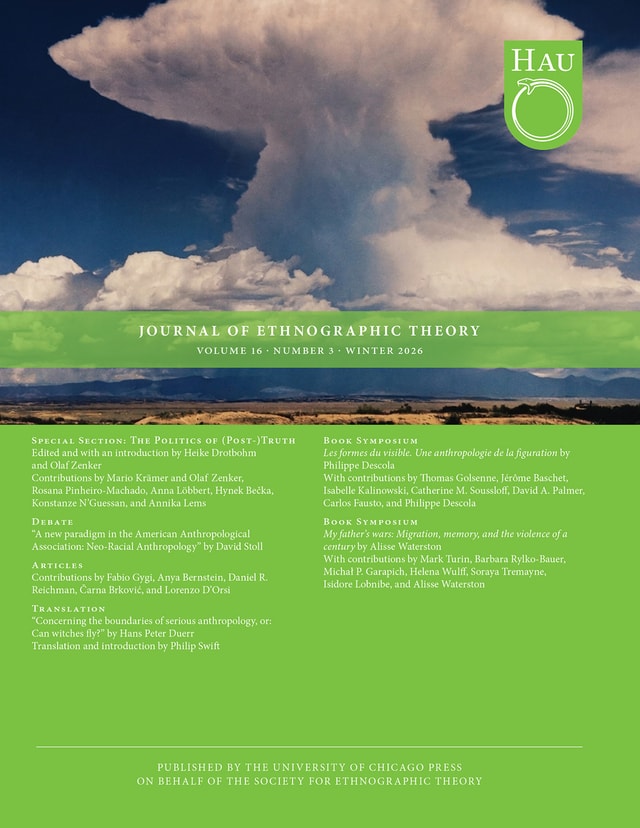
This is volume 16 issue 2 of HAU: Journal of Ethnographic Theory. HAU: Journal of Ethnographic Theory, is an international journal which aims to situate ethnography as the prime heuristic of anthropology, and return it to the forefront of conceptual developments in the discipline. The journal is motivated by the need to reinstate ethnographic theorization in contemporary anthropology as a potent alternative to its "explanation" or "contextualization" by philosophical arguments, moves which have resulted in a loss of the discipline's distinctive theoretical nerve. By drawing out its potential to critically engage and challenge Western cosmological assumptions and conceptual determinations, HAU aims to provide an exciting new arena for evaluating ethnography as a daring enterprise for 'worlding' alien terms and forms of life, by exploiting their potential for rethinking humanity and alterity.
[more]
cover of HAU: Journal of Ethnographic Theory, volume 16 number 3 (Winter 2026)

HAU

Journal of Ethnographic Theory, volume 16 number 3 (Winter 2026)

The University of Chicago Press

University of Chicago Press Journals, 2026
This is volume 16 issue 3 of HAU: Journal of Ethnographic Theory. HAU: Journal of Ethnographic Theory, is an international journal which aims to situate ethnography as the prime heuristic of anthropology, and return it to the forefront of conceptual developments in the discipline. The journal is motivated by the need to reinstate ethnographic theorization in contemporary anthropology as a potent alternative to its "explanation" or "contextualization" by philosophical arguments, moves which have resulted in a loss of the discipline's distinctive theoretical nerve. By drawing out its potential to critically engage and challenge Western cosmological assumptions and conceptual determinations, HAU aims to provide an exciting new arena for evaluating ethnography as a daring enterprise for 'worlding' alien terms and forms of life, by exploiting their potential for rethinking humanity and alterity.
[more]
cover of HEARING, MOTHER-FATHER DEAF: Hearing People in Deaf Families

HEARING, MOTHER-FATHER DEAF

Hearing People in Deaf Families

Michele Bishop

Gallaudet University Press, 2009

The 14th Volume in the Sociolinguistics in Deaf Communities Series

The newest entry in the Sociolinguistics in Deaf Communities series explores the richness and complexity of the lives of hearing people in deaf families. Along with their own contributions, volume editors Michele Bishop and Sherry L. Hicks present the work of an extraordinary cadre of deaf, hearing, and Coda (children of deaf adults) researchers: Susan Adams, Jean Andrews, Oya Ataman, Anne E. Baker, Beppie van den Bogaerde , Helsa B. Borinstein, Karen Emmorey, Tamar H. Gollan, Mara Lúcia Masutti, Susan Mather, Ronice Müller de Quadros, Jemina Napier, Paul Preston, Jennie E. Pyers, Robin Thompson, and Andrea Wilhelm. Their findings represent research in a number of countries, including Australia, Brazil, England, Germany, the Netherlands, and the United States.

Hearing, Mother^Father Deaf: Hearing People in Deaf Families includes a comprehensive description of the societal influences at work in the lives of deaf people and their hearing children, which serves as a backdrop for the essays. The topics range from bimodal bilingualism in adults to cultural and linguistic behaviors of hearing children from deaf families; sign and spoken language contact phenomena; and to issues of self-expression, identity, and experience. A blend of data-based research and personal writings, the articles in this sociolinguistic study provide a thorough understanding of the varied experiences of hearing people and their deaf families throughout the world.

[more]
cover of HIGH STAKES: BIGTIME SPORTS & DOWNTOWN REDEVELOPMENT

HIGH STAKES

BIGTIME SPORTS & DOWNTOWN REDEVELOPMENT

Timothy Jon Curry, Kent Schwirian, and Rachael A. Woldoff

The Ohio State University Press, 2004

[more]
cover of HIV Exceptionalism: Development through Disease in Sierra Leone

HIV Exceptionalism

Development through Disease in Sierra Leone

Adia Benton

University of Minnesota Press, 2015

WINNER, 2017 RACHEL CARSON PRIZE, SOCIETY FOR THE SOCIAL STUDIES OF SCIENCE

In 2002, Sierra Leone emerged from a decadelong civil war. Seeking international attention and development aid, its government faced a dilemma. Though devastated by conflict, Sierra Leone had a low prevalence of HIV. However, like most African countries, it stood to benefit from a large influx of foreign funds specifically targeted at HIV/AIDS prevention and care.

What Adia Benton chronicles in this ethnographically rich and often moving book is how one war-ravaged nation reoriented itself as a country suffering from HIV at the expense of other, more pressing health concerns. During her fieldwork in the capital, Freetown, a city of one million people, at least thirty NGOs administered internationally funded programs that included HIV/AIDS prevention and care. Benton probes why HIV exceptionalism—the idea that HIV is an exceptional disease requiring an exceptional response—continues to guide approaches to the epidemic worldwide and especially in Africa, even in low-prevalence settings.

In the fourth decade since the emergence of HIV/AIDS, many today are questioning whether the effort and money spent on this health crisis has in fact helped or exacerbated the problem. HIV Exceptionalism does this and more, asking, what are the unanticipated consequences that HIV/AIDS development programs engender?

[more]
cover of Habeas Viscus: Racializing Assemblages, Biopolitics, and Black Feminist Theories of the Human

Habeas Viscus

Racializing Assemblages, Biopolitics, and Black Feminist Theories of the Human

Alexander G. Weheliye

Duke University Press, 2014
Habeas Viscus focuses attention on the centrality of race to notions of the human. Alexander G. Weheliye develops a theory of "racializing assemblages," taking race as a set of sociopolitical processes that discipline humanity into full humans, not-quite-humans, and nonhumans. This disciplining, while not biological per se, frequently depends on anchoring political hierarchies in human flesh. The work of the black feminist scholars Hortense Spillers and Sylvia Wynter is vital to Weheliye's argument. Particularly significant are their contributions to the intellectual project of black studies vis-à-vis racialization and the category of the human in western modernity. Wynter and Spillers configure black studies as an endeavor to disrupt the governing conception of humanity as synonymous with white, western man. Weheliye posits black feminist theories of modern humanity as useful correctives to the "bare life and biopolitics discourse" exemplified by the works of Giorgio Agamben and Michel Foucault, which, Weheliye contends, vastly underestimate the conceptual and political significance of race in constructions of the human. Habeas Viscus reveals the pressing need to make the insights of black studies and black feminism foundational to the study of modern humanity.
[more]
cover of Habit's Pathways: Repetition, Power, Conduct

Habit's Pathways

Repetition, Power, Conduct

Tony Bennett

Duke University Press, 2023

Habit has long preoccupied a wide range of theologians, philosophers, sociologists, psychologists, and neuroscientists. In Habit’s Pathways Tony Bennett explores the political consequences of the varied ways in which habit’s repetitions have been acted on to guide or direct conduct. Bennett considers habit’s uses and effects across the monastic regimens of medieval Europe, in plantation slavery and the factory system, through colonial forms of rule, and within a range of medicalized pathologies. He brings these episodes in habit’s political histories to bear on contemporary debates ranging from its role in relation to the politics of white supremacy to the digital harvesting of habits in practices of algorithmic governance. Throughout, Bennett tracks how habit’s repetitions have been articulated differently across divisions of class, race, and gender, demonstrating that although habit serves as an apparatus for achieving success, self-fulfillment, and freedom for the powerful, it has simultaneously served as a means of control over women, racialized peoples, and subordinate classes.
[more]
cover of Habitat For Humanity: Building Private Homes, Building Public Religion

Habitat For Humanity

Building Private Homes, Building Public Religion

Jerome Baggett

Temple University Press, 2001

Habitat for Humanity®, a grassroots house-building ministry founded in 1976 by evangelical Christians, is one of the best-known and most widely popular nonprofit organizations in operation today. With approximately 1500 local Habitat affiliates in the United States and more than 85,000 homes primarily by mobilizing concerned citizens, who include about 250,000 American volunteers each year.

The author tells the story of Habitat's development and the special fervor it evokes among volunteers and those for whom it builds houses. Through interviews with staff, he also provides a look into the organizational dynamics of Habitat, a non-profit whose religious mission for social change is inevitably affected by the instrumental, bottom-line orientation of the state and the market.

Baggett argues that Habitat is an examine of a particular social form of religion, the paradenominational organization, that is uniquely adapted to the climate of the modern world. It is one of the vital forms that  voluntarism takes today.

[more]
cover of Habits of Compassion: Irish Catholic Nuns and the Origins of New York's Welfare System, 1830-1920

Habits of Compassion

Irish Catholic Nuns and the Origins of New York's Welfare System, 1830-1920

Maureen Fitzgerald

University of Illinois Press, 2006

The Irish-Catholic Sisters accomplished tremendously successful work in founding charitable organizations in New York City from the Irish famine through the early twentieth century. Maureen Fitzgerald argues that their championing of the rights of the poor—especially poor women—resulted in an explosion of state-supported services and programs. 

Parting from Protestant belief in meager and means-tested aid, Irish Catholic nuns argued for an approach based on compassion for the poor. Fitzgerald positions the nuns' activism as resistance to Protestantism's cultural hegemony. As she shows, Roman Catholic nuns offered strong and unequivocal moral leadership in condemning those who punished the poor for their poverty and unmarried women for sexual transgression. Fitzgerald also delves into the nuns' own communities, from the class-based hierarchies within the convents to the political power they wielded within the city. That power, amplified by an alliance with the local Irish Catholic political machine, allowed the women to expand public charities in the city on an unprecedented scale.

[more]
cover of Habitual Offenders: A True Tale of Nuns, Prostitutes, and Murderers in Seventeenth-Century Italy

Habitual Offenders

A True Tale of Nuns, Prostitutes, and Murderers in Seventeenth-Century Italy

Craig A. Monson

University of Chicago Press, 2016

In April 1644, two nuns fled Bologna’s convent for reformed prostitutes. A perfunctory archiepiscopal investigation went nowhere, and the nuns were quickly forgotten. By June of the next year, however, an overwhelming stench drew a woman to the wine cellar of her Bolognese townhouse, reopened after a two-year absence—where to her horror she discovered the eerily intact, garroted corpses of the two missing women.
           
Drawing on over four thousand pages of primary sources, the intrepid Craig A. Monson reconstructs this fascinating history of crime and punishment in seventeenth-century Italy. Along the way, he explores Italy’s back streets and back stairs, giving us access to voices we rarely encounter in conventional histories: prostitutes and maidservants, mercenaries and bandits, along with other “dubious” figures negotiating the boundaries of polite society. Painstakingly researched and breathlessly told, Habitual Offenders will delight historians and true-crime fans alike.
[more]
cover of Habitus of the Hood

Habitus of the Hood

Edited by Chris Richardson and Hans A. Skott-Myhre

Intellect Books, 2012

Since the 1990s, popular culture the world over has frequently looked to the ’hood for inspiration, whether in music, film, or television. Habitus of the Hood explores the myriad ways in which the hood has been conceived—both within the lived experiences of its residents and in the many mediated representations found in popular culture. Using a variety of methodologies including autoethnography, textual studies, and critical discourse analysis, contributors analyze and connect these various conceptions.

[more]
cover of Hacked Transmissions: Technology and Connective Activism in Italy

Hacked Transmissions

Technology and Connective Activism in Italy

Alessandra Renzi

University of Minnesota Press, 2020

Mapping the transformation of media activism from the seventies to the present day

Hacked Transmissions is a pioneering exploration of how social movements change across cycles of struggle and alongside technology. Weaving a rich fabric of local and international social movements and media practices, politicized hacking, and independent cultural production, it takes as its entry point a multiyear ethnography of Telestreet, a network of pirate television channels in Italy that combined emerging technologies with the medium of television to challenge the media monopoly of tycoon-turned-prime minister Silvio Berlusconi. 

Street televisions in Italy represented a unique experiment in combining old and new media to forge grassroots alliances, fight social isolation, and build more resilient communities. Alessandra Renzi digs for the roots of Telestreet in movements of the 1970s and the global activism of the 1990s to trace its transformations in the present work of one of the network’s more active nodes, insu^tv, in Naples. In so doing, she offers a comprehensive account of transnational media activism, with particular attention to the relations among groups and projects, their modes of social reproduction, the contexts giving rise to them, and the technology they adopt—from zines and radios to social media. Hacked Transmissions is also a study in method, providing examples of co-research between activist researchers and social movements, and a theoretical framework that captures the complexities of grassroots politics and the agency of technology. 

Providing a rare and timely glimpse into a key activist/media project of the twenty-first century, Hacked Transmissions marks a vital contribution to debates in a range of fields, including media and communication studies, anthropology, science and technology studies, social movements studies, sociology, and cultural theory.

[more]
cover of Hacking the Academy: New Approaches to Scholarship and Teaching from Digital Humanities

Hacking the Academy

New Approaches to Scholarship and Teaching from Digital Humanities

Daniel J. Cohen and Tom Scheinfeldt, Editors

University of Michigan Press, 2013

On May 21, 2010, Daniel J. Cohen and Tom Scheinfeldt posted the following provocative questions online:

“Can an algorithm edit a journal? Can a library exist without books? Can students build and manage their own learning management platforms? Can a conference be held without a program? Can Twitter replace a scholarly society?”

As recently as the mid-2000s, questions like these would have been unthinkable. But today serious scholars are asking whether the institutions of the academy as they have existed for decades, even centuries, aren’t becoming obsolete. Every aspect of scholarly infrastructure is being questioned, and even more importantly, being hacked. Sympathetic scholars of traditionally disparate disciplines are canceling their association memberships and building their own networks on Facebook and Twitter. Journals are being compiled automatically from self-published blog posts. Newly minted PhDs are forgoing the tenure track for alternative academic careers that blur the lines between research, teaching, and service. Graduate students are looking beyond the categories of the traditional CV and building expansive professional identities and popular followings through social media. Educational technologists are “punking” established technology vendors by rolling out their own open source infrastructure.

Here, in Hacking the Academy, Daniel J. Cohen and Tom Scheinfeldt have gathered a sampling of the answers to their initial questions from scores of engaged academics who care deeply about higher education. These are the responses from a wide array of scholars, presenting their thoughts and approaches with a vibrant intensity, as they explore and contribute to ongoing efforts to rebuild scholarly infrastructure for a new millennium.

[more]
cover of Hacking the Iron Curtain: A Media Archaeology of the Russian Internet

Hacking the Iron Curtain

A Media Archaeology of the Russian Internet

Natalia Konradova

University of Wisconsin Press, 2026

For decades before the internet existed, scientists, technologists, novelists, and enthusiasts of all descriptions dreamed of instantaneous, worldwide communication systems. What forms such systems might take and what technologies could be used to accomplish this goal were open questions—questions asked by people around the world, including in the Cold War–era superpowers of the United States and the Soviet Union. 

Media archaeologist Natalia Konradova examines the history of the internet in Russia and its predecessor state, cutting through layers of technological history and dusting off conceptual artifacts of the past. Inspired by the fundamental question of how Soviets imagined future technologies, she investigates experiments with telepathy alongside the (then equally improbable) dream of a global, digitally connected computer network. Since the story of the Russian internet is inextricably wound up with Soviet society and the history of the Cold War, Hacking the Iron Curtain is as much a cultural and political history as it is a technological one—a history that illustrates how collective dreams can challenge geopolitical ambitions and inspire world-changing technologies.

[more]
cover of Haifa: City of Steps

Haifa

City of Steps

Nili Scharf Gold

Brandeis University Press, 2017
Nili Gold, who was born in Haifa to German-speaking parents in 1948, the first year of Israeli statehood, here offers a remarkable homage to her native city during its heyday as an international port and cultural center. Spanning the 1920s and ’30s, when Jews and Arabs lived together amicably and buildings were erected that reflected European, modernist, Jewish, and Arab architectural influences, through 1948, when most Arabs left, and into the ’50s and ’60s burgeoning of the young state of Israel, Gold anchors her personal and family history in five landmark clusters. All in the neighborhood of Hadar HaCarmel, these landmarks define Haifa as a whole. In exquisite detail, Gold describes Memorial Park and its environs, including the border between the largest Jewish and Arab neighborhoods in Haifa; the intersection of Herzl and Balfour Streets, whose highlight is the European/Middle Eastern Technion edifice; Talpiot Market, recalling Haifa as a lively commercial hub; Alliance High School and the Great Synagogue, the former dedicated to instilling a love of intellectual pursuits, while the synagogue was an arm of the dominant Israeli religious establishment; the Ge’ula Elementary School and neighboring buildings that played a historical role, among them, the Struck House, with its Arab-inspired architecture—all against the dramatic backdrop of the mountain, sea, and bay, and their reverberations in memory and literature. Illustrated with more than thirty-five photographs and six maps, Gold’s astute observations of the changing landscape of her childhood and youth highlight literary works that portray deeply held feelings for Haifa, by such canonical Israeli writers as A. B. Yehoshua, Sami Michael, and Dahlia Ravikovitch.
[more]
cover of Hailing the State: Indian Democracy between Elections

Hailing the State

Indian Democracy between Elections

Lisa Mitchell

Duke University Press, 2023

In Hailing the State, Lisa Mitchell explores the methods of collective assembly that people in India use to hold elected officials and government administrators accountable, demand inclusion in decision making, and stage informal referendums. Mitchell traces the colonial and postcolonial lineages of collective forms of assembly, in which—rather than rejecting state authority—participants mobilize with expectations that officials will uphold the law and fulfill electoral promises. She shows how assembly, which ranges from sit-ins, hunger strikes, and demands for meetings with officials to massive general strikes and road and rail blockades, is fundamental to the functioning of democracy in India. These techniques are particularly useful for historically marginalized groups and others whose voices may not be easily heard. Moving beyond an exclusive focus on electoral processes, Mitchell argues that to understand democracy—both in India and beyond—we must also pay attention to what occurs between elections, thereby revising understanding of what is possible for democratic action around the world.
[more]
cover of Hair Raising: Beauty, Culture, and African American Women

Hair Raising

Beauty, Culture, and African American Women

Rooks, Noliwe M

Rutgers University Press, 1996

We all know there is a politics of skin color, but is there a politics of hair?In this book, Noliwe Rooks explores the history and politics of hair and beauty culture in African American communities from the nineteenth century to the 1990s. She discusses the ways in which African American women have located themselves in their own families, communities, and national culture through beauty advertisements, treatments, and styles. Bringing the story into today's beauty shop, listening to other women talk about braids, Afros, straighteners, and what they mean today to grandmothers, mothers, sisters, friends, and boyfriends, she also talks about her own family and has fun along the way. Hair Raising is that rare sort of book that manages both to entertain and to illuminate its subject.
[more]
cover of Haiti Fights Back: The Life and Legacy of Charlemagne Péralte

Haiti Fights Back

The Life and Legacy of Charlemagne Péralte

Yveline Alexis

Rutgers University Press, 2021

Winner of the 2021 Haitian Studies Association Book Prize​

Haiti Fights Back: The Life and Legacy of Charlemagne Péralte is the first US scholarly examination of the politician and caco leader (guerrilla fighter) who fought against the US military occupation of Haiti. The occupation lasted close to two decades, from 1915-1934. Alexis argues for the importance of documenting resistance while exploring the occupation’s mechanics and its imperialism. She takes us to Haiti, exploring the sites of what she labels as resistance zones, including Péralte’s hometown of Hinche and the nation’s large port areas--Port-au-Prince and Cap-Haïtien. Alexis offers a new reading of U.S. military archival sources that record Haitian protests as banditry. Haiti Fights Back illuminates how Péralte launched a political movement, and meticulously captures how Haitian women and men resisted occupation through silence, military battles, and writings. She locates and assembles rare, multilingual primary sources from traditional repositories, living archives (oral stories), and artistic representations in Haiti and the United States. The interdisciplinary work draws on legislation, cacos’ letters, newspapers, and murals, offering a unique examination of Péralte’s life (1885-1919) and the significance of his legacy through the twenty-first century. Haiti Fights Back offers a new approach to the study of the U.S. invasion of the Americas by chronicling how Caribbean people fought back.
 
[more]
cover of Haiti and the Revolution Unseen: The Persistence of the Decolonial Imagination

Haiti and the Revolution Unseen

The Persistence of the Decolonial Imagination

Natalie Marie Léger

Vanderbilt University Press, 2025

With Haiti and the Revolution Unseen, Natalie Marie Léger alters the genealogy of the Haitian revolutionary subject in the archive of Caribbean cultural thought and shifts our attention to the revolutionists previously left out of the archive: Saint Domingue’s Africanized captives. She posits that canonical Caribbean writers of the Haitian Revolution (1791–1804), like C. L. R. James, Aimé Césaire, Alejo Carpentier, and Édouard Glissant, ignore the conditions of difference that inspired the captive populace’s dreams of freedom from French colonial rule. These authors replicate the forms of colonial power that they sought to vilify with their Haitian revolutionist texts because they excise the African Haitian revolutionist from the story of the Revolution. Despite the fact that two-thirds of the enslaved population were African born on the eve of the Revolution, canonized Caribbean literature of the Revolution writes the Haitian revolutionist as acculturated into the West. The absence of African Haitian revolutionists results in narratives that do not see Haitian ideas about Haiti and the Haitian Revolution. They are the stories of a Haiti and the Haitian Revolution unseen.
 
Léger writes against a Haiti- and Haitians-less idea of the Revolution. She asks scholars and artists of the Revolution to know Haitians as Ginens (African Haitians) and Haiti as Ayiti Ginen (Africa Haiti). This form of knowing demands a decolonial understanding of the Haitian Revolution and a reevaluation of its stories as told by influential twentieth-century Caribbean writers. The story she tells showcases the immense political impact of the African Haitian revolutionist’s philosophies of freedom in Saint Domingue and Haiti thereafter; and she argues that the absence of these philosophies in Caribbean classics of the Revolution demands consideration of why these classics continue to shape how the Revolution and Haiti are discussed in Caribbean Studies, Black Studies, Postcolonial Studies and Haitian Studies. More pressingly, Léger calls on artists and scholars of the Revolution to be mindful of how Haiti and Haitians are figured in narratives of the Revolution. The immense space Haiti holds in Caribbean imaginings of freedom and revolution makes mediating it, its Revolution, and peoples through a prejudiced gaze that serves the West hugely problematic, since a denigrated Haiti yields stunted visions of the Caribbean’s future. These conditions require attention to the pervasive presence of colonial paradigms for being in classic literatures of the Revolution and the way they undermine the generative manner Caribbean writers have used Haiti to think through their past, present, and future.

[more]
cover of Half A Job: Bad and Good Part-Time Jobs in a Changing Labor Market

Half A Job

Bad and Good Part-Time Jobs in a Changing Labor Market

Chris Tilly

Temple University Press, 1996

Over 20 million people are working part-time in the United States, more than six million of them involuntarily. Both Time and Fortune magazines have run recent cover stories about this constrained faction of the workforce, who tend to earn on average 40 percent less than full-time workers. Addressing this disturbing trend, Chris Tilly presents a current, in-depth analysis of how U.S. businesses use part-time employment, and why they are using it more and more.

Worker demand for part-time jobs peaked more than twenty years ago, but employers' desires for cheap labor and schedule flexibility have continued to drive the long-term growth of part-time jobs. Tilly argues that this growth is a reaction to the expanding trade and service industries, which, by their nature, depend on part-time workers. Examining the nature and purposes of the different types of part-time employment, he explores the roots of part-time jobs in the organization of work, and the inadequacies of existing public policies on part-time employment.

Using not only statistical analysis but over eighty interviews with employers in the retail and insurance industries, Tilly suggests new approaches to providing flexibility without insecurity.

[more]
cover of Half Humankind: Contexts and Texts of the Controversy about Women in England, 1540-1640

Half Humankind

Contexts and Texts of the Controversy about Women in England, 1540-1640

Katherine Usher Henderson and Barbara F. McManus

University of Illinois Press, 1985
Half Humankind is the first study to provide modernized and annotated editions of the key documents from the controversy about women in Renaissance England. The selections -- ten treatises debating the merits of womankind and six eulogies and condemnations depicting actual women -- range in style from careful logic and studied eloquence to ribald humor and witty parody. Illuminated by an extensive discussion tying the selections to Renaissance society and traditional literature, this volume is an invaluable resource for scholars and students of literature, history, and women's studies.
 
[more]
cover of Half Sisters of History: Southern Women and the American Past

Half Sisters of History

Southern Women and the American Past

Catherine Clinton

Duke University Press, 1994

Long relegated to the margins of historical research, the history of women in the American South has rightfully gained prominence as a distinguished discipline. A comprehensive and much-needed tribute to southern women’s history, Half Sisters of History brings together the most important work in this field over the past twenty years.
This collection of essays by pioneering scholars surveys the roots and development of southern women’s history and examines the roles of white women and women of color across the boundaries of class and social status from the founding of the nation to the present. Authors including Anne Firor Scott, Elizabeth Fox-Genovese, Jacquelyn Dowd Hall, and Nell Irwin Painter, among others, analyze women’s participation in prewar slavery, their representation in popular fiction, and their involvement in social movements. In no way restricted to views of the plantation South, other essays examine the role of women during the American Revolution, the social status of Native American women, the involvement of Appalachian women in labor struggles, and the significance of women in the battle for civil rights. Because of their indelible impact on gender relations, issues of class, race, and sexuality figure centrally in these analyses.
Half Sisters of History will be important not only to women’s historians, but also to southern historians and women’s studies scholars. It will prove invaluable to anyone in search of a full understanding of the history of women, the South, or the nation itself.

Contributors. Catherine Clinton, Sara Evans, Elizabeth Fox-Genovese, Jacquelyn Dowd Hall, Jacqueline Jones, Suzanne D. Lebsock, Nell Irwin Painter, Theda Perdue, Anne Firor Scott, Deborah Gray White

[more]
cover of Halfway to Freedom: The History of Black Washington, DC

Halfway to Freedom

The History of Black Washington, DC

Maurice Jackson. Foreword by Lonnie G. Bunch III.

Duke University Press, 2026

Halfway to Freedom is a social, political, intellectual, and cultural history of African Americans in Washington, DC, looking at the role that race, gender, color, culture, class, and power have played in the city and its relationship with the federal government, the nation, and the world.

For more than two hundred years, the history and culture of the District of Columbia have been in great part shaped by its Black residents. Several Black men were elected to political positions citywide only a handful of years after the end of the Civil War, and while the years after Reconstruction saw the region plagued with segregation and racial violence, the capital’s Black population continued to grow at all economic levels. Washington became the first major US city with a majority Black population in 1957, a status it held for almost seventy years as gentrification has led to the decline of Black political and economic power in DC in the twenty-first century. 
 
Halfway to Freedom is a social, political, intellectual, and cultural history of African Americans in Washington, DC; it explores the role that race, gender, color, class, and power have played in the city and its relationship with the federal government. Maurice Jackson explores the material conditions that shaped life for African Americans, free and enslaved, from the earliest moments of the District’s history to more contemporary times of organization and activism. Through an array of archival materials, especially firsthand accounts of Black residents in the area, Jackson critiques how and why DC exists as a haven within the Black American imaginary given the realities of conflict its Black residents have faced and continue to face today. In doing so, he highlights and honors the gains they have earned through the concerted struggles of labor organizations, women’s movements, sports, music, art, legal activism, and more.

[more]
cover of Hall of Mirrors: Power, Witchcraft, and Caste in Colonial Mexico

Hall of Mirrors

Power, Witchcraft, and Caste in Colonial Mexico

Laura A. Lewis

Duke University Press, 2003

Through an examination of caste in sixteenth- and seventeenth-century Mexico, Hall of Mirrors explores the construction of hierarchy and difference in a Spanish colonial setting. Laura A. Lewis describes how the meanings attached to the categories of Spanish, Indian, black, mulatto, and mestizo were generated within that setting, as she shows how the cultural politics of caste produced a system of fluid and relational designations that simultaneously facilitated and undermined Spanish governance.

Using judicial records from a variety of colonial courts, Lewis highlights the ethnographic details of legal proceedings as she demonstrates how Indians, in particular, came to be the masters of witchcraft, a domain of power that drew on gendered and hegemonic caste distinctions to complicate the colonial hierarchy. She also reveals the ways in which blacks, mulattoes, and mestizos mediated between Spaniards and Indians, alternatively reinforcing Spanish authority and challenging it through alliances with Indians. Bringing to life colonial subjects as they testified about their experiences, Hall of Mirrors discloses a series of contradictions that complicate easy distinctions between subalterns and elites, resistance and power.

[more]
cover of Hallyu 2.0: The Korean Wave in the Age of Social Media

Hallyu 2.0

The Korean Wave in the Age of Social Media

Sangjoon Lee and Abé Mark Nornes, editors

University of Michigan Press, 2015

Collectively known as Hallyu, Korean music, television programs, films, online games, and comics enjoy global popularity, thanks to new communication technologies. In recent years, Korean popular culture has also become the subject of academic inquiry. Whereas the Hallyu’s impact on Korea’s national image and domestic economy, as well as on transnational cultural flows, have received much scholarly attention, there has been little discussion of the role of social media in Hallyu’s propagation.

Contributors to Hallyu 2.0: The Korean Wave in the Age of Social Media explore the ways in which Korean popular cultural products are shared by audiences around the globe; how they generate new fans, markets, and consumers through social media networks; and how scholars can analyze, interpret, and envision the future of this unprecedented cultural phenomenon.
[more]
cover of Han Heroes and Yamato Warriors: Competing Masculinities in Chinese and Japanese War Cinema

Han Heroes and Yamato Warriors

Competing Masculinities in Chinese and Japanese War Cinema

Amanda Weiss

Hong Kong University Press, 2023

An exploration of collective memory through the lens of East Asian film during World War II.

Taking the “tidal wave” of memory in the late twentieth and early twenty-first century as its starting point, this monograph explores the collective memory of World War II in East Asia (1937–1945) through film. Weiss argues that Chinese, Japanese, and American remembrance of World War II is intertwined in what she terms a “memory loop,” the transnational mediation and remediation of war narratives. Gender is central to this process, as the changing representation of male soldiers, political leaders, and patriarchal father figures within these narratives reveals Japanese and Chinese challenges to each other and to the perceived “foundational” American narrative of the war. This process continues to intensify due to the globally visible nature of the memory loop, which drives this cycle of transmission, translation, and reassessment.

This volume is the first to bring together a collection of Chinese and Japanese war films that have received little attention in English-language literature. It also produces new readings of popular war memory in East Asia by revealing the gendered dimensions of collective remembrance in these films.
[more]
cover of Han: People of the River

Han

People of the River

Craig Mishler

University of Alaska Press, 2004

The upper Yukon River basin is one of the wildest, most beautiful, and coldest places on earth. The indigenous Han Indians, whose homeland straddles the U.S.-Canadian border, traveled this country as hunters and gatherers and found a way to survive in it that exemplifies their innovation and tenacity.

The history of the upper Yukon valley from the earliest Western contact with the Han in the 1840s has been one of continuous change. As a result of the gold rush, the Han suddenly became homeless in their own homeland. This book tells the story of that displacement and of current efforts by the Han to reclaim their lands and restore a vibrant way of life. In-depth profiles of Chief Isaac, Chief Charley, and others illustrate the critical importance of traditional leadership in stressful times.

Mishler and Simeone have carefully researched and compiled new information from historic records, adding their own, firsthand field observations and oral interviews with Elders during the 1970s, 1980s, and 1990s. They present detailed historical data on the fur trade, missionization, and the gold rush, as well as an analysis of Han social structure, settlement patterns, religion, subsistence, and expressive culture. The final chapter illustrates contemporary life in Eagle Village with two vivid ethnographic snapshots- a Christmas eve dance in 1972 and a long summer day in 1997. Appendices include a methodological essay, a historic chronology, rules for Han card games, and genealogies for many Han families. As a model of innovative ethnographic and ethnohistorical work, Han, People of the River makes an important contribution to anthropological and indigenous studies literature. As a vivid and deeply thoughtful depiction of the past, present, and future of the Han, it is meant for all Alaskans and everyone who cares about Alaska history and Alaska Native peoples.
[more]
cover of Hand Trembling, Frenzy Witchcraft, and Moth Madness: A Study of Navajo Seizure Disorders

Hand Trembling, Frenzy Witchcraft, and Moth Madness

A Study of Navajo Seizure Disorders

Jerrold E. Levy

University of Arizona Press, 1987

According to traditional Navajo belief, seizures are the result of sibling incest, sexual witchcraft, or possession by a supernatural spirit—associations that have kept such disorders from being known outside Navajo families. This new study is concerned with discovering why the Navajos have accorded seizures such importance and determining their meaning in the larger context of Navajo culture. The book is based on a 14-year study of some 40 Navajo patients and on an epidemiological survey among the Navajos and among three Pueblo tribes.
[more]
cover of Handbook for In-Service Training in Human Services

Handbook for In-Service Training in Human Services

William Crimando

Southern Illinois University Press, 1988

A practical "how-to" workbook that outlines a plan for the design and implementation of staff in-service training programs for human service agencies and facilities.

Crimando and Riggar have made every effort to guarantee the usefulness of this text to practitioners, instructors, and students. This is a working book designed to assist trainers as they acquire the knowledge and skills needed to provide thorough, systematic in-service training that will enhance human service endeavors.

The authors have organized the nineteen chapters into four parts that treat significant steps in the training-program design process. These include analyzing problems that require training solutions; developing a proposal; writing a plan of action for training; and evaluating a program. Each of the chapters combines text, examples, exercises, and supplementary readings to foster a full appreciation of the process involved. Even those topics frequently overlooked or disregarded are included: budgeting program time and financial resources, obtaining administrative commitment, and transferring and maintaining skills in the work setting.

[more]
cover of Handbook for Management of Human Service Agencies

Handbook for Management of Human Service Agencies

T.F. Riggar and R.E. Matkin

Southern Illinois University Press, 1986

A basic guide for individuals responsible for developing and/or operating comprehensive or specialized human service programs.

Drawing on more than a decade of classroom experience and development and incorporating standards from the Commission on Accreditation of Rehabilitation Facilities (1985 Edition), Riggar and Matkin have created a management tool that is as practical for human service providers as it is for students. Here is the fundamental management knowledge required to establish or manage all types of human service programs and facilities.

The text is organized into 23 sections that describe tasks ranging from con­structing mission statements and admis­sion criteria to developing start-up budgets and allocating space for both di­rect and indirect services. Each section provides definitions and guidelines, prac­tical examples, exercises, and selected references. While the focus is on the prac­tices of the private not-for-profit sector, those working in a profit-oriented setting will find many of the sections and ex­ercises to be valuable aids for developing, operating, and maintaining successful programs.

[more]
cover of Handbook for Rural Health Care Ethics: A Practical Guide for Professionals

Handbook for Rural Health Care Ethics

A Practical Guide for Professionals

Edited by William A. Nelson

Dartmouth College Press, 2010
The rural community presents not only distinct health care delivery challenges but also ethical problems for clinicians and administrators of small, rural health care facilities. Health care delivered in a rural context—in closely knit, tightly interdependent small community settings—poses unique ethical considerations for clinical practitioners. For example, a provider in a resource-poor rural setting may be faced with treating a family member, friend, business associate, or neighbor, since the role separation between clinician and patient that predominates in the urban setting is less likely to occur in a small town. Because of the unique rural context, the solutions that health care providers develop to resolve complex ethics dilemmas may differ from solutions reached in urban areas. The Handbook for Rural Health Care Ethics is designed to be a useful resource for clinicians and administrators in rural settings. It draws on the available research and real-life examples to paint a picture of challenging, yet all-too-familiar ethics conflicts while offering strategies for a proactive, preventive approach to ethical issues.
[more]
cover of Handbook of Latin American Studies, Vol. 76: Humanities

Handbook of Latin American Studies, Vol. 76

Humanities

Katherine D. McCann, Volume Editor

University of Texas Press, 2023

Beginning with Number 41 (1979), the University of Texas Press became the publisher of the Handbook of Latin American Studies, the most comprehensive annual bibliography in the field. Compiled by the Hispanic Division of the Library of Congress and annotated by a corps of specialists in various disciplines, the Handbook alternates from year to year between social sciences and humanities.

The Handbook annotates works on Mexico, Central America, the Caribbean and the Guianas, Spanish South America, and Brazil, as well as materials covering Latin America as a whole. Most of the subsections are preceded by introductory essays that serve as biannual evaluations of the literature and research underway in specialized areas.

[more]