139 books match the query 'Social archaeology' and 6 start with h
cover of High Uinta Trails

High Uinta Trails

John Veranth

University of Utah Press, 1998

 An indispensable resource for selecting a destination and planning a trip in the High Uintas.

High Uinta Wilderness—three emotion-charged words that describe a very precious place. The highest mountains, the unique alpine ecosystem, and the largest designated Wilderness in Utah are all found here.

This is a complete rewriting of the original High Uinta Trails, first published in 1974. Access road and land management information has been expanded, new areas and routes have been added, and trail conditions have been completely updated.

The descriptions of the trails, lakes, ridges, and summits are an indispensable resource for selecting a destination and planning a trip but there are still plenty of undocumented places in the Uintas to explore.
[more]
cover of Hinterland Households: Rural Agrarian Household Diversity in Northwest Honduras

Hinterland Households

Rural Agrarian Household Diversity in Northwest Honduras

John G. Douglass

University Press of Colorado, 2002
The rural sector of agrarian societies has historically been viewed as composed of undifferentiated households primarily interested in self-sufficiency. In more recent times, households have been seen as more diverse than previously thought, both internal
[more]
cover of Historic Zuni Architecture and Society: An Archaeological Application of Space Syntax

Historic Zuni Architecture and Society

An Archaeological Application of Space Syntax

T. J. Ferguson

University of Arizona Press, 1996

The historic architecture and settlements of the Zuni Indian Tribe in western New Mexico provide an unusual opportunity to investigate social change. In this monograph, the development of historic Zuni society is analyzed by delineating systematic links between the structure of Zuni society and the structure of architectural forms that the Zuni people built to facilitate their activities. Ferguson shows how the structure of open space within Zuni settlements was linked to defense. As long as the Zunis were subject to attack by Spaniards or Navajos, they built settlements that were difficult for outsiders to get into or move around in. As the need for defense waned, settlements became more open and accessible. He also shows how the internal spaces of traditional Zuni houses are oriented around the activities of the women--matriarchs of their families and clans. Federal housing projects tended to spatially isolate the activities of women from interaction with the rest of the household, thus instituting unexpected social change.

Historic Zuni Architecture and Society utilizes an interdisciplinary approach, analyzing archaeological data using method, theory, and techniques from the fields of architecture, planning, and ethnology. Archaeologists will find in the book an innovative application of space syntax to archaeological problems, and cultural anthropologists and others interested in the history of the Zuni Indians will value its observations about changes that are currently taking place in Zuni social organization.
[more]
cover of Historical Archaeology in the Cortez Mining District: Under the Nevada Giant

Historical Archaeology in the Cortez Mining District

Under the Nevada Giant

Erich Obermayr

University of Nevada Press, 2025

The Cortez Hills Expansion Project archaeological excavations uncovered a wealth of information about the Cortez Mining District, from its beginning in 1863 to the government-mandated end to the mining of precious metals in the district during World War II. Obermayr and McQueen use archaeological data as a foundation to tell the story of life in one of Nevada’s most intriguing, long-lived mining districts. Archaeologists excavate and analyze many thousands of artifacts, uncovering the homes and workplaces—and even trash dumps—of prospectors and miners, mill workers, charcoal burners, brickmakers, blacksmiths, teamsters, and families. They present an archaeological view of everyday life: how Cortez was populated by a variety of ethnic groups, how they lived, what products they bought or consumed, what their social status was, and how, even in this remote location, they created their own version of lives exemplifying the era’s Victorian ideals.
 
Readers interested in the archaeology of the West, mining history, and the history of Nevada will find this book fascinating.
 
[more]
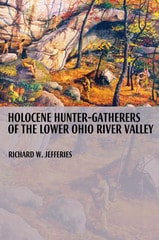
cover of Holocene Hunter-Gatherers of the Lower Ohio River Valley

Holocene Hunter-Gatherers of the Lower Ohio River Valley

Richard Jefferies

University of Alabama Press, 2009
By the Early Holocene (10,000 to 8,000 B.P.), small wandering bands of Archaic hunter-gatherers began to annually follow the same hunting trails, basing their temporary camps on seasonal conditions and the presence of food. The Pleistocene glaciers had receded by this time, making food more plentiful in some areas and living conditions less hazardous. Although these Archaic peoples have long been known from their primary activities as hunters and gatherers of wild food resources, recent evidence has been found that indicates they also began rudimentary cultivation sometime during the Middle Holocene.
Richard Jefferies—an Archaic specialist—comprehensively addresses the approximately 7,000 years of the prehistory of eastern North America, termed the Archaic Period by archaeologists. Jefferies centers his research on a 380-mile section of the Lower Ohio River Valley, an area rife with both temporary and long-term Archaic sites. He covers the duration of the Holocene and provides a compendium of knowledge of the era, including innovative research strategies and results. Presenting these data from a cultural-ecological perspective emphasizing the relationships between hunter-gatherers and the environments in which they lived, Jefferies integrates current research strategies with emerging theories that are beginning to look at culture history in creative ways
[more]
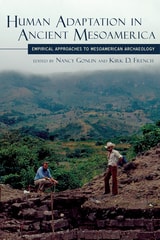
cover of Human Adaptation in Ancient Mesoamerica: Empirical Approaches to Mesoamerican Archaeology

Human Adaptation in Ancient Mesoamerica

Empirical Approaches to Mesoamerican Archaeology

Nancy Gonlin

University Press of Colorado, 2016

This volume explores the dynamics of human adaptation to social, political, ideological, economic, and environmental factors in Mesoamerica and includes a wide array of topics, such as the hydrological engineering behind Teotihuacan’s layout, the complexities of agriculture and sustainability in the Maya lowlands, and the nuanced history of abandonment among different lineages and households in Maya centers.

The authors aptly demonstrate how culture is the mechanism that allows people to adapt to a changing world, and they address how ecological factors, particularly land and water, intersect with nonmaterial and material manifestations of cultural complexity. Contributors further illustrate the continuing utility of the cultural ecological perspective in framing research on adaptations of ancient civilizations.

This book celebrates the work of Dr. David Webster, an influential Penn State archaeologist and anthropologist of the Maya region, and highlights human adaptation in Mesoamerica through the scientific lenses of anthropological archaeology and cultural ecology.

Contributors include Elliot M. Abrams, Christopher J. Duffy, Susan Toby Evans, Kirk D. French, AnnCorinne Freter, Nancy Gonlin, George R. Milner, Zachary Nelson, Deborah L. Nichols, David M. Reed, Don S. Rice, Prudence M. Rice, Rebecca Storey, Kirk Damon Straight, David Webster, Stephen L. Whittington, Randolph J. Widmer, John D. Wingard, and W. Scott Zeleznik.

[more]