Results by title
201 books match the query 'Social movements' and 6 start with h
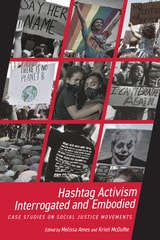
Hashtag Activism Interrogated and Embodied
Case Studies on Social Justice Movementsedited by Melissa Ames & Kristi McDuffie
Utah State University Press, 2022
The chapters capture twenty-first-century digital activism unfolding in different social and geopolitical climates. Delving into hashtag activism in various forms (tweets, memes, and personal narratives) and spaces (Twitter, Facebook, and in-person protests), these chapters reveal how participants question and construct online and offline identities and imagined and actualized communities. They also showcase the complicated ways hashtag activism intersects with consumer, popular, and celebrity cultures.
Hashtag Activism Interrogated and Embodied calls for broader inclusion in what is considered hashtag activism, such as digital fandom, how hashtags are co-opted for nefarious purposes, the effects of anti-activism, and the role of journalism and the media. It will appeal to a range of disciplines including rhetoric and composition, internet studies, communication studies, media studies, feminist studies, affect studies, cultural studies, technical communication, and sociology.
Contributors: Robert Barry, André Brock, Elizabeth Buchanan, Rosemary Clark-Parsons, Gabriel I. Green, Neha Gupta, Jeffrey J. Hall, Kyesha Jennings, Morgan K. Johnson, Salma Kalim, Megan McIntyre, Sean Milligan, Avishek Ray, Sarah Riddick, Stephanie Vie, Erin B. Waggoner, Holly M. Wells, William I. Wolff

High-Risk Feminism in Colombia
Women's Mobilization in Violent ContextsJulia Margaret Zulver
Rutgers University Press, 2022
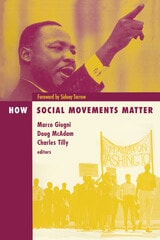
How Social Movements Matter
Marco Giugni
University of Minnesota Press, 1999
Provides original assessments of the consequences of social movements.
We have all witnessed social movements and felt their effects-some subtle, others profound. But to truly understand their impact over time, in different countries, and on various segments of society requires the kind of rare insight this book provides. Bringing together several well-known scholars, this volume offers an assessment of the consequences of social movements in Western countries.
Policy, institutional, cultural, short- and long-term, and intended and unintended outcomes are among the types of consequences the authors consider in depth. They also compare political outcomes of several contemporary movements-specifically, twomen’s, peace, ecology, and extreme-right movements-in different countries. Contributors: Edwin Amenta, New York U; Paul Burstein, U of Washington; Donatella della Porta, U of Florence; Joyce Gelb, CUNY; Vivien Hart, U of Sussex; Ruud Koopmans, Science Center, Berlin; Hanspeter Kriesi, U of Geneva; David S. Meyer, CUNY; Kelly Moore, Columbia U; Dieter Rucht, U of Kent, Canterbury; Paul Statham, Science Center, Berlin; Sidney Tarrow, Cornell U; Dominique Wisler, U of Geneva; Michael P. Young.ISBN 0-8166-2914-5 Cloth £00.00 $57.95xxISBN 0-8166-2915-3 Paper £00.00 $22.95x336 Pages 10 tables, 4 figures 5 7/8 x 9 AugustSocial Movements, Protest and Contention Series, volume 10Translation inquiries: University of Minnesota Press
Human Rights and Social Movements
Neil Stammers, Robert Jupe, and Jane Andrew
Pluto Press, 2009
This book champions social movements as one of the most influential agents that shape our conceptions of human rights.
Stammers argues that human rights cannot be properly understood outside of the context of social movement struggles. He explains how much of the literature on human rights has systematically obscured this link, consequently distorting our understandings of human rights.
Stammers identifies the contours of a new framework through which human rights can be understood. He suggests that what he calls the 'paradox of institutionalisation' can only be addressed through a recognition of the importance of human rights arising out of grassroots activism, and through processes of institutional democratisation.

Humanity's Last Stand
Confronting Global CatastropheMark Schuller
Rutgers University Press, 2021
Humanity’s Last Stand dares to ask these big questions, exploring the interconnections between climate change, global capitalism, xenophobia, and white supremacy. As it unearths how capitalism was born from plantation slavery and the slaughter of Indigenous people, it also invites us to imagine life after capitalism. The book teaches its readers how to cultivate an anthropological imagination, a mindset that remains attentive to local differences even as it identifies global patterns of inequality and racism.
Surveying the struggles of disenfranchised peoples around the globe from frontline communities affected by climate change, to #BlackLivesMatter activists, to Indigenous water protectors, to migrant communities facing increasing hostility, anthropologist Mark Schuller argues that we must develop radical empathy in order to move beyond simply identifying as “allies” and start acting as “accomplices.” Bringing together the insights of anthropologists and activists from many cultures, this timely study shows us how to stand together and work toward a more inclusive vision of humanity before it’s too late.
More information and instructor resources (https://humanityslaststand.org)

Hunting the Ethical State
The Benkadi Movement of Côte d'IvoireJoseph Hellweg
University of Chicago Press, 2011
In the 1990s a nationwide crime wave overtook Côte d’Ivoire. The Ivoirian police failed to control the situation, so a group of poor, politically marginalized, and mostly Muslim men took on the role of the people’s protectors as part of a movement they called Benkadi. These men were dozos—hunters skilled in ritual sacrifice—and they applied their hunting and occult expertise, along with the ethical principles implicit in both forms of knowledge, to the tracking and capturing of thieves. Meanwhile, as Benkadi emerged, so too did the ethnic, regional, and religious divisions that would culminate in Côte d’Ivoire’s 2002–07 rebellion.
Hunting the Ethical State reveals how dozos worked beyond these divisions to derive their new roles as enforcers of security from their ritual hunting ethos. Much as they used sorcery to shape-shift and outwit game, they now transformed into unofficial police, and their ritual networks became police bureaucracies. Though these Muslim and northern-descended men would later resist the state, Joseph Hellweg demonstrates how they briefly succeeded at making a place for themselves within it. Ultimately, Hellweg interprets Benkadi as a flawed but ingenious and thoroughly modern attempt by non-state actors to reform an African state.