Results by title
260 books match the query 'Soviet Union' and 7 start with h

Hacking the Iron Curtain
A Media Archaeology of the Russian InternetNatalia Konradova
University of Wisconsin Press, 2026
For decades before the internet existed, scientists, technologists, novelists, and enthusiasts of all descriptions dreamed of instantaneous, worldwide communication systems. What forms such systems might take and what technologies could be used to accomplish this goal were open questions—questions asked by people around the world, including in the Cold War–era superpowers of the United States and the Soviet Union.
Media archaeologist Natalia Konradova examines the history of the internet in Russia and its predecessor state, cutting through layers of technological history and dusting off conceptual artifacts of the past. Inspired by the fundamental question of how Soviets imagined future technologies, she investigates experiments with telepathy alongside the (then equally improbable) dream of a global, digitally connected computer network. Since the story of the Russian internet is inextricably wound up with Soviet society and the history of the Cold War, Hacking the Iron Curtain is as much a cultural and political history as it is a technological one—a history that illustrates how collective dreams can challenge geopolitical ambitions and inspire world-changing technologies.
Media archaeologist Natalia Konradova examines the history of the internet in Russia and its predecessor state, cutting through layers of technological history and dusting off conceptual artifacts of the past. Inspired by the fundamental question of how Soviets imagined future technologies, she investigates experiments with telepathy alongside the (then equally improbable) dream of a global, digitally connected computer network. Since the story of the Russian internet is inextricably wound up with Soviet society and the history of the Cold War, Hacking the Iron Curtain is as much a cultural and political history as it is a technological one—a history that illustrates how collective dreams can challenge geopolitical ambitions and inspire world-changing technologies.
[more]
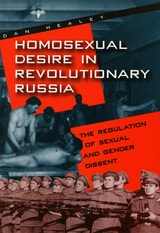
Homosexual Desire in Revolutionary Russia
The Regulation of Sexual and Gender DissentDan Healey
University of Chicago Press, 2001
The first full-length study of same-sex love in any period of Russian or Soviet history, Homosexual Desire in Revolutionary Russia investigates the private worlds of sexual dissidents during the pivotal decades before and after the 1917 Bolshevik Revolution. Using records and archives available to researchers only since the fall of Communism, Dan Healey revisits the rich homosexual subcultures of St. Petersburg and Moscow, illustrating the ambiguous attitude of the late Tsarist regime and revolutionary rulers toward gay men and lesbians. Homosexual Desire in Revolutionary Russia reveals a world of ordinary Russians who lived extraordinary lives and records the voices of a long-silenced minority.
[more]
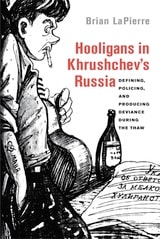
Hooligans in Khrushchev's Russia
Defining, Policing, and Producing Deviance during the ThawBrian LaPierre
University of Wisconsin Press, 2012
Swearing, drunkenness, promiscuity, playing loud music, brawling—in the Soviet Union these were not merely bad behavior, they were all forms of the crime of "hooliganism." Defined as "rudely violating public order and expressing clear disrespect for society," hooliganism was one of the most common and confusing crimes in the world's first socialist state. Under its shifting, ambiguous, and elastic terms, millions of Soviet citizens were arrested and incarcerated for periods ranging from three days to five years and for everything from swearing at a wife to stabbing a complete stranger.
Hooligans in Khrushchev's Russia offers the first comprehensive study of how Soviet police, prosecutors, judges, and ordinary citizens during the Khrushchev era (1953–64) understood, fought against, or embraced this catch-all category of criminality. Using a wide range of newly opened archival sources, it portrays the Khrushchev period—usually considered as a time of liberalizing reform and reduced repression—as an era of renewed harassment against a wide range of state-defined undesirables and as a time when policing and persecution were expanded to encompass the mundane aspects of everyday life. In an atmosphere of Cold War competition, foreign cultural penetration, and transatlantic anxiety over "rebels without a cause," hooliganism emerged as a vital tool that post-Stalinist elites used to civilize their uncultured working class, confirm their embattled cultural ideals, and create the right-thinking and right-acting socialist society of their dreams.
Hooligans in Khrushchev's Russia offers the first comprehensive study of how Soviet police, prosecutors, judges, and ordinary citizens during the Khrushchev era (1953–64) understood, fought against, or embraced this catch-all category of criminality. Using a wide range of newly opened archival sources, it portrays the Khrushchev period—usually considered as a time of liberalizing reform and reduced repression—as an era of renewed harassment against a wide range of state-defined undesirables and as a time when policing and persecution were expanded to encompass the mundane aspects of everyday life. In an atmosphere of Cold War competition, foreign cultural penetration, and transatlantic anxiety over "rebels without a cause," hooliganism emerged as a vital tool that post-Stalinist elites used to civilize their uncultured working class, confirm their embattled cultural ideals, and create the right-thinking and right-acting socialist society of their dreams.
[more]
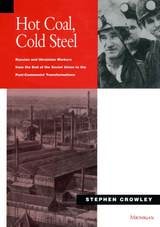
Hot Coal, Cold Steel
Russian and Ukrainian Workers from the End of the Soviet Union to the Post-Communist TransformationsStephen Crowley
University of Michigan Press, 1997
Well after the disintegration of the Communist Party and the Soviet state--and through several years of economic collapse--industrial workers in almost every sector of the former Soviet Union have remained quiescent and the same ineffective and unpopular trade unions still hold a virtual monopoly on worker's representation. Why? While many argue that labor is a central variable in the development of economic and political systems, little is known about workers in the states of the former Soviet Union since the fall of Communism. In a comparative study of two groups of industrial workers--the coal miners and steelworkers--at the end of the Soviet era, Stephen Crowley sheds light on where these workers have been and where they are going.
Coal miners in the final years of the Soviet Union effectively organized and led strikes which supported the end of Communism, even though their heavy subsidies would be threatened by capitalism. Steel workers, in contrast, did not effectively organize and strike. This pattern has continued under the new governments, with the coal miners effectively organized and seeking protection from the worst consequences of marketization, while the steel workers remain weakly organized despite deteriorating economic conditions.
Based on extensive on-site research including interviews with miners and steelworkers, labor leaders and plant managers, Crowley develops a detailed picture of the conditions under which workers organize. His findings have application beyond the conditions of post-Communist Russia and Ukraine to other societies undergoing fundamental change.
This book will be of interest to sociologists and political scientists interested in the role of labor in transitional societies, the patterns of organization of labor, as well as area specialists.
Stephen Crowley is Associate Professor of Political Science, Oberlin College.
[more]

How the Soviet Union Disappeared
An Essay on the Causes of DissolutionWisla Suraska
Duke University Press, 1998
Many theories have been offered to explain the disintegration of the Soviet Union, yet none sufficiently explain the speed and profundity of the empire’s collapse. In this powerful polemic, Wisla Suraska disputes popular interpretations of the dissolution of the Soviet Union and explains how theories, such as totalitarian theory, have failed to examine the exigencies of arbitrary government. At the center of Suraska’s own theories on the Soviet collapse is her claim that it came about not simply because it was an economically declining country that contained too many nationalities but because it was despotic and that despotism is unworkable in modern societies.
Using numerous secondary sources, recently published memoir literature, and new archival research, Suraska’s multidimensional study delves into the many factors involved in the dissolution of the Soviet empire—the role of Gorbachev and his contest with Yeltsin, the weakness of the Soviet state, and the poverty of ideas that informed perestroika. She also examines the complex relationship between the Communist Party, the KGB, and the military; the way Gorbachev dealt with the German question; and the rise of post-Marxist thought in the Soviet Union. Whether discussing how insufficient control over coercive forces or the growing strength of provincial barons impacted the collapse, Suraska furthers her argument that the explosion of nationalisms in the Soviet Union was as much activated by the breakdown of central structures as it actually contributed to the final demolition of the regime. In the end, How the Soviet Union Disappeared reveals Gorbachev’s perestroika as having been nothing short of a radical attempt to rebuild power that the Soviet center had lost in the post-Stalinist period.
In its questioning of the assumptions of most previous scholarship and discourse on the Soviet Union, this book will be of interest to Sovietologists, political scientists, and students of communism and nationalism.
[more]
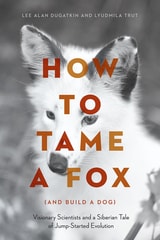
How to Tame a Fox (and Build a Dog)
Visionary Scientists and a Siberian Tale of Jump-Started EvolutionLee Alan Dugatkin and Lyudmila Trut
University of Chicago Press, 2017
Tucked away in Siberia, there are furry, four-legged creatures with wagging tails and floppy ears that are as docile and friendly as any lapdog. But, despite appearances, these are not dogs—they are foxes. They are the result of the most astonishing experiment in breeding ever undertaken—imagine speeding up thousands of years of evolution into a few decades. In 1959, biologists Dmitri Belyaev and Lyudmila Trut set out to do just that, by starting with a few dozen silver foxes from fox farms in the USSR and attempting to recreate the evolution of wolves into dogs in real time in order to witness the process of domestication. This is the extraordinary, untold story of this remarkable undertaking.
Most accounts of the natural evolution of wolves place it over a span of about 15,000 years, but within a decade, Belyaev and Trut’s fox breeding experiments had resulted in puppy-like foxes with floppy ears, piebald spots, and curly tails. Along with these physical changes came genetic and behavioral changes, as well. The foxes were bred using selection criteria for tameness, and with each generation, they became increasingly interested in human companionship. Trut has been there the whole time, and has been the lead scientist on this work since Belyaev’s death in 1985, and with Lee Dugatkin, biologist and science writer, she tells the story of the adventure, science, politics, and love behind it all. In How to Tame a Fox, Dugatkin and Trut take us inside this path-breaking experiment in the midst of the brutal winters of Siberia to reveal how scientific history is made and continues to be made today.
To date, fifty-six generations of foxes have been domesticated, and we continue to learn significant lessons from them about the genetic and behavioral evolution of domesticated animals. How to Tame a Fox offers an incredible tale of scientists at work, while also celebrating the deep attachments that have brought humans and animals together throughout time.
[more]
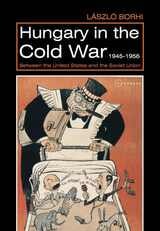
Hungary in the Cold War, 1945-1956
Between the United States and the Soviet UnionLászló Borhi
Central European University Press, 2004
Based on new archival evidence, examines Soviet Empire building in Hungary and the American response to it. Hungary was not important enough to resist the Soviets, its democratic opposition failed to win American sympathy, the US simply had no leverage over the Soviets, who sacrificed cooperation with the West for a closed sphere in Eastern Europe. The imposition of a Stalinist regime assured Hungary's unconditional loyalty to Soviet imperial needs. Unlike the GDR, Eastern Europe was never considered a bargaining chip for bettering relations with the West. The book analyzes why, given all its idealism and power, the US failed even in its minimal aims concerning the states of Eastern Europe. Eventually both powers pursued power politics: the Soviets in a naked form, the US subtly, but both with little regard for the fate of Hungarians.
[more]