Results by title
370 books match the query 'Spain' and 7 start with h

Heaven, Hell, and Everything in Between
Murals of the Colonial AndesBy Ananda Cohen-Aponte
University of Texas Press, 2016
Examining the vivid, often apocalyptic church murals of Peru from the early colonial period through the nineteenth century, Heaven, Hell, and Everything in Between explores the sociopolitical situation represented by the artists who generated these murals for rural parishes. Arguing that the murals were embedded in complex networks of trade, commerce, and the exchange of ideas between the Andes and Europe, Ananda Cohen-Aponte also considers the ways in which artists and viewers worked through difficult questions of envisioning sacredness.
This study brings to light the fact that, unlike the murals of New Spain, the murals of the Andes possess few direct visual connections to a pre-Columbian painting tradition; the Incas’ preference for abstracted motifs created a problem for visually translating Catholic doctrine to indigenous congregations, as the Spaniards were unable to read Inca visual culture. Nevertheless, as Cohen Suarez demonstrates, colonial murals of the Andes can be seen as a reformulation of a long-standing artistic practice of adorning architectural spaces with images that command power and contemplation. Drawing on extensive secondary and archival sources, including account books from the churches, as well as on colonial Spanish texts, Cohen Suarez urges us to see the murals not merely as decoration or as tools of missionaries but as visual archives of the complex negotiations among empire, communities, and individuals.
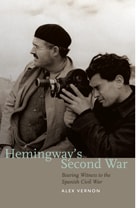
Hemingway’s Second War
Bearing Witness to the Spanish Civil WarAlex Vernon
University of Iowa Press, 2011
In 1937 and 1938, Ernest Hemingway made four trips to Spain to cover its civil war for the North American News Alliance wire service and to help create the pro-Republican documentary film The Spanish Earth. Hemingway’s Second War is the first book-length scholarly work devoted to this subject.
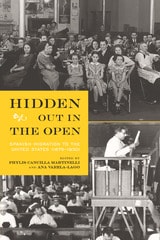
Hidden Out in the Open
Spanish Migration to the United States (1875-1930)Phylis Cancilla Martinelli
University Press of Colorado, 2018
The chapters in this volume are geographically wide-ranging, reflecting the transnational nature of the Spanish diaspora in the Americas, encompassing networks that connected Spain, Cuba, Latin American countries, the United States, and American-controlled territories in Hawai’i and Panama. The geographic diversity reveals the different jobs immigrants engaged in, from construction gangs in the Panama Canal to mining crews in Arizona and West Virginia. Contributors analyze the Spanish experience in the United States from a variety of perspectives, discussing rural and urban enclaves, the role of the state, and the political mobilization of migrants, using a range of methodological approaches that examine ethnicity, race, gender, and cultural practices through the lenses of sociology, history, and cultural studies.
The mention of the Spanish influence in the United States often conjures up images of conquistadores and padres of old. Forgotten in this account are the Spanish immigrants who reached American shores in the late nineteenth and early twentieth centuries. Hidden Out in the Open reveals the role of the modern migration of Spaniards in this "land of immigrants" and rectifies the erasure of Spain in the American narrative. The book will be of interest to scholars and students of US history and the history of modern Spain and Europe, as well as those interested ethnic and migration/diaspora studies, Hispanic/Latino studies, and the study of working class and radicalism.
Contributors: Brian D. Bunk, Christopher J. Castañeda, Thomas Hidalgo, Beverly Lozano, Phylis Cancilla Martinelli, Gary R. Mormino, George E. Pozzetta†, Ana Varela-Lago.

Hierarchy, Commerce, and Fraud in Bourbon Spanish America
A Postal Inspector's ExposeRuth Hill
Vanderbilt University Press, 2021
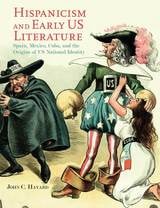
Hispanicism and Early US Literature
Spain, Mexico, Cuba, and the Origins of US National IdentityJohn C. Havard
University of Alabama Press, 2018
Revealing how Spain, Mexico, and Cuba helped shape the literary origins of American national identity.
In Hispanicism and Early US Literature, author John C. Havard posits that representations of Spain, Spanish America, Spanishness, and Spanish Americanness are integral elements in the evolution of early national and antebellum US literature. He argues that Spanish-speaking countries have long held a broad fascination for Americans and that stock narratives regarding these peoples were central to the period’s US literature.
Beginning with the work of eighteenth-century literary nationalists such as Joel Barlow, US literature has been drawn to reflect on Spain and Spanish America. Such reflection was often inspired by geopolitical conflicts such as US expansion into Spanish Louisiana and the US-Mexican War. Havard terms the discourse emerging from these reflections “Hispanicism.” This discourse was used to portray the dominant viewpoint of classical liberalism that propounded an American exceptionalism premised on the idea that Hispanophone peoples were comparatively lacking the capacity for self-determination, hence rationalizing imperialism. On the conservative side were warnings against progress through conquest.
Havard delves into selected works of early national and antebellum literature on Spain and Spanish America to illuminate US national identity. Poetry and novels by Joel Barlow, James Fenimore Cooper, and Herman Melville are mined to further his arguments regarding identity, liberalism, and conservatism. Understudied authors Mary Peabody Mann and José Antonio Saco are held up to contrast American and Cuban views on Hispanicism and Cuban annexation as well as to develop the focus on nationality and ideology via differences in views on liberalism.
More than just a work of literary criticism, there is a substantial amount of cultural and political history discussed. Havard’s use of archival sources such as political articles and personal correspondence elucidates not just literary genres and movements such as early national epic poetry, abolitionist fiction, and the American Renaissance, but also US prominent culture.
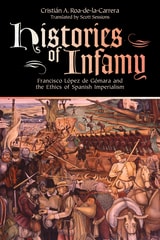
Histories of Infamy
Francisco López de Gómara and the Ethics of Spanish ImperialismCristián A. Roa-de-la-Carrera
University Press of Colorado, 2005
- Luis Fernando Restrepo, University of Arkansas
“In an eloquent and thorough exegesis, Roa-de-la-Carrera reveals how and why López de Gómara, having written the best of all possible books in exultation of Spanish imperialism, nevertheless failed to convince the readers of his time."
- Susan Schroeder, Tulane University
In Histories of Infamy, Cristián Roa-de-la-Carrera explores Francisco López de Gómara's (1511-ca.1559) attempt to ethically reconcile Spain's civilizing mission with the conquistadors' abuse and exploitation of Native peoples.
The most widely read account of the conquest in its time, Gómara's Historia general de las Indias y Conquista de México rationalized the conquistadors' crimes as unavoidable evils in the task of bringing "civilization" to the New World. Through an elaborate defense of Spanish imperialism, Gómara aimed to convince his readers of the merits of the conquest, regardless of the devastation it had wrought upon Spain's new subjects. Despite his efforts, Gómara's apologist text quickly fell into disrepute and became ammunition for Spain's critics. Evaluating the effectiveness of ideologies of colonization, Roa-de-la-Carrera's analysis will appeal to scholars in colonial studies and readers interested in the history of the Americas.
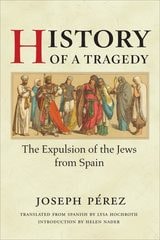
History of a Tragedy
THE EXPULSION OF THE JEWS FROM SPAINJoseph Perez
University of Illinois Press, 2006
Few events in the history of Spain have provoked as much controversy as the expulsion of the Jews in 1492. Conflicts within the Catholic Church, suspicions within the newly unified Spain, and the claims of Spanish merchants combined to make the Spain of Ferdinand and Isabella intolerant and inquisitorial. Yet the roots of Spanish anti-Semitism went deeper. In this concise survey of the expulsion of the Sephardic Jews, Joseph Pérez studies the evolution of the Jewish community in Spain from the time of the Visigoths to the reign of the Catholic kings. He explores the Jewish community’s role in creating and sustaining the vibrant cultural, political, and economic world of medieval Spain, and how growing religious intolerance, a pervasive resentment of the “others,” and a string of escalating encroachments culminated in expulsion.