Results by title
308 books match the query 'Story' and 9 start with h
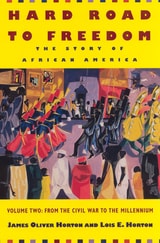
Hard Road to Freedom
The Story of African America, The Civil War to the MillenniumHorton, Lois E
Rutgers University Press, 2002

Hawker Hunter
the story of a thoroughbredSreco Bradic
Amsterdam University Press, 2023
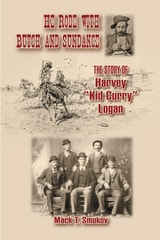
He Rode with Butch and Sundance
The Story of Harvey "Kid Curry" LoganMark T. Smokov
University of North Texas Press, 2012
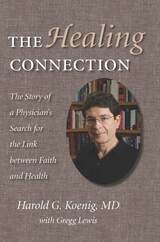
Healing Connection
Story Of Physicians Search For Link Between Faith & HeaHarold Koenig
Templeton Press, 2004
"It is inspiring to see a physician who is unafraid to stand up for his religious beliefs and who understands how those beliefs can resonate with good science." —Larry Dossey, MD, author of Reinventing Medicine and Healing Words
The name Harold G. Koenig is well known in the fast-growing field of spirituality and health. Founder and director of the widely respected Duke University Center for Theology, Spirituality, and Health, Dr. Koenig is recognized worldwide for his groundbreaking work in medical science and religious faith. In this book—now available in paperback—he shares his remarkable personal story and shows how personal trials became the catalyst for his pioneering research.
In part one, he describes his turbulent youth: growing up on a California vineyard, college days of experimentation during the 1970s, adventures as a student researcher in Africa with Jane Goodall, an emotional breakdown, expulsion from medical school for disruptive behavior, battling mental illness as a street person in San Francisco. He refers to his ongoing battle with a chronic and debilitating physical disease in terms of the insights it gives him for his work, and he recounts the striking realization of God's call, the people and events that helped him refine a vision into a mission, and the subsequent professional opposition that resided alongside his success.
Part two draws on the real-life examples of former patients and summarizes Koenig's most important findings concerning the impact of Christian faith on mental and physical health, encapsulated by the statement: religious faith and practice are connected to mental and physical health.
In part three he challenges individuals and the American church to consider the implications of the research and to develop constructive ways of implementing the healing connection that can be found in faith.
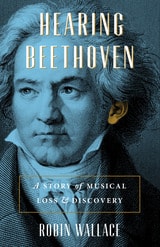
Hearing Beethoven
A Story of Musical Loss and DiscoveryRobin Wallace
University of Chicago Press, 2018
We’re all familiar with the image of a fierce and scowling Beethoven, struggling doggedly to overcome his rapidly progressing deafness. That Beethoven continued to play and compose for more than a decade after he lost his hearing is often seen as an act of superhuman heroism. But the truth is that Beethoven’s response to his deafness was entirely human. And by demystifying what he did, we can learn a great deal about Beethoven’s music. Perhaps no one is better positioned to help us do so than Robin Wallace, who not only has dedicated his life to the music of Beethoven but also has close personal experience with deafness. One day, Wallace’s late wife, Barbara, found she couldn’t hear out of her right ear—the result of radiation administered to treat a brain tumor early in life. Three years later, she lost hearing in her left ear as well. Over the eight and a half years that remained of her life, despite receiving a cochlear implant, Barbara didn’t overcome her deafness or ever function again like a hearing person.
Wallace shows here that Beethoven didn’t do those things, either. Rather than heroically overcoming his deafness, Beethoven accomplished something even more challenging: he adapted to his hearing loss and changed the way he interacted with music, revealing important aspects of its very nature in the process. Wallace tells the story of Beethoven’s creative life, interweaving it with his and Barbara’s experience to reveal aspects that only living with deafness could open up. The resulting insights make Beethoven and his music more accessible and help us see how a disability can enhance human wholeness and flourishing.

Heavenly Supper
The Story of Maria JanisFulvio Tomizza
University of Chicago Press, 1991
So begins Fulvio Tomizza's absorbing account of the true story of Maria Janis, a devout peasant woman from the mountains north of Bergamo. Too poor to enter a convent, Maria had set out to serve God by relinquishing the little she had, through renunciation of all food but the bread and wine of communion. Encouraged by the restless village priest Pietro Morali, Maria claimed to have existed in this sanctified state for five years. During this time, she, Morali, and the weaver Pietro Palazzi travel from a little village in the Alps to Rome and then to Venice, where their alleged sacrilege is discovered and they are brought to trial. Both revered as a saint and reviled as a fraud, Maria with her "privilege" inspires and threatens believers within the Church. Combining the historian's precision with the novelist's imagination, Tomizza painstakingly reconstructs her story, crafting a fascinating portrait of sublimated love, ambition, and jealousy.
Heavenly Supper alternates a chronological account of the trial with analyses of each protagonist's life history. Along the way, Tomizza gives voice to the minds and hearts of his characters, allowing them to speak for themselves in their own words. The world he recreates resonates with the fervor of the Counter Reformation when faith and its consequences were rigidly controlled by the Church. As suspenseful as a detective novel, Tomizza's story goes beyond the trial to evoke a panoramic view of seventeenth-century Italian culture.
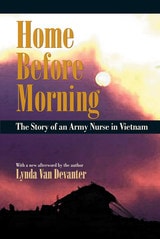
Home before Morning
The Story of an Army Nurse in VietnamLynda Van Devanter
University of Massachusetts Press, 2001
Lynda Van Devanter was the girl next door, the cheerleader who went to Catholic schools, enjoyed sports, and got along well with her four sisters and parents. After high school she attended nursing school and then did something that would shatter her secure world for the rest of her life: in 1969, she joined the army and was shipped to Vietnam. When she arrived in Vietnam her idealistic view of the war vanished quickly. She worked long and arduous hours in cramped, ill-equipped, understaffed operating rooms. She saw friends die. Witnessing a war close-up, operating on soldiers and civilians whose injuries were catastrophic, she found the very foundations of her thinking changing daily.
After one traumatic year, she came home, a Vietnam veteran. Coming home was nearly as devastating as the time she spent in Asia. Nothing was the same -- including Lynda herself. Viewed by many as a murderer instead of a healer, she felt isolated and angry. The anger turned to depression; like many other Vietnam veterans she suffered from delayed stress syndrome. Working in hospitals brought back chilling scenes of hopelessly wounded soldiers. A marriage ended in divorce. The war that was fought physically halfway around the world had become a personal, internal battle.
Home before Morning is the story of a woman whose courage, stamina, and personal history make this a compelling autobiography. It is also the saga of others who went to war to aid the wounded and came back wounded -- physically and emotionally -- themselves. And, it is the true story of one person's triumphs: her understanding of, and coming to terms with, her destiny.
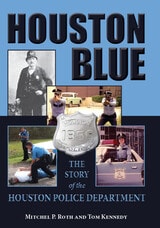
Houston Blue
The Story of the Houston Police DepartmentMitchel P. Roth
University of North Texas Press, 2012
How Science Takes Stock
The Story of Meta-AnalysisMorton Hunt
Russell Sage Foundation, 1997