Results by title
206 books match the query 'Study & Teaching' and 5 start with h
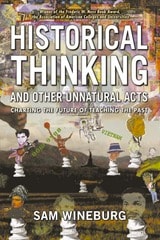
Historical Thinking
Sam Wineburg
Temple University Press, 2001
Although most of us think of history -- and learn it -- as a conglomeration of facts, dates, and key figures, for professional historians it is a way of knowing, a method for developing and understanding about the relationships of peoples and events in the past. A cognitive psychologist, Wineburg has been engaged in studying what is intrinsic to historical thinking, how it might be taught, and why most students still adhere to the "one damned thing after another" concept of history.
Whether he is comparing how students and historians interpret documentary evidence or analyzing children's drawings, Wineburg's essays offer "rough maps of how ordinary people think about the past and use it to understand the present." Arguing that we all absorb lessons about history in many settings -- in kitchen table conversations, at the movies, or on the world-wide web, for instance -- these essays acknowledge the role of collective memory in filtering what we learn in school and shaping our historical thinking.

Histories on Econometrics, Volume 43
Marcel Boumans, Ariane Dupont-Kieffer, Dou Qin, editors
Duke University Press, 0
Contributors: John Aldrich, Jeff E. Biddle, Olav Bjerkholt, Marcel Boumans, Chao-Hsi Huang, Robert W. Dimand, Duo Qin, Ariane Dupont-Kieffer, Hsiang-Ke Chao, Aiko Ikeo, Francisco Louçã, Mary S. Morgan, Daniela Parisi, Alain Pirotte, Charles G. Renfro, Thomas Stapleford, Sofia Terlica
Marcel Boumans is Associate Professor of Economics at the University of Amsterdam. Ariane Dupont-Kieffer is a Researcher at the French National Institute of Research on Transport and Safety. Duo Qin is Reader of Economics at the University of London.
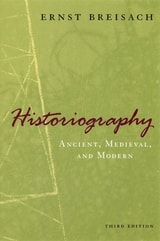
Historiography
Ancient, Medieval, and Modern, Third EditionErnst Breisach
University of Chicago Press, 2007
In this pioneering work, Ernst Breisach presents an effective, well-organized, and concise account of the development of historiography in Western culture. Neither a handbook nor an encyclopedia, this up-to-date third edition narrates and interprets the development of historiography from its origins in Greek poetry to the present, with compelling sections on postmodernism, deconstructionism, African-American history, women’s history, microhistory, the Historikerstreit, cultural history, and more. The definitive look at the writing of history by a historian, Historiography provides key insights into some of the most important issues, debates and innovations in modern historiography.
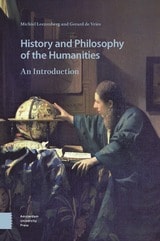
History and Philosophy of the Humanities
An IntroductionMichiel Leezenberg
Amsterdam University Press, 2019
'History and Philosophy of the Humanities: An Introduction' presents a reasoned overview of the conceptual and historical backgrounds of the humanities. In four sections, it discusses:
- the most influential views on scientific knowledge from Aristotle to Thomas Kuhn;
- the birth of the modern humanities and its relation to the natural and social sciences;
- the various methodological schools and conceptual issues in the humanities;
- several themes that set the agenda for current debates in the humanities: critiques of modernity; gender, sexuality and identity; and postcolonialism.
Thus, it provides students in the humanities with a comprehensive understanding of the backgrounds of their own discipline, its relation to other disciplines, and the state of the art of the humanities at large.
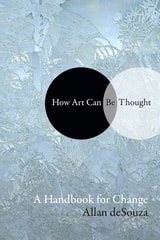
How Art Can Be Thought
A Handbook for ChangeAl-An deSouza
Duke University Press, 2018