Results by title
250 books match the query 'Subjects' and 4 start with h
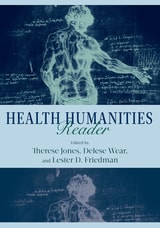
Health Humanities Reader
Jones, Therese
Rutgers University Press, 2014
Over the past forty years, the health humanities, previously called the medical humanities, has emerged as one of the most exciting fields for interdisciplinary scholarship, advancing humanistic inquiry into bioethics, human rights, health care, and the uses of technology. It has also helped inspire medical practitioners to engage in deeper reflection about the human elements of their practice.
In Health Humanities Reader, editors Therese Jones, Delese Wear, and Lester D. Friedman have assembled fifty-four leading scholars, educators, artists, and clinicians to survey the rich body of work that has already emerged from the field—and to imagine fresh approaches to the health humanities in these original essays. The collection’s contributors reflect the extraordinary diversity of the field, including scholars from the disciplines of disability studies, history, literature, nursing, religion, narrative medicine, philosophy, bioethics, medicine, and the social sciences.
With warmth and humor, critical acumen and ethical insight, Health Humanities Reader truly humanizes the field of medicine. Its accessible language and broad scope offers something for everyone from the experienced medical professional to a reader interested in health and illness.
[more]
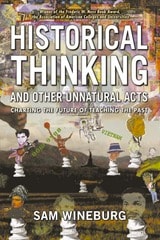
Historical Thinking
Sam Wineburg
Temple University Press, 2001
Since ancient times, the pundits have lamented young people's lack of historical knowledge and warned that ignorance of the past surely condemns humanity to repeating its mistakes. In the contemporary United States, this dire outlook drives a contentious debate about what key events, nations, and people are essential for history students. Sam Wineburg says that we are asking the wrong questions. This book demolishes the conventional notion that there is one true history and one best way to teach it.
Although most of us think of history -- and learn it -- as a conglomeration of facts, dates, and key figures, for professional historians it is a way of knowing, a method for developing and understanding about the relationships of peoples and events in the past. A cognitive psychologist, Wineburg has been engaged in studying what is intrinsic to historical thinking, how it might be taught, and why most students still adhere to the "one damned thing after another" concept of history.
Whether he is comparing how students and historians interpret documentary evidence or analyzing children's drawings, Wineburg's essays offer "rough maps of how ordinary people think about the past and use it to understand the present." Arguing that we all absorb lessons about history in many settings -- in kitchen table conversations, at the movies, or on the world-wide web, for instance -- these essays acknowledge the role of collective memory in filtering what we learn in school and shaping our historical thinking.
[more]
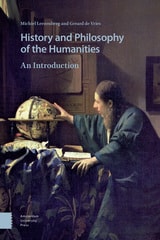
History and Philosophy of the Humanities
An IntroductionMichiel Leezenberg
Amsterdam University Press, 2018
The humanities include disciplines as diverse as literary theory, linguistics, history, film studies, theology, and philosophy. Do these various fields of study have anything in common, which distinguishes them from e.g. physics or sociology? The tripartite division between the natural sciences, the social sciences and the humanities may seem self-evident, but it has arisen only in the course of the 19th century, and has been contested ever since.History and Philosophy of the Humanities: An Introduction presents a reasoned overview of the conceptual and historical backgrounds of the humanities. In four sections, it discusses:- The most influential views on scientific knowledge from Aristotle to Thomas Kuhn;- The birth of the modern humanities;- The various methodological schools and conceptual issues in the humanities;- Some themes that set the agenda for current debates in the humanities: critiques of modernity; gender, sexuality and identity; and post-colonialism.Thus, it provides students in the various disciplines of the humanities with a comprehensive understanding of the backgrounds of their field, its relation with other disciplines, and the state of the art in the humanities at large. Intended readership: advanced undergraduate and graduate students.
[more]

History and Philosophy of the Humanities
An IntroductionMichiel Leezenberg
Amsterdam University Press, 2019
The humanities include disciplines as diverse as literary theory, linguistics, history, film studies, theology, and philosophy. Do these various fields of study have anything in common that distinguishes them from, say, physics or sociology? The tripartite division between the natural sciences, the social sciences and the humanities may seem self-evident, but it only arose during the course of the 19th century and is still contested today.
'History and Philosophy of the Humanities: An Introduction' presents a reasoned overview of the conceptual and historical backgrounds of the humanities. In four sections, it discusses:
- the most influential views on scientific knowledge from Aristotle to Thomas Kuhn;
- the birth of the modern humanities and its relation to the natural and social sciences;
- the various methodological schools and conceptual issues in the humanities;
- several themes that set the agenda for current debates in the humanities: critiques of modernity; gender, sexuality and identity; and postcolonialism.
Thus, it provides students in the humanities with a comprehensive understanding of the backgrounds of their own discipline, its relation to other disciplines, and the state of the art of the humanities at large.
[more]