Results by title
85 books match the query 'Television broadcasting' and 4 start with h
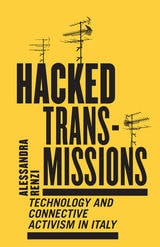
Hacked Transmissions
Technology and Connective Activism in ItalyAlessandra Renzi
University of Minnesota Press, 2020
Mapping the transformation of media activism from the seventies to the present day
Hacked Transmissions is a pioneering exploration of how social movements change across cycles of struggle and alongside technology. Weaving a rich fabric of local and international social movements and media practices, politicized hacking, and independent cultural production, it takes as its entry point a multiyear ethnography of Telestreet, a network of pirate television channels in Italy that combined emerging technologies with the medium of television to challenge the media monopoly of tycoon-turned-prime minister Silvio Berlusconi.
Street televisions in Italy represented a unique experiment in combining old and new media to forge grassroots alliances, fight social isolation, and build more resilient communities. Alessandra Renzi digs for the roots of Telestreet in movements of the 1970s and the global activism of the 1990s to trace its transformations in the present work of one of the network’s more active nodes, insu^tv, in Naples. In so doing, she offers a comprehensive account of transnational media activism, with particular attention to the relations among groups and projects, their modes of social reproduction, the contexts giving rise to them, and the technology they adopt—from zines and radios to social media. Hacked Transmissions is also a study in method, providing examples of co-research between activist researchers and social movements, and a theoretical framework that captures the complexities of grassroots politics and the agency of technology.
Providing a rare and timely glimpse into a key activist/media project of the twenty-first century, Hacked Transmissions marks a vital contribution to debates in a range of fields, including media and communication studies, anthropology, science and technology studies, social movements studies, sociology, and cultural theory.
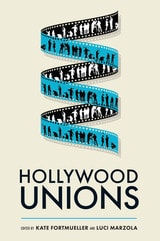
Hollywood Unions
Kate Fortmueller
Rutgers University Press, 2025
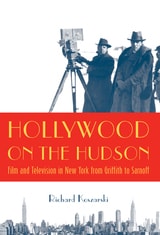
Hollywood on the Hudson
Film and Television in New York from Griffith to SarnoffKoszarski, Richard
Rutgers University Press, 2008
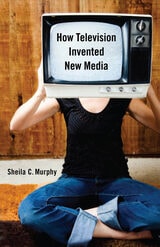
How Television Invented New Media
Murphy, Sheila C
Rutgers University Press, 2011
Now if I just remembered where I put that original TV play device--the universal remote control . . .
Television is a global industry, a medium of representation, an architectural component of space, and a nearly universal frame of reference for viewers. Yet it is also an abstraction and an often misunderstood science whose critical influence on the development, history, and diffusion of new media has been both minimized and overlooked. How Television Invented New Media adjusts the picture of television culturally while providing a corrective history of new media studies itself.
Personal computers, video game systems, even iPods and the Internet built upon and borrowed from television to become viable forms. The earliest personal computers, disguised as video games using TV sets as monitors, provided a case study for television's key role in the emergence of digital interactive devices. Sheila C. Murphy analyzes how specific technologies emerge and how representations, from South Park to Dr. Horrible's Sing-Along-Blog, mine the history of television just as they converge with new methods of the making and circulation of images. Past and failed attempts to link television to computers and the Web also indicate how services like Hulu or Netflix On-Demand can give rise to a new era for entertainment and program viewing online. In these concrete ways, television's role in new and emerging media is solidified and finally recognized.