Results by title
303 books match the query 'Time' and 9 start with h
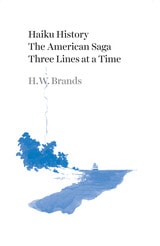
Haiku History
The American Saga Three Lines at a TimeBy H.W. Brands
University of Texas Press, 2020
For the past nine years, acclaimed historian H. W. Brands has been tweeting the history of the United States. But this has been no ordinary version of the American tale. Instead, Brands gives his 5,000-plus followers a regular dose of history and poetry combined: his tweets are in the form of haiku.
Haiku History presents a selection of these smart, shrewd, and always informative short poems. “Shivers and specters / Flit over souls in Salem / As nineteen are hanged; describes the Salem witch trials, and “In angry war paint / Men board three Indiamen / And toss the cargo” depicts the Boston Tea Party. “Then an anarchist / Makes one of the war heroes / The next president” recalls the assassination of William McKinley and the accession of Teddy Roosevelt to the presidency, while “Second invasion: / Iraq, where Saddam is still / In troubling control” returns us to the invasion of Iraq in 2003. As he travels from the thirteen colonies to the 2016 election, Brands brings to life the wars, economic crises, social upheavals, and other events that have shaped our nation. A history book like no other, Haiku History injects both fun and poetry into the story of America—three lines at a time.

High Mountains Rising
Appalachia in Time and PlaceEdited by Richard A. Straw and H. Tyler Blethen
University of Illinois Press, 2004
The first half of the fourteen essays deal with historical issues including Native Americans, pioneer settlement, slavery, the Civil War and Reconstruction, industrialization, the Great Depression, migration, and finally, modernization. The remaining essays take a more cultural focus, addressing stereotypes, music, folklife, language, literature, and religion.
Bringing together many of the most prestigious scholars in Appalachian studies, this volume has been designed for general and classroom use, and includes suggestions for further reading.
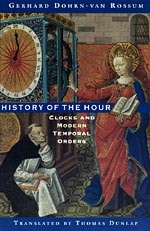
History of the Hour
Clocks and Modern Temporal OrdersGerhard Dohrn-van Rossum
University of Chicago Press, 1996
"In tracing the evolution of time consciousness with scholarship and skill . . . Dohrn-van Rossum evokes the many ways that the small moments of life have come to be reckoned with the passage of time."—Dava Sobel, Civilization
"Dohrn-van Rossum paints a highly nuanced picture of time's conquest of modern life."—Steven Lagerfeld, Wilson Quarterly
"This book is definitive in showing the clock's pervasive influence over European society."—Virginia Quarterly Review
"[A] delightful, excellently translated history."—Choice
"Dohrn-van Rossum has produced a persuasive and brilliantly documented new understanding of how modern time-consciousness arose."—Owen Gingerich, Nature
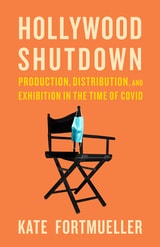
Hollywood Shutdown
Production, Distribution, and Exhibition in the Time of COVIDBy Kate Fortmueller
University of Texas Press, 2021
By March 2020, the spread of COVID-19 had reached pandemic proportions, forcing widespread shutdowns across industries, including Hollywood. Studios, networks and production companies, and the thousands of workers who make film and television possible, were forced to adjust their time-honored business and labor practices. In this book, Kate Fortmueller asks what happened when the coronavirus closed Hollywood.
Hollywood Shutdown examines how the COVID-19 pandemic affected film and television production, influenced trends in distribution, reshaped theatrical exhibition, and altered labor practices. From January movie theater closures in China to the bumpy September release of Mulan on the Disney+ streaming platform, Fortmueller probes various choices made by studios, networks, unions and guilds, distributors, and exhibitors during the evolving crisis. In seeking to explain what happened in the first nine months of 2020, this book also considers how the pandemic will transform Hollywood practices in the twenty-first century.
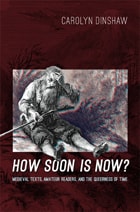
How Soon Is Now?
Medieval Texts, Amateur Readers, and the Queerness of TimeCarolyn Dinshaw
Duke University Press, 2012
Whether discussing Victorian men of letters who parodied the Book of John Mandeville, a fictionalized fourteenth-century travel narrative, or Hope Emily Allen, modern coeditor of the early-fifteenth-century Book of Margery Kempe, Dinshaw argues that these and other medievalists outside the academy inhabit different temporalities than modern professionals operating according to the clock. How Soon Is Now? clears space for amateurs, hobbyists, and dabblers who approach medieval worlds from positions of affect and attachment, from desires to build other kinds of worlds. Unruly, untimely, they urge us toward a disorderly and asynchronous collective.
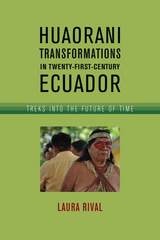
Huaorani Transformations in Twenty-First-Century Ecuador
Treks into the Future of TimeLaura Rival
University of Arizona Press, 2016
Rival’s intimate knowledge of Huaorani culture spans twenty-five years. Here in a collection of broad-ranging essays, she offers a fascinating and provocative study. The first section, “Among Forest Beings,” shows that the Huaorani have long adapted to life in the tropical rain forest with minimal reliance on horticulture, yet have developed a complex relationship with plants. In “In the Longhouse,” the second section, Rival focuses on the intimate relations that create human persons and enact kinship relations. She also discusses women’s lives and perspectives. The third section, “In the Midst of Enemies,” considers how Huaorani society fits in larger political and economic contexts, illustrating how native values shape their encounters with oil companies, the state, and other external forces. Rival carefully analyzes insider/outsider dialectics wherein Huaorani people re-create meaningful and valued worlds in the face of alien projects, such as petroleum development, carbon trading, or intercultural education.
Capitalizing on the author’s decades-long study and interactions in the community, Huaorani Transformations in Twenty-First-Century Ecuador brings new insights to the Huaorani’s unique way of relating to humans, to other-than-humans, and to the forest landscape they have inhabited for centuries.
Human Experience of Time
The Development of Its Philosophic MeaningCharles Sherover
Northwestern University Press, 2001
Humanities in the Time of AI
Laurent Dubreuil
University of Minnesota Press, 2025
Why AI offers a chance for the humanities to strengthen their relevance and significance
If humanistic research consists of the generation of consensus positions, simple expression, summarized texts, or passable translations, then we have arrived at the place where AI is able to accomplish these different missions to a convincing degree. However, Laurent Dubreuil argues, such tasks do not, in any way, constitute the humanities. On the contrary, he posits, a maximalist take on scholarship would not focus on generation but on creation, as a subject and as an object. Dubreuil seizes the opportunity of what AI reveals about the meaning of humanistic inquiry to offer a path for the renewal of the humanities on transhistorical, transcultural, and transdisciplinary grounds.
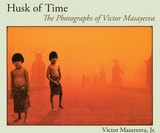
Husk of Time
The Photographs of Victor MasayesvaVictor Masayesva, Jr.; Introduction by Beverly R. Singer
University of Arizona Press, 2006