Results by title
62 books match the query 'Twain, Mark' and 3 start with h
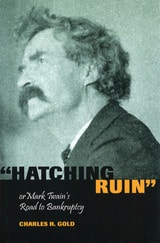
Hatching Ruin
Or Mark Twain's Road to BankruptcyCharles H. Gold
University of Missouri Press, 2003
In “Hatching Ruin,” Charles H. Gold provides a complete description of Samuel L. Clemens’s business relationships with Charles L. Webster and James W. Paige during the 1880s. Gold analyzes how these relationships affected Clemens as a person and an artist, most notably in A Connecticut Yankee in King Arthur’s Court.
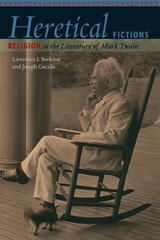
Heretical Fictions
Religion in the Literature of Mark TwainLAWRENCE I. BERKOVE
University of Iowa Press, 2010
Challenging the prevailing belief that Mark Twain’s position on religion hovered somewhere between skepticism and outright heresy, Lawrence Berkove and Joseph Csicsila marshal biographical details of Twain’s life alongside close readings of his work to explore the religious faith of America’s most beloved writer and humorist. They conclude not only that religion was an important factor in Twain’s life but also that the popular conception of Twain as agnostic, atheist, or apostate is simply wrong.
Heretical Fictions is the first full-length study to assess the importance of Twain’s heretical Calvinism as the foundation of his major works, bringing to light important thematic ties that connect the author’s early work to his high period and from there to his late work. Berkove and Csicsila set forth the main elements of Twain’s “countertheological” interpretation of Calvinism and analyze in detail the way it shapes five of his major books—Roughing It, The Adventures of Tom Sawyer, Adventures of Huckleberry Finn, A Connecticut Yankee in King Arthur's Court, and No. 44, The Mysterious Stranger—as well as some of his major short stories. The result is a ground-breaking and unconventional portrait of a seminal figure in American letters.

Huckleberry Finn as Idol and Target
The Functions of Criticism in Our TimeJonathan Arac
University of Wisconsin Press, 1997
If racially offensive epithets are banned on CNN air time and in the pages of USA Today, Jonathan Arac asks, shouldn’t a fair hearing be given to those who protest their use in an eighth-grade classroom? Placing Mark Twain’s comic masterpiece, Huckleberry Finn, in the context of long-standing American debates about race and culture, Jonathan Arac has written a work of scholarship in the service of citizenship.
Huckleberry Finn, Arac points out, is America’s most beloved book, assigned in schools more than any other work because it is considered both the “quintessential American novel” and “an important weapon against racism.” But when some parents, students, and teachers have condemned the book’s repeated use of the word “nigger,” their protests have been vehemently and often snidely countered by cultural authorities, whether in the universities or in the New York Times and the Washington Post. The paradoxical result, Arac contends, is to reinforce racist structures in our society and to make a sacred text of an important book that deserves thoughtful reading and criticism. Arac does not want to ban Huckleberry Finn, but to provide a context for fairer, fuller, and better-informed debates.
Arac shows how, as the Cold War began and the Civil Rights movement took hold, the American critics Lionel Trilling, Henry Nash Smith, and Leo Marx transformed the public image of Twain’s novel from a popular “boy’s book” to a central document of American culture. Huck’s feelings of brotherhood with the slave Jim, it was implied, represented all that was right and good in American culture and democracy. Drawing on writings by novelists, literary scholars, journalists, and historians, Arac revisits the era of the novel’s setting in the 1840s, the period in the 1880s when Twain wrote and published the book, and the post–World War II era, to refute many deeply entrenched assumptions about Huckleberry Finn and its place in cultural history, both nationally and globally. Encompassing discussion of Harriet Beecher Stowe, Frederick Douglass, Ralph Ellison, Archie Bunker, James Baldwin, Shelley Fisher Fishkin, and Mark Fuhrman, Arac’s book is trenchant, lucid, and timely.