57 books match the query 'Victorian Era (1837-1901)' and 4 start with h

cover of Health and Efficiency: Fatigue, the Science of Work, and the Making of the Working-Class Body

Health and Efficiency

Fatigue, the Science of Work, and the Making of the Working-Class Body

Steffan Blayney

University of Massachusetts Press, 2022

A new model of health emerged in Britain between 1870 and 1939. Centered on the working body, organized around the concept of efficiency, and grounded in scientific understandings of human labor, scientists, politicians, and capitalists of the era believed that national economic productivity could be maximized by transforming the body of the worker into a machine. At the core of this approach was the conviction that worker productivity was intimately connected to worker health.

Under this new “science of work,” fatigue was seen as the ultimate pathology of the working-class body, reducing workers’ capacity to perform continued physical or mental labor. As Steffan Blayney shows, the equation between health and efficiency did not go unchallenged. While biomedical and psychological experts sought to render the body measurable, governable, and intelligible, ordinary men and women found ways to resist the logics of productivity and efficiency imposed on them, and to articulate alternative perspectives on work, health, and the body.
[more]
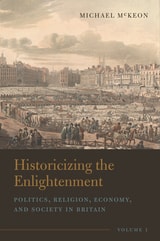
cover of Historicizing the Enlightenment, Volume 1: Politics, Religion, Economy, and Society in Britain

Historicizing the Enlightenment, Volume 1

Politics, Religion, Economy, and Society in Britain

Michael McKeon

Bucknell University Press, 2023

The Enlightenment has been blamed for some of the most deadly developments of modern life: racism and white supremacy, imperialist oppression, capitalist exploitation, neoliberal economics, scientific positivism, totalitarian rule. These developments are thought to have grown from principles that are rooted in the soil of the Enlightenment: abstraction, reduction, objectification, quantification, division, universalization. Michael McKeon’s new book corrects this defective view by historicizing the Enlightenment--by showing that the Enlightenment has been abstracted from its history. From its past: critics have ignored that Enlightenment thought is a reaction against deadly traditions that precede it. From its present: the Enlightenment extended its reactive analysis of the past to its own present through self-analysis and self-criticism. From its future: much of what’s been blamed amounts to the failure of its posterity to sustain Enlightenment principles. To historicize the Enlightenment requires that we conjure what it was like to live through the emergence of concepts and practices that are now commonplace—society, privacy, the public, the market, experiment, secularity, representative democracy, human rights, social class, sex and gender, fiction, the aesthetic attitude. McKeon’s book argues the continuity of Enlightenment thought, its consistency and integrity across this broad range of conceptual domains. It also shows how the Enlightenment has shaped our views of both tradition and modernity, and the revisionary work that needs to be done in order to understand our place in the future. In the process, Historicizing the Enlightenment exemplifies a distinctive historiography and historical method.
 
Published by Bucknell University Press. Distributed worldwide by Rutgers University Press.
[more]
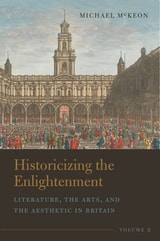
cover of Historicizing the Enlightenment, Volume 2: Literature, the Arts, and the Aesthetic in Britain

Historicizing the Enlightenment, Volume 2

Literature, the Arts, and the Aesthetic in Britain

Michael McKeon

Bucknell University Press, 2023

Enlightenment critics from Dryden through Johnson and Wordsworth conceived the modern view that art and especially literature entails a double reflection: a reflection of the world, and a reflection on the process by which that reflection is accomplished. Instead “neoclassicism” and “Augustanism” have been falsely construed as involving a one-dimensional imitation of classical texts and an unselfconscious representation of the world. In fact these Enlightenment movements adopted an oblique perspective that registers the distance between past tradition and its present reenactment, between representation and presence. Two modern movements, Romanticism and modernism, have  appropriated as their own these innovations, which derive from Enlightenment thought. Both of these movements ground their error in a misreading of “imitation” as understood by Aristotle and his Enlightenment proponents. Rightly understood, neoclassical imitation, constitutively aware of the difference between what it knows and how it knows it, is an experimental inquiry that generates a range of prefixes—“counter-,” “mock-,” “anti-,” “neo-”—that mark formal degrees of its epistemological detachment. Romantic ideology has denied the role of the imagination in Enlightenment imitation, imposing on the eighteenth century a dichotomous periodization: duplication versus imagination, the mirror versus the lamp. Structuralist ideology has dichotomized narration and description, form and content, structure and history. Poststructuralist ideology has propounded for the novel a contradictory “novel tradition”—realism, modernism, postmodernism, postcolonialism—whose stages both constitute a sequence and collapse it, each stage claiming the innovation of the stage that precedes it.  

 
Published by Bucknell University Press. Distributed worldwide by Rutgers University Press.
[more]
cover of How the West Came to Rule: The Geopolitical Origins of Capitalism

How the West Came to Rule

The Geopolitical Origins of Capitalism

Alex Anievas and Kerem Nisancioglu

Pluto Press, 2015

***Winner, International Studies Association International Political Sociology Best Book Prize 2017***
***Winner, British International Studies Association International Political Economy Working Group Book Prize 2016***

 
Mainstream historical accounts of the development of capitalism describe a profess which is fundamentally European—a system that was born in the mills and factories of English and under the guillotines of the French Revolution. This groundbreaking book tells a very difference story.
 
How the West Came to Rule offers a unique interdisciplinary and international historical account of the origins of capitalism. It argues that, contrary to dominant wisdom, capitalism’s origins should not be understood as a development confined to the geographically and culturally sealed borders of Europe, but the outcome of a wider array of global processes in which non-European societies played a decisive role.
 
Here is a provocative, incisive explanation of how capitalism emerged in England and Europe through a dialectical intersocietal and geopolitical process. The authors’ aim to undermine a Eurocentric bias that has been prominent in the debate about capitalisms rise to supremacy, and their case is remarkably convincing. They provide a fundamental rethinking. Anievas and Nisancioglu contend that often cited assumptions are neither theoretically nor empirically tenable and deny the agency of non-Western societies to the emergence of capitalism. Topics covered include:
 
*The Problem of Eurocentrism
*The Problem of Historical Specificity
*The Brenner Thesis: Explanation and Critique
*The Geopolitical in the Making of Capitalism
*The Political Marxist Conception of Capitalism
*Rethinking the Origins of Capitalism
*And much more!
 
Through an outline of the uneven histories of Mongolian expansion, New World discoveries, Ottoman-Habsburg rivalry, the development of the colonies, and bourgeois revolutions, Alex Anievas and Kerem Nisancioglu offer an account of capitalism’s origins that convincingly argues against the prevailing Eurocentric narratives. It will change minds and open the eyes of historians, economists, and political thinkers.
[more]