Results by title
349 books match the query 'Violence' and 5 start with h
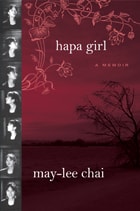
Hapa Girl
A MemoirMay-lee Chai
Temple University Press, 2008
In the mid-1960s, Winberg Chai, a young academic and the son of Chinese immigrants, married an Irish-American artist. In Hapa Girl ("hapa" is Hawaiian for "mixed") their daughter tells the story of this loving family as they moved from Southern California to New York to a South Dakota farm by the 1980s. In their new Midwestern home, the family finds itself the object of unwelcome attention, which swiftly escalates to violence. The Chais are suddenly socially isolated and barely able to cope with the tension that arises from daily incidents of racial animosity, including random acts of cruelty.
May-lee Chai's memoir ends in China, where she arrives just in time to witness a riot and demonstrations. Here she realizes that the rural Americans' "fears of change, of economic uncertainty, of racial anxiety, of the unknowable future compared to the known past were the same as China's. And I realized finally that it had not been my fault."
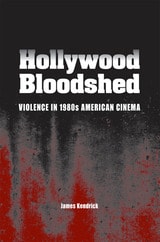
Hollywood Bloodshed
Violence in 1980s American CinemaJames Kendrick
Southern Illinois University Press, 2009
In Hollywood Bloodshed, James Kendrick presents a fascinating look into the political and ideological instabilities of the 1980s as studied through the lens of cinema violence.
Kendrick uses in-depth case studies to reveal how dramatic changes in the film industry and its treatment of cinematic bloodshed during the Reagan era reflected shifting social tides as Hollywood struggled to find a balance between the lucrative necessity of screen violence and the rising surge of conservatism.
As public opinion shifted toward the right and increasing emphasis was placed on issues such as higher military spending, family values, and “money culture,” film executives were faced with an epic dilemma: the violent aspects of cinema that had been the studios’ bread and butter were now almost universally rejected by mainstream audiences. Far from eliminating screen bloodshed altogether, studios found new ways of packaging violence that would allow them to continue to attract audiences without risking public outcry, ushering in a period of major transition in the film industry. Studios began to shy away from the revolutionary directors of the 1970s—many of whom had risen to fame through ideologically challenging films characterized by a more disturbing brand of violence—while simultaneously clearing the way for a new era in film. The 1980s would see the ascent of entertainment conglomerates and powerful producers and the meteoric rise of the blockbuster—a film with no less violence than its earlier counterparts, but with action-oriented thrills rather than more troubling images of brutality.
Kendrick analyzes these and other radical cinematic changes born of the conservative social climate of the 1980s, including the disavowal of horror films in the effort to present a more acceptable public image; the creation of the PG-13 rating to designate the gray area of movie violence between PG and R ratings; and the complexity of marketing the violence of war movies for audience pleasure. The result is a riveting study of an often overlooked, yet nevertheless fascinating time in cinema history. While many volumes have focused on the violent films of the New American Cinema directors of the 1970s or the rise of icons such as Woo, Tarantino, and Rodriguez in the 1990s, Kendrick’s Hollywood Bloodshed bridges a major gap in film studies.This comprehensive volume offers much-needed perspective on a decade that altered the history of Hollywood—and American culture—forever.
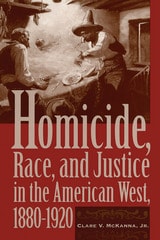
Homicide, Race, and Justice in the American West, 1880-1920
Clare V. McKanna
University of Arizona Press, 1997
This scenario dramatically brings home to the viewer what historians have long debated and hundreds of other films and books suggest: the turn-of-the-century West was a violent time and place. Ranchers, miners, deputy sheriffs, teenagers and old men, occasionally even housewives and mothers found themselves at the business end of a shotgun or a .38 revolver. Yet, since western historians tend to portray violence as essentially episodic--frontier gunfights, range wars, vigilante movements, and the like--solid data has been hard to come by.
As a beginning point for actually measuring lethal violence and assessing the administration of justice, here at last is a detailed and well-documented study of homicide in the American West. Comparing data from representative areas--Douglas County, Nebraska; Las Animas County, Colorado; and Gila County, Arizona--this book reveals a level of violence far greater than many historians have believed, even surpassing eastern cities like New York and Boston.
Clashing cultures and transient populations, a boomtown mentality, easy availability of alcohol and firearms: these and many other factors come under scrutiny as catalysts in the violence that permeated the region. By comparing homicide data, including coroner's inquests, indictments, plea bargains, and sentences across both racial and regional lines, the book also offers persuasive evidence that criminal justice systems of the Old West were weighted heavily in favor of defendants who were white and against those who were African American, Native American, or Mexican.
Packed with information, this is a book for students and scholars of western history, social history, criminology, and justice studies. Western history buffs will be captivated by colorful anecdotes about the real West, where guns could and did blaze over anything from love trysts to vendettas to too much foam on the beer. From whatever perspective, all readers are sure to find here a well-constructed framework for understanding the West as it was and for interpreting the region as it moves into the future.
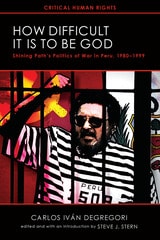
How Difficult It Is to Be God
Shining Path’s Politics of War in Peru, 1980–1999Carlos Iván Degregori; Edited and with an introduction by Steve J. Stern; Translated by Nancy Appelbaum, Joanna Drzewieniecki, Héctor Flores, Eric Hershberg, Judy Rein, Steve J. Stern, and Kimberly Theidon
University of Wisconsin Press, 2012
In How Difficult It Is to Be God, Carlos Iván Degregori—the world’s leading expert on Shining Path and the intellectual architect for Peru’s highly regarded Truth and Reconciliation Commission—elucidates the movement’s dynamics. An anthropologist who witnessed Shining Path’s recruitment of militants in the 1970s, Degregori grounds his findings in deep research and fieldwork. He explains not only the ideology and culture of revolution among the insurgents, but also their capacity to extend their influence to university youths, Indian communities, and competing social and political movements.
Making Degregori’s most important work available to English-language readers for the first time, this translation includes a new introduction by historian Steve J. Stern, who analyzes the author’s achievement, why it matters, and the debates it sparked. For anyone interested in Peru and Latin America’s age of “dirty war,” or in the comparative study of revolutions, Maoism, and human rights, this book will provide arresting new insights.
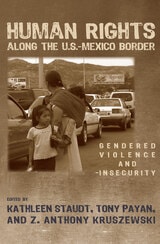
Human Rights along the U.S.–Mexico Border
Gendered Violence and InsecurityEdited by Kathleen Staudt, Tony Payan, and Z. Anthony Kruszewski
University of Arizona Press, 2009
From the Pacific to the Gulf of Mexico, scholars from both sides of the 2,000-mile border reflect expertise in disciplines ranging from international relations to criminal justice, conveying a more complex picture of the region than that presented in other studies.
Initial chapters offer an overview of routine sexual assaults on women migrants, the harassment of Central American immigrants at the hands of authorities and residents, corruption and counterfeiting along the border, and near-death experiences of border crossers. Subsequent chapters then connect analysis with solutions in the form of institutional change, social movement activism, policy reform, and the spread of international norms that respect human rights as well as good governance.
These chapters show how all facets of the border situation—globalization, NAFTA, economic inequality, organized crime, political corruption, rampant patriarchy—promote gendered violence and other expressions of hyper-masculinity. They also show that U.S. immigration policy exacerbates the problems of border violence—in marked contrast to the border policies of European countries.
By focusing on women’s everyday experiences in order to understand human security issues, these contributions offer broad-based alternative approaches and solutions that address everyday violence and inattention to public safety, inequalities, poverty, and human rights. And by presenting a social and democratic international feminist framework to address these issues, they offer the opportunity to transform today’s security debate in constructive ways.