246 books match the query 'Violence in Society' and 6 start with h
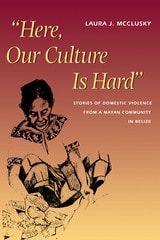
cover of Here, Our Culture Is Hard: Stories of  Domestic Violence from a Mayan Community in Belize

Here, Our Culture Is Hard

Stories of Domestic Violence from a Mayan Community in Belize

By Laura McClusky

University of Texas Press, 2001

Marriage among the Maya of Central America is a model of complementarity between a man and a woman. This union demands mutual respect and mutual service. Yet some husbands beat their wives.

In this pioneering book, Laura McClusky examines the lives of several Mopan Maya women in Belize. Using engaging ethnographic narratives and a highly accessible analysis of the lives that have unfolded before her, McClusky explores Mayan women's strategies for enduring, escaping, and avoiding abuse. Factors such as gender, age inequalities, marriage patterns, family structure, educational opportunities, and economic development all play a role in either preventing or contributing to domestic violence in the village. McClusky argues that using narrative ethnography, instead of cold statistics or dehumanized theoretical models, helps to keep the focus on people, "rehumanizing" our understanding of violence. This highly accessible book brings to the social sciences new ways of thinking about, representing, and studying abuse, marriage, death, gender roles, and violence.
[more]
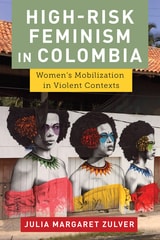
cover of High-Risk Feminism in Colombia: Women's Mobilization in Violent Contexts

High-Risk Feminism in Colombia

Women's Mobilization in Violent Contexts

Julia Margaret Zulver

Rutgers University Press, 2022

High-Risk Feminism in Colombia documents the experiences of grassroots women’s organizations that united to demand gender justice during and in the aftermath of Colombia’s armed conflict. In doing so, it illustrates a little-studied phenomenon: women whose experiences with violence catalyze them to mobilize and resist as feminists, even in the face of grave danger. Despite a well-established tradition of studying women in war, we tend to focus on their roles as mothers or carers, as peacemakers, or sometimes as revolutionaries. This book explains the gendered underpinnings of why women engage in feminist mobilization, even when this takes place in a ‘domain of losses’ that exposes them to high levels of risk. It follows four women’s organizations who break with traditional gender norms and defy armed groups’ social and territorial control, exposing them to retributive punishment. It provides rich evidence to document how women are able to surmount the barriers to mobilization when they frame their actions in terms of resistance, rather than fear.

 
[more]
cover of Home Safe Home: Housing Solutions for Survivors of Intimate Partner Violence

Home Safe Home

Housing Solutions for Survivors of Intimate Partner Violence

Botein, Hilary

Rutgers University Press, 2016

Housing matters for everyone, as it provides shelter, security, privacy, and stability. For survivors of intimate partner violence (IPV), housing takes on an additional meaning; it is the key to establishing a new life, free from abuse. IPV survivors often face such inadequate housing options, however, that they must make excruciating choices between cycling through temporary shelters, becoming homeless, or returning to their abusers. 
 
Home Safe Home offers a multifaceted analysis that accounts for both IPV survivors’ needs and the practical challenges involved in providing them with adequate permanent housing. Incorporating the varied perspectives of the numerous housing providers, activists, policymakers, and researchers who have a stake in these issues, the book also lets IPV survivors have their say, expressing their views on what housing and services can best meet their short and long-term goals. Researchers Hilary Botein and Andrea Hetling not only examine the federal and state policies and funding programs determining housing for IPV survivors, but also provide detailed case studies that put a human face on these policy issues. 
 
As it traces how housing options and support mechanisms for IPV survivors have evolved over time, Home Safe Home also offers innovative suggestions for how policymakers and advocates might work together to better meet the needs of this vulnerable population. 
 
[more]
cover of Hoodlum Movies: Seriality and the Outlaw Biker Film Cycle, 1966-1972

Hoodlum Movies

Seriality and the Outlaw Biker Film Cycle, 1966-1972

Stanfield, Peter

Rutgers University Press, 2018
From The Wild Angels in 1966 until its conclusion in 1972, the cycle of outlaw motorcycle films contained forty-odd formulaic examples. All but one were made by independent companies that specialized in producing exploitation movies for drive-ins, neighborhood theaters, and rundown inner city theaters. Despised by critics, but welcomed by exhibitors denied first-run films, these cheaply and quickly produced movies were made to appeal to audiences of mobile youths. The films are repetitive, formulaic, and eminently forgettable, but there is a story to tell about all of the above, and it is one worth hearing. Hoodlum Movies is not only about the films, its focus is on why and how these films were made, who they were made for, and how the cycle developed through the second half of the 1960s and came to a shuddering halt in 1972.   
[more]
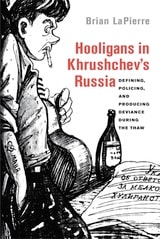
cover of Hooligans in Khrushchev's Russia: Defining, Policing, and Producing Deviance during the Thaw

Hooligans in Khrushchev's Russia

Defining, Policing, and Producing Deviance during the Thaw

Brian LaPierre

University of Wisconsin Press, 2012

Swearing, drunkenness, promiscuity, playing loud music, brawling—in the Soviet Union these were not merely bad behavior, they were all forms of the crime of "hooliganism." Defined as "rudely violating public order and expressing clear disrespect for society," hooliganism was one of the most common and confusing crimes in the world's first socialist state. Under its shifting, ambiguous, and elastic terms, millions of Soviet citizens were arrested and incarcerated for periods ranging from three days to five years and for everything from swearing at a wife to stabbing a complete stranger.

Hooligans in Khrushchev's Russia offers the first comprehensive study of how Soviet police, prosecutors, judges, and ordinary citizens during the Khrushchev era (1953–64) understood, fought against, or embraced this catch-all category of criminality. Using a wide range of newly opened archival sources, it portrays the Khrushchev period—usually considered as a time of liberalizing reform and reduced repression—as an era of renewed harassment against a wide range of state-defined undesirables and as a time when policing and persecution were expanded to encompass the mundane aspects of everyday life. In an atmosphere of Cold War competition, foreign cultural penetration, and transatlantic anxiety over "rebels without a cause," hooliganism emerged as a vital tool that post-Stalinist elites used to civilize their uncultured working class, confirm their embattled cultural ideals, and create the right-thinking and right-acting socialist society of their dreams.

[more]
cover of Human Matter: A Fiction

Human Matter

A Fiction

By Rodrigo Rey Rosa; translated by Eduardo Aparicio

University of Texas Press, 2019

More than a decade ago, novelist Rodrigo Rey Rosa made his first visit to the Historical Archive of the Guatemala National Police, where millions of previously hidden records were being cataloged, scanned, and eventually published online. Bringing to light detailed evidence of crimes against humanity, the Archive Recovery Project inspired Rey Rosa to craft a meta-novel that weaves the language of arrest records and surveillance reports with the contemporary journal entries of a novelist (named Rodrigo) who is attempting to synthesize the stories of political activists, indigenous people, and other women and men who became ensnared in a deadly web of state-sponsored terrorism.

When Rodrigo's access to the archive is suspended, he proceeds to the General Archives of Central America and the Library of Congress, also collaborating with the son of the Identification Bureau's former head in a relentless pursuit of understanding. Reminiscent of Roberto Bolaño's finely honed masterworks, Human Matter is both a tour de force of fiction and a sobering meditation on the realities of collective memory, raising timely questions about how our history is recorded and retold.

Originally published in Spanish in 2009, its success demanded a subsequent publication in June of 2017.

[more]