Results by title
81 books match the query 'Volume 3' and 2 start with h
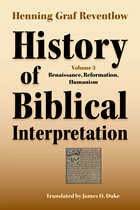
History of Biblical Interpretation, Volume 3
Rennaissance, Reformation, HumanismHenning Graf Reventlow
SBL Press, 2009
Volume 3 of History of Biblical Interpretation deals with an era—Renaissance, Reformation, and humanism—characterized by major changes, such as the rediscovery of the writings of antiquity and the newly invented art of printing. These developments created the context for one of the most important periods in the history of biblical interpretation, one that combined both philological insights made possible by the now-accessible ancient texts with new theological impulses and movements. As representative of this period, this volume examines the lives and teaching of Johann Reuchlin, Erasmus, Martin Luther, Philipp Melanchthon, John Calvin, Thomas Müntzer, Hugo Grotius, and a host of other influential exegetes.
[more]

History of Religious Ideas, Volume 3
From Muhammad to the Age of ReformsMircea Eliade
University of Chicago Press, 1985
This volume completes the immensely learned three-volume A History of Religious Ideas. Eliade examines the movement of Jewish thought out of ancient Eurasia, the Christian transformation of the Mediterranean area and Europe, and the rise and diffusion of Islam from approximately the sixth through the seventeenth centuries. Eliade's vast knowledge of past and present scholarship provides a synthesis that is unparalleled. In addition to reviewing recent interpretations of the individual traditions, he explores the interactions of the three religions and shows their continuing mutual influence to be subtle but unmistakable.
As in his previous work, Eliade pays particular attention to heresies, folk beliefs, and cults of secret wisdom, such as alchemy and sorcery, and continues the discussion, begun in earlier volumes, of pre-Christian shamanistic practices in northern Europe and the syncretistic tradition of Tibetan Buddhism. These subcultures, he maintains, are as important as the better-known orthodoxies to a full understanding of Judaism, Christianity, and Islam.
As in his previous work, Eliade pays particular attention to heresies, folk beliefs, and cults of secret wisdom, such as alchemy and sorcery, and continues the discussion, begun in earlier volumes, of pre-Christian shamanistic practices in northern Europe and the syncretistic tradition of Tibetan Buddhism. These subcultures, he maintains, are as important as the better-known orthodoxies to a full understanding of Judaism, Christianity, and Islam.
[more]