Results by title
54 books match the query 'Washington (D.C.)' and 2 start with h
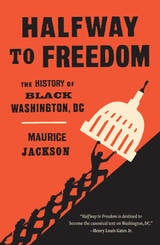
Halfway to Freedom
The History of Black Washington, DCMaurice Jackson. Foreword by Lonnie G. Bunch III.
Duke University Press, 2026
For more than two hundred years, the history and culture of the District of Columbia have been in great part shaped by its Black residents. Several Black men were elected to political positions citywide only a handful of years after the end of the Civil War, and while the years after Reconstruction saw the region plagued with segregation and racial violence, the capital’s Black population continued to grow at all economic levels. Washington became the first major US city with a majority Black population in 1957, a status it held for almost seventy years as gentrification has led to the decline of Black political and economic power in DC in the twenty-first century.
Halfway to Freedom is a social, political, intellectual, and cultural history of African Americans in Washington, DC; it explores the role that race, gender, color, class, and power have played in the city and its relationship with the federal government. Maurice Jackson explores the material conditions that shaped life for African Americans, free and enslaved, from the earliest moments of the District’s history to more contemporary times of organization and activism. Through an array of archival materials, especially firsthand accounts of Black residents in the area, Jackson critiques how and why DC exists as a haven within the Black American imaginary given the realities of conflict its Black residents have faced and continue to face today. In doing so, he highlights and honors the gains they have earned through the concerted struggles of labor organizations, women’s movements, sports, music, art, legal activism, and more.
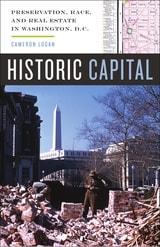
Historic Capital
Preservation, Race, and Real Estate in Washington, D.C.Cameron Logan
University of Minnesota Press, 2017
Washington, D.C. has long been known as a frustrating and sometimes confusing city for its residents to call home. The monumental core of federal office buildings, museums, and the National Mall dominates the city’s surrounding neighborhoods and urban fabric. For much of the postwar era, Washingtonians battled to make the city their own, fighting the federal government over the basic question of home rule, the right of the city’s residents to govern their local affairs.
In Historic Capital, urban historian Cameron Logan examines how the historic preservation movement played an integral role in Washingtonians’ claiming the city as their own. Going back to the earliest days of the local historic preservation movement in the 1920s, Logan shows how Washington, D.C.’s historic buildings and neighborhoods have been a site of contestation between local interests and the expansion of the federal government’s footprint. He carefully analyzes the long history of fights over the right to name and define historic districts in Georgetown, Dupont Circle, and Capitol Hill and documents a series of high-profile conflicts surrounding the fate of Lafayette Square, Rhodes Tavern, and Capitol Park, SW before discussing D.C. today.
Diving deep into the racial fault lines of D.C., Historic Capital also explores how the historic preservation movement affected poor and African American residents in Anacostia and the U Street and Shaw neighborhoods and changed the social and cultural fabric of the nation’s capital. Broadening his inquiry to the United States as a whole, Logan ultimately makes the provocative and compelling case that historic preservation has had as great an impact on the physical fabric of U.S. cities as any other private or public sector initiative in the twentieth century.