Results by title
52 books match the query 'Women, Black' and 3 start with h
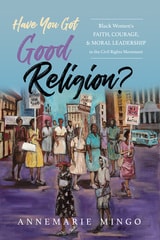
Have You Got Good Religion?
Black Women's Faith, Courage, and Moral Leadership in the Civil Rights MovementAnneMarie Mingo
University of Illinois Press, 2024
A depiction of moral imagination that resonates today, Have You Got Good Religion? reveals how Black Churchwomen’s understanding of God became action and transformed a nation.

Hiding in Plain Sight
Black Women, the Law, and the Making of a White Argentine RepublicErika Denise Edwards
University of Alabama Press, 2020
WINNER OF THE ASSOCIATION OF BLACK WOMEN HISTORIANS 2020 LETITIA WOODS-BROWN AWARD FOR THE BEST BOOK IN AFRICAN AMERICAN WOMEN'S HISTORY
WINNER OF THE WESTERN ASSOCIATION OF WOMEN HISTORIAN'S BARBARA “PENNY” KANNER AWARD
2021 FINALIST FOR THE HARRIET TUBMAN BOOK PRIZE
2020 FINALIST BERSHIRE CONFERENCE OF WOMEN HISTORIANS BOOK PRIZE
Uncovering the Afro-Argentine women behind the myth of a white nation.
Argentina promotes itself as a country of European immigrants. This makes it an exception to other Latin American countries, which embrace a more mixed—African, Indian, European—heritage. Hiding in Plain Sight: Black Women, the Law, and the Making of a White Argentine Republic traces the origins of what some white Argentines mischaracterize as a “black disappearance” by delving into the intimate lives of black women and explaining how they contributed to the making of a “white” Argentina. Erika Denise Edwards has produced the first comprehensive study in English of the history of African descendants outside of Buenos Aires in the late colonial and early republican periods, with a focus on how these women sought whiteness to better their lives and that of their children.
Edwards argues that attempts by black women to escape the stigma of blackness by recategorizing themselves and their descendants as white began as early as the late eighteenth century, challenging scholars who assert that the black population drastically declined at the end of the nineteenth century because of the whitening or modernization process. She further contends that in Córdoba, Argentina, women of African descent (such as wives, mothers, daughters, and concubines) were instrumental in shaping their own racial reclassifications and destinies.
This volume makes use of a wealth of sources to relate these women’s choices. The sources consulted include city censuses and notarial and probate records that deal with free and enslaved African descendants; criminal, ecclesiastical, and civil court cases; marriages and baptisms records and newsletters. These varied sources provide information about the day-to-day activities of cordobés society and how women of African descent lived, formed relationships, thrived, and partook in the transformation of racial identities in Argentina.
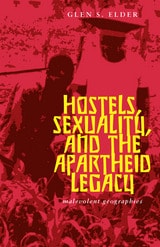
Hostels, Sexuality, and the Apartheid Legacy
Malevolent GeographiesGlen S. Elder
Ohio University Press, 2003
In the last decade, the South African state has been transformed dramatically, but the stubborn, menacing geography of apartheid still stands in the way of that country’s visions of change. Environmentally degraded old homelands still scar the rural geography of South Africa.
Formerly segregated, now gated, neighborhoods still inhibit free movement. Hostels, Sexuality, and the Apartheid Legacy is a study of another such space, the converted “male” migrant worker hostel.
Professor Glen Elder identifies hostels as sites of public and domestic violence, literal destruction and rebuilding, and as an important node in the spread of HIV/AIDS.
Hostels have also become home to increasing numbers of “invisible” female residents. Finding that one way to understand hostel space is through women’s experiences, Professor Elder turned to thirty black migrant women living in an East Rand hostel to map the everyday geographies of South Africa’s time of change.
By following the lives of these women, Elder identifies spatialized forms of marginalization, impoverishment, infection, and disempowerment. But, as he points out, the women’s survival strategies may provide signposts to the way out of apartheid’s malevolent geography.
Hostels, Sexuality, and the Apartheid Legacy argues that the gendered geography of the migrant labor system developed in South Africa was premised upon sexual assumptions about men, women, and their bodies, and that feminist and queer analyses of space can inform public policy decisions.