Results by title
80 books match the query 'Women in politics' and 4 start with h

Half-Life of a Zealot
Swanee Hunt
Duke University Press, 2006
Half-Life of a Zealot tells how the girl who spoke against “Reds” alongside her father became a fierce advocate for progressive change in America and abroad, an innovative philanthropist, and Bill Clinton’s Ambassador to Austria. In captivating prose, Hunt describes the warmth and wear of Southern Baptist culture, which instilled in her a calling to help those who are vulnerable. The reader is drawn into her full-throttle professional life as it competes with critical family needs.
Hunt gives a remarkably frank account of her triumphs and shortcomings; her sorrows, including a miscarriage and the failure of a marriage; the joys and struggles of her second marriage; and her angst over the life-threatening illness of one of her three children. She is candid about the opportunities her fortune has created, as well as the challenge of life as an heiress.
Much of Swanee Hunt’s professional life is devoted to expanding women’s roles in making and shaping public policy. She is the founding director of Harvard’s Women and Public Policy Program at the Kennedy School of Government, chair of the Initiative for Inclusive Security, and president of the Hunt Alternatives Fund.
Swanee Hunt’s autobiography brims over with strong women: her mother, whose religious faith and optimism were an inspiration; her daughter, who fights the social stigma of mental disorders; the women of war-torn Bosnia, who transformed their grief into action; and friends like Hillary Clinton, who used her position as First Lady to strengthen the voices of others.
Hunt is one more strong woman. Half-Life of a Zealot is her story—so far.
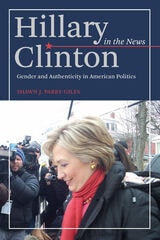
Hillary Clinton in the News
Gender and Authenticity in American PoliticsShawn J. Parry-Giles
University of Illinois Press, 2014
The charge of inauthenticity has trailed Hillary Clinton from the moment she entered the national spotlight and stood in front of television cameras. Hillary Clinton in the News: Gender and Authenticity in American Politics shows how the U.S. news media created their own news frames of Clinton's political authenticity and image-making, from her participation in Bill Clinton's 1992 presidential campaign through her own 2008 presidential bid.
Using theories of nationalism, feminism, and authenticity, Parry-Giles tracks the evolving ways the major networks and cable news programs framed Clinton's image as she assumed roles ranging from surrogate campaigner, legislative advocate, and financial investor to international emissary, scorned wife, and political candidate. This study magnifies how the coverage that preceded Clinton's entry into electoral politics was grounded in her earliest presence in the national spotlight, and in long-standing nationalistic beliefs about the boundaries of authentic womanhood and first lady comportment. Once Clinton dared to cross those gender boundaries and vie for office in her own right, the news exuded a rhetoric of sexual violence. These portrayals served as a warning to other women who dared to enter the political arena and violate the protocols of authentic womanhood.
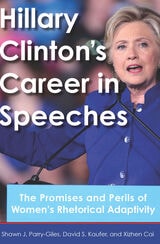
Hillary Clinton's Career in Speeches
The Promises and Perils of Women's Rhetorical AdaptivityShawn J. Parry-Giles
Michigan State University Press, 2023
How Women Win Presidential Elections in Latin America
Catherine Reyes-Housholder
Temple University Press, 2026
Between 1990 and 2020, women candidates won only 6% of the world’s presidential races. How Women Win Presidential Elections in Latin America explains the factors, strategies, and perceptions that help (or hinder) women to democratically access their country’s highest political office. Catherine Reyes-Housholder introduces a theory of gendered incentives and perceived potential to reveal why a political party would break with tradition and nominate a woman. She also shows how citizens respond when women candidates are running in incumbent parties or competing to displace those in power.
Drawing on comparative research on the presidency and gender, How Women Win Presidential Elections in Latin America examines the successful campaigns of Michelle Bachelet in Chile and Dilma Rousseff in Brazil, as well as why Blanca Ovelar lost her presidential race in Paraguay. Reyes-Housholder’s findings indicate that voter sexism is not a major factor; however, women do not triumph in these elections in the same ways that men do. Rather, the central unknown factor behind women’s victories is how they become candidates of major parties—and gender profoundly influences who parties nominate.
How Women Win Presidential Elections in Latin America is a valuable investigation of women and executive politics.