Results by title
295 books match the query 'Zoology' and 10 start with h
HUMANS AND OTHER ANIMALS
Edited by Arien Mack with a foreword by Marc Bekoff
The Ohio State University Press, 1999
Throughout history and in all places, animals have been an essential part of human culture. They have been hunted and domesticated, studied and mythologized, feared and loved. Our complicated relationships with other animals have repeatedly found expression in art, literature, religion, and science.
In 1995 the New School for Social Research sponsored a landmark conference to explore human/animal interactions. Published as a special issue of the journal Social Research (under the title In the Company of Animals), this collection is now available for the first time in a book edition.
In 1995 the New School for Social Research sponsored a landmark conference to explore human/animal interactions. Published as a special issue of the journal Social Research (under the title In the Company of Animals), this collection is now available for the first time in a book edition.
[more]
Headless Males Make Great Lovers
And Other Unusual Natural HistoriesMarty Crump
University of Chicago Press, 2005
The natural world is filled with diverse—not to mention quirky and odd—animal behaviors. Consider the male praying mantis that continues to mate after being beheaded; the spiders, insects, and birds that offer gifts of food in return for sex; the male hip-pocket frog that carries his own tadpoles; the baby spiders that dine on their mother; the beetle that craves excrement; or the starfish that sheds an arm or two to escape a predator's grasp.
Headless Males Make Great Lovers and Other Unusual Natural Histories celebrates the extraordinary world of animals with essays on curious creatures and their amazing behaviors. In five thematic chapters, Marty Crump—a tropical field biologist well known for her work with the reproductive behavior of amphibians—examines the bizarre conduct of animals as they mate, parent, feed, defend themselves, and communicate. Crump's enthusiasm for the unusual behaviors she describes-from sex change and free love in sponges to aphrodisiac concoctions in bats-is visible on every page, thanks to her skilled storytelling, which makes even sea slugs, dung beetles, ticks, and tapeworms fascinating and appealing. Steeped in biology, Headless Males Make Great Lovers points out that diverse and unrelated animals often share seemingly bizarre behaviors—evidence, Crump argues, that these natural histories, though outwardly weird, are successful ways of living.
Illustrated throughout, and filled with vignettes of personal and scientific interest, Headless Males Make Great Lovers will enchant the general reader with its tales of blood-squirting horned lizards and intestine-ejecting sea cucumbers—all in the service of a greater appreciation of the diversity of the natural histories of animals.
[more]
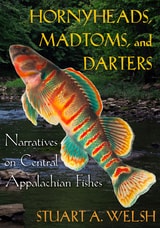
Hornyheads, Madtoms, and Darters
Narratives on Central Appalachian FishesStuart A. Welsh
Ohio University Press, 2023
A collection of essays on nature, naturalists, and the natural history of fishes in central Appalachia. A nature lover’s paradise, central Appalachia supports a diversity of life in an extensive network of waterways and is home to a dazzling array of fish species. This book focuses not only on the fishes of central Appalachia but also on the fascinating things these fishes do in their natural habitats. An ecological dance unfolds from a species and population perspective, although the influence of the community and the ecosystem also figures in the text. Stuart A. Welsh’s essays link central Appalachian fishes with the complexities of competition and predation, species conservation, parasitic infections, climate change, public attitudes, reproductive and foraging ecology, unique morphology, habitat use, and nonnative species. The book addresses a selection of the families of central Appalachian fishes, including lampreys, gars, freshwater eels, pikes, minnows, suckers, catfishes, trouts, trout-perches, sculpins, sunfishes, and perches. These essays often refer to the works of naturalists who contributed to our knowledge of nature during previous centuries and who recorded their discoveries when science writing was less concise than it is today. Although many of these works are nearly forgotten, these early naturalists built a strong knowledge base that supports much of our current science and thus merits reexamination. Most people are not scientists, but many have an interest in nature and are, in their own way, naturalists. This book is for those people willing to peer beneath the water’s surface.
[more]
How Animals Grieve
Barbara J. King
University of Chicago Press, 2013
From the time of our earliest childhood encounters with animals, we casually ascribe familiar emotions to them. But scientists have long cautioned against such anthropomorphizing, arguing that it limits our ability to truly comprehend the lives of other creatures. Recently, however, things have begun to shift in the other direction, and anthropologist Barbara J. King is at the forefront of that movement, arguing strenuously that we can—and should—attend to animal emotions. With How Animals Grieve, she draws our attention to the specific case of grief, and relates story after story—from fieldsites, farms, homes, and more—of animals mourning lost companions, mates, or friends.
King tells of elephants surrounding their matriarch as she weakens and dies, and, in the following days, attending to her corpse as if holding a vigil. A housecat loses her sister, from whom she's never before been parted, and spends weeks pacing the apartment, wailing plaintively. A baboon loses her daughter to a predator and sinks into grief. In each case, King uses her anthropological training to interpret and try to explain what we see—to help us understand this animal grief properly, as something neither the same as nor wholly different from the human experience of loss.
The resulting book is both daring and down-to-earth, strikingly ambitious even as it’s careful to acknowledge the limits of our understanding. Through the moving stories she chronicles and analyzes so beautifully, King brings us closer to the animals with whom we share a planet, and helps us see our own experiences, attachments, and emotions as part of a larger web of life, death, love, and loss.
[more]

How Dogs Work
Raymond Coppinger and Mark Feinstein
University of Chicago Press, 2015
How well do we really know dogs? People may enjoy thinking about them as “man’s best friend,” but what actually drives the things they do? What is going on in their fur-covered heads as they look at us with their big, expressive eyes? Raymond Coppinger and Mark Feinstein know something about these questions, and with How Dogs Work, they’re ready to share; this is their guide to understanding your dog and its behavior.
Approaching dogs as a biological species rather than just as pets, Coppinger and Feinstein accessibly synthesize decades of research and field experiments to explain the evolutionary foundations underlying dog behaviors. They examine the central importance of the shape of dogs: how their physical body (including the genes and the brain) affects behavior, how shape interacts with the environment as animals grow, and how all of this has developed over time. Shape, they tell us, is what makes a champion sled dog or a Border collie that can successfully herd sheep. Other chapters in How Dogs Work explore such mysteries as why dogs play; whether dogs have minds, and if so what kinds of things they might know; why dogs bark; how dogs feed and forage; and the influence of the early relationship between mother and pup. Going far beyond the cozy lap dog, Coppinger and Feinstein are equally fascinated by what we can learn from the adaptations of dogs, wolves, coyotes, jackals, dingoes, and even pumas in the wild, as well as the behavior of working animals like guarding and herding dogs.
We cherish dogs as family members and deeply value our lengthy companionship with them. But, isn’t it time we knew more about who Fido and Trixie really are? How Dogs Work will provide some keys to unlocking the origins of many of our dogs' most common, most puzzling, and most endearing behaviors.
[more]
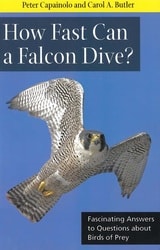
How Fast Can A Falcon Dive?
Fascinating Answers to Questions about Birds of PreyCapainolo, Peter
Rutgers University Press, 2010
How Fast Can a Falcon Dive? explores the world of raptors in a way that will appeal to bird lovers and biology enthusiasts alike. This colorful volume is complete with more than fifty-five color and black and white images from photographers and artists around the world. In a reader friendly question and answer format, ornithologist Peter Capainolo and science writer Carol A. Butler define and classify raptors, explore the physical attributes of birds of prey, view how their bodies work, and explain the social and physical behaviors of these species-how they communicate, hunt, reproduce, and more. Capainolo, who received one of the first falconry licenses issued in New York state at age eighteen, relates his personal experience in falconry to describe raptor training and husbandry where the human-bird interactions are complex.
From stories of red-tailed hawks making their homes on the ledges of Manhattan skyscrapers to their role in protecting California's vineyards from flocks of grape-loving starlings, How Fast Can a Falcon Dive? explores how these avian predators interact with people and with their environment.
From stories of red-tailed hawks making their homes on the ledges of Manhattan skyscrapers to their role in protecting California's vineyards from flocks of grape-loving starlings, How Fast Can a Falcon Dive? explores how these avian predators interact with people and with their environment.
[more]
How Monkeys See the World
Inside the Mind of Another SpeciesDorothy L. Cheney and Robert M. Seyfarth
University of Chicago Press, 1990
Cheney and Seyfarth enter the minds of vervet monkeys and other primates to explore the nature of primate intelligence and the evolution of cognition.
"This reviewer had to be restrained from stopping people in the street to urge them to read it: They would learn something of the way science is done, something about how monkeys see their world, and something about themselves, the mental models they inhabit."—Roger Lewin, Washington Post Book World
"A fascinating intellectual odyssey and a superb summary of where science stands."—Geoffrey Cowley, Newsweek
"A once-in-the-history-of-science enterprise."—Duane M. Rumbaugh, Quarterly Review of Biology
[more]
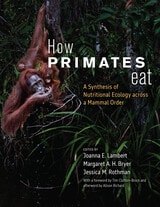
How Primates Eat
A Synthesis of Nutritional Ecology across a Mammal OrderEdited by Joanna E. Lambert, Margaret A. H. Bryer, and Jessica M. Rothman
University of Chicago Press, 2024
Exploring everything from nutrients to food acquisition and research methods, a comprehensive synthesis of the study of diet and feeding in nonhuman primates.
What do we mean when we say that a diet is nutritious? Why can some animals get all the energy they need from eating leaves while others would perish on such a diet? Why don’t mountain gorillas eat fruit all day as chimpanzees do? Answers to these questions about food and feeding are among the many tasty morsels that emerge from this authoritative book. Informed by the latest scientific tools and millions of hours of field and laboratory work on species across the primate order and around the globe, this volume is an exhaustive synthesis of our understanding of what, why, and how primates eat. State-of-the-art information presented at physiological, behavioral, ecological, and evolutionary scales will serve as a road map for graduate students, researchers, and practitioners as they work toward a holistic understanding of life as a primate and the urgent conservation consequences of diet and food availability in a changing world.
What do we mean when we say that a diet is nutritious? Why can some animals get all the energy they need from eating leaves while others would perish on such a diet? Why don’t mountain gorillas eat fruit all day as chimpanzees do? Answers to these questions about food and feeding are among the many tasty morsels that emerge from this authoritative book. Informed by the latest scientific tools and millions of hours of field and laboratory work on species across the primate order and around the globe, this volume is an exhaustive synthesis of our understanding of what, why, and how primates eat. State-of-the-art information presented at physiological, behavioral, ecological, and evolutionary scales will serve as a road map for graduate students, researchers, and practitioners as they work toward a holistic understanding of life as a primate and the urgent conservation consequences of diet and food availability in a changing world.
[more]
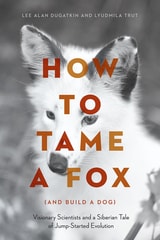
How to Tame a Fox (and Build a Dog)
Visionary Scientists and a Siberian Tale of Jump-Started EvolutionLee Alan Dugatkin and Lyudmila Trut
University of Chicago Press, 2017
Tucked away in Siberia, there are furry, four-legged creatures with wagging tails and floppy ears that are as docile and friendly as any lapdog. But, despite appearances, these are not dogs—they are foxes. They are the result of the most astonishing experiment in breeding ever undertaken—imagine speeding up thousands of years of evolution into a few decades. In 1959, biologists Dmitri Belyaev and Lyudmila Trut set out to do just that, by starting with a few dozen silver foxes from fox farms in the USSR and attempting to recreate the evolution of wolves into dogs in real time in order to witness the process of domestication. This is the extraordinary, untold story of this remarkable undertaking.
Most accounts of the natural evolution of wolves place it over a span of about 15,000 years, but within a decade, Belyaev and Trut’s fox breeding experiments had resulted in puppy-like foxes with floppy ears, piebald spots, and curly tails. Along with these physical changes came genetic and behavioral changes, as well. The foxes were bred using selection criteria for tameness, and with each generation, they became increasingly interested in human companionship. Trut has been there the whole time, and has been the lead scientist on this work since Belyaev’s death in 1985, and with Lee Dugatkin, biologist and science writer, she tells the story of the adventure, science, politics, and love behind it all. In How to Tame a Fox, Dugatkin and Trut take us inside this path-breaking experiment in the midst of the brutal winters of Siberia to reveal how scientific history is made and continues to be made today.
To date, fifty-six generations of foxes have been domesticated, and we continue to learn significant lessons from them about the genetic and behavioral evolution of domesticated animals. How to Tame a Fox offers an incredible tale of scientists at work, while also celebrating the deep attachments that have brought humans and animals together throughout time.
[more]
Hyman's Comparative Vertebrate Anatomy
Edited by Marvalee H. Wake
University of Chicago Press, 1992
The purpose of this book, now in its third edition, is to introduce the morphology of vertebrates in a context that emphasizes a comparison of structire and of the function of structural units. The comparative method involves the analysis of the history of structure in both developmental and evolutionary frameworks. The nature of adaptation is the key to this analysis. Adaptation of a species to its environment, as revealed by its structure, function, and reproductive success, is the product of mutation and natural selection–the process of evolution. The evolution of structure and function, then, is the theme of this book which presents, system by system, the evolution of structure and function of vertebrates. Each chapter presents the major evolutionary trends of an organ system, with instructions for laboratory exploration of these trends included so the student can integrate concept with example.
[more]