Results by title
1713 books match the query '21st century' and 56 start with h

Human Capital versus Basic Income
Ideology and Models for Anti-Poverty Programs in Latin AmericaFabián A. Borges
University of Michigan Press, 2022
There were two distinct models of CCTs: a “human capital” model based on means-tested targeting and strict enforcement of program conditions, exemplified by the program launched by Mexico’s right, and a more universalistic “basic income” model with more permissive enforcement of conditionality, exemplified by Brazil’s program under Lula. These two models then spread across the region. Whereas right and center governments, with assistance from international financial institutions, enacted CCTs based on the human capital model, the left, with assistance from Brazil, enacted CCTs based on the basic income model.
The existence of two distinct types of CCTs and their relation to ideology is supported by quantitative analyses covering the entire region and in-depth case studies based on field research in three countries. Left-wing governments operate CCTs that cover more people and spend more on those programs than their center or right-wing counterparts. Beyond coverage, a subsequent analysis of the 10 national programs adopted after Lula’s embrace of CCTs confirms that program design—evaluated in terms of scope of the target population, strictness of conditionality enforcement, and stipend structure—is shaped by government ideology. This finding is then fleshed out through case studies of the political processes that culminated in the adoption of basic income CCTs by left-wing governments in Argentina and Bolivia and a human capital CCT by a centrist president in Costa Rica.
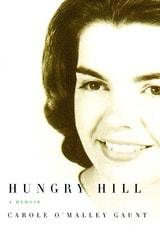
Hungry Hill
A MemoirCarole O'Malley Gaunt
University of Massachusetts Press, 2007
On a sweltering June night in 1959, Betty O'Malley died from lymphatic cancer, leaving behind an alcoholic husband and eight shell-shocked children—seven sons and one daughter, ranging in age from two to fifteen years. The daughter, Carole, was thirteen at the time. In this poignant memoir, she recalls in vivid detail the chaotic course of her family life over the next four years.
The setting for the story is Hungry Hill, an Irish-Catholic working-class neighborhood in Springfield, Massachusetts. The author recounts her sad and turbulent story with remarkable clarity, humor, and insight, punctuating the narrative with occasional fictional scenes that allow the adult Carole to comment on her teenage experiences and to probe the impact of her mother's death and her father's alcoholism.
Hungry Subjects
Mapping Appetites in the African Cultural LandscapeNjeri Githire
University of Michigan Press, 2026
Against the backdrop of media representations of Africa through persistent and pervasive images of emaciated, starving Africans and the critical need to marshall food aid in response, Hungry Subjects places Africa’s food anxiety within a broader historical context and expands ongoing food scholarship beyond its current confines in the social sciences. Njeri Githire weaves together coming-of-age texts across the African and African diasporic literary landscape in English, French, and Portuguese expression to ask how African writers incorporate food into their storylines to transmit cultural information, question norms, and propose alternatives. Eating is an intimately personal yet inherently social experience codified by public rituals and commerce, invariably linked to a larger tapestry of historical, cultural, economic, and political dynamics. Delving into the political dynamics of food as a tool of power and control alongside subversive potentialities, Hungry Subjects appraises the narrative and political thrust of (not-)eating and exposes the ways in which postcolonial manifestations of colonial-era power relations are symbolized in food’s many functions and meanings.
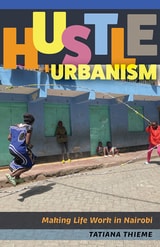
Hustle Urbanism
Making Life Work in NairobiTatiana Thieme
University of Minnesota Press, 2025
Exploring hustle as a social, cultural, and economic phenomenon in contemporary Nairobi
In Nairobi’s underserved neighborhoods, “hustle” has emerged as both a vital survival strategy and a way of life for youth. Exploring the multiple meanings and manifestations of the hustle economy across different scenarios of provisioning, distribution, exchange, learning, and mobilizing, Hustle Urbanism draws on more than a decade of ethnographic engagement to center the logics, perspectives, and inventive strategies of a group of youth who constantly navigate job scarcity, inadequate basic services, and climate-induced harms.
Tatiana Thieme shows how young people develop tools of resistance against the legacies of colonial violence and uneven urban development while carving out spaces of opportunity for themselves and their peers. The stories she includes bring thick ethnographic detail and longitudinal perspective to the lives and livelihoods of youth whose diverse skill sets and knowledges span from circular economies and eco-activism to hip hop and local leadership. Filling a significant gap in both existing scholarship and popular discussion, Hustle Urbanism offers critical theorization of precarious urban environments and the affirmative modes of making life work in the city against the odds.
While Thieme cautions against fetishizing hustle as a form of social and economic uplift, she calls for a greater recognition of the ingenuity and skill involved in hustle urbanism, arguing that studying hustle narratives and practices opens up timely empirical and theoretical questions about overlapping urban struggles and possibilities that coexist in the everyday city.
Retail e-book files for this title are screen-reader friendly with images accompanied by short alt text and/or extended descriptions.
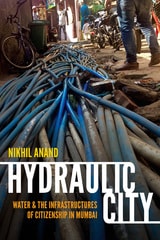
Hydraulic City
Water and the Infrastructures of Citizenship in MumbaiNikhil Anand
Duke University Press, 2017
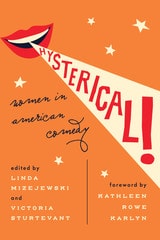
Hysterical!
Women in American ComedyEdited by Linda Mizejewski and Victoria Sturtevant; foreword by Kathleen Rowe Karlyn
University of Texas Press, 2017
Ideal for classroom use, this anthology of original essays by the leading authorities on women’s comedy surveys the disorderly, subversive, and unruly performances of women comics from silent film to contemporary multimedia
Winner, Susan Koppleman Award for Best Anthology, Multi-Authored, or Edited Book in Feminist Studies, Popular and American Culture Associations (PACA), 2017
Amy Schumer, Samantha Bee, Mindy Kaling, Melissa McCarthy, Tig Notaro, Leslie Jones, and a host of hilarious peers are killing it nightly on American stages and screens large and small, smashing the tired stereotype that women aren’t funny. But today’s funny women aren’t a new phenomenon—they have generations of hysterically funny foremothers. Fay Tincher’s daredevil stunts, Mae West’s linebacker walk, Lucille Ball’s manic slapstick, Carol Burnett’s athletic pratfalls, Ellen DeGeneres’s tomboy pranks, Whoopi Goldberg’s sly twinkle, and Tina Fey’s acerbic wit all paved the way for contemporary unruly women, whose comedy upends the norms and ideals of women’s bodies and behaviors.
Hysterical! Women in American Comedy delivers a lively survey of women comics from the stars of the silent cinema up through the multimedia presences of Tina Fey and Lena Dunham. This anthology of original essays includes contributions by the field’s leading authorities, introducing a new framework for women’s comedy that analyzes the implications of hysterical laughter and hysterically funny performances. Expanding on previous studies of comedians such as Mae West, Moms Mabley, and Margaret Cho, and offering the first scholarly work on comedy pioneers Mabel Normand, Fay Tincher, and Carol Burnett, the contributors explore such topics as racial/ethnic/sexual identity, celebrity, stardom, censorship, auteurism, cuteness, and postfeminism across multiple media. Situated within the main currents of gender and queer studies, as well as American studies and feminist media scholarship, Hysterical! masterfully demonstrates that hysteria—women acting out and acting up—is a provocative, empowering model for women’s comedy.