Results by title
3258 books match the query 'Art' and 80 start with h
Home Before the Raven Caws
Richard Feldman
Indiana Historical Society Press, 2012
Home Front
Daily Life in the Civil War NorthPeter John Brownlee, Sarah Burns, Diane Dillon, Daniel Greene, and Scott Manning Stevens
University of Chicago Press, 2013
Home Front: Daily Life in the Civil War North reveals this side of the war as it happened, comprehensively examining the visual culture of the Northern home front. Through contributions from leading scholars from across the humanities, we discover how the war influenced household economies and the cotton economy; how the absence of young men from the home changed daily life; how war relief work linked home fronts and battle fronts; why Indians on the frontier were pushed out of the riven nation’s consciousness during the war years; and how wartime landscape paintings illuminated the nation’s past, present, and future.
A companion volume to a collaborative exhibition organized by the Newberry Library and the Terra Foundation for American Art, Home Front is the first book to expose the visual culture of a world far removed from the horror of war yet intimately bound to it.
Homegrown
Austin Music Posters 1967 to 1982Edited by Alan Schaefer with essays by Joe Nick Patoski and Nels Jacobson
University of Texas Press, 2015
Before Austin became the “live music capital of the world” and attracted tens of thousands of music fans, it had a vibrant local music scene that spanned late sixties psychedelic and avant-garde rock to early eighties punk. Venues such as the Vulcan Gas Company and the Armadillo World Headquarters hosted both innovative local musicians and big-name touring acts. Poster artists not only advertised the performances—they visually defined the music and culture of Austin during this pivotal period. Their posters promoted an alternative lifestyle that permeated the city and reflected Austin’s transformation from a sleepy university town into a veritable oasis of underground artistic and cultural activity in the state of Texas.
This book presents a definitive survey of music poster art produced in Austin between 1967 and 1982. It vividly illustrates four distinct generations of posters—psychedelic art of the Vulcan Gas Company, early works from the Armadillo World Headquarters, an emerging variety of styles from the mid-1970s, and the radical visual aesthetic of punk—produced by such renowned artists as Gilbert Shelton, Jim Franklin, Kerry Awn, Micael Priest, Guy Juke, Ken Featherston, NOXX, and Danny Garrett. Setting the posters in context, Texas music and pop-culture authority Joe Nick Patoski details the history of music posters in Austin, and artist and poster art scholar Nels Jacobson explores the lives and techniques of the artists.
Homosexuality in Cold War America
Resistance and the Crisis of MasculinityRobert J. Corber
Duke University Press, 1997
By exploring the representation of gay men in film noir, Corber suggests that even as this Hollywood genre reinforced homophobic stereotypes, it legitimized the gay male "gaze." He emphasizes how film noir’s introduction of homosexual characters countered the national "project" to render gay men invisible, and marked a deep subversion of the Cold War mentality. Corber then considers the work of gay male writers Tennessee Williams, Gore Vidal, and James Baldwin, demonstrating how these authors declined to represent homosexuality as a discrete subculture and instead promoted a model of political solidarity rooted in the shared experience of oppression. Homosexuality in Cold War America reveals that the ideological critique of the dominant culture made by gay male authors of the 1950s laid the foundation for the gay liberation movement of the following decade.
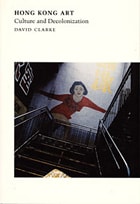
Hong Kong Art
Culture and DecolonizationDavid Clarke
Duke University Press, 2002
Clarke shows how a sense of local identity emerged in Hong Kong as the transition approached and found expression in the often politicized art produced. Given the recent international exposure of mainland Chinese contemporary art, this book considers the uniqueness of the art of China’s most cosmopolitan city. With a modern visual culture that was flourishing even when the People’s Republic was still closed to the outside world, Hong Kong has established itself as an exemplary site for both local and transnational elements to formulate into brilliant and groundbreaking art.
The author writes about individual artists and art works with a detail that will appeal to artists, curators, and art historians, as well as to postcolonial scholars, cultural studies scholars, and others.
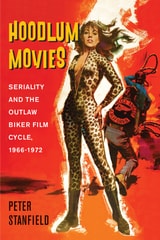
Hoodlum Movies
Seriality and the Outlaw Biker Film Cycle, 1966-1972Stanfield, Peter
Rutgers University Press, 2018
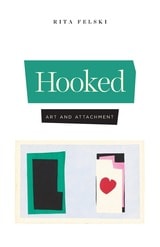
Hooked
Art and AttachmentRita Felski
University of Chicago Press, 2020
How does a novel entice or enlist us? How does a song surprise or seduce us? Why do we bristle when a friend belittles a book we love, or fall into a funk when a favored TV series comes to an end? What characterizes the aesthetic experiences of feeling captivated by works of art? In Hooked, Rita Felski challenges the ethos of critical aloofness that is a part of modern intellectuals’ self-image. The result is sure to be as widely read as Felski’s book, The Limits of Critique.
Wresting the language of affinity away from accusations of sticky sentiment and manipulative marketing, Felski argues that “being hooked” is as fundamental to the appreciation of high art as to the enjoyment of popular culture. Hooked zeroes in on three attachment devices that connect audiences to works of art: identification, attunement, and interpretation. Drawing on examples from literature, film, music, and painting—from Joni Mitchell to Matisse, from Thomas Bernhard to Thelma and Louise—Felski brings the language of attachment into the academy. Hooked returns us to the fundamentals of aesthetic experience, showing that the social meanings of artworks are generated not just by critics, but also by the responses of captivated audiences.
Hooked
Art and AttachmentRita Felski
University of Chicago Press, 2020
This is an auto-narrated audiobook edition of this book.
How does a novel entice or enlist us? How does a song surprise or seduce us? Why do we bristle when a friend belittles a book we love, or fall into a funk when a favored TV series comes to an end? What characterizes the aesthetic experiences of feeling captivated by works of art? In Hooked, Rita Felski challenges the ethos of critical aloofness that is a part of modern intellectuals’ self-image. The result is sure to be as widely read as Felski’s book, The Limits of Critique.
Wresting the language of affinity away from accusations of sticky sentiment and manipulative marketing, Felski argues that “being hooked” is as fundamental to the appreciation of high art as to the enjoyment of popular culture. Hooked zeroes in on three attachment devices that connect audiences to works of art: identification, attunement, and interpretation. Drawing on examples from literature, film, music, and painting—from Joni Mitchell to Matisse, from Thomas Bernhard to Thelma and Louise—Felski brings the language of attachment into the academy. Hooked returns us to the fundamentals of aesthetic experience, showing that the social meanings of artworks are generated not just by critics, but also by the responses of captivated audiences.
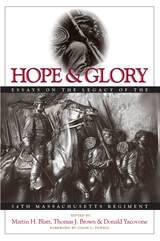
Hope and Glory
Essays on the Legacy of the 54th Massachusetts RegimentMartin H. Blatt
University of Massachusetts Press, 2009
The monument by Augustus Saint-Gaudens to Robert Gould Shaw and the 54th Massachusetts Regiment, located on Boston Common, stands at a symbolic crossroads of American history. A reminder of the nation's ongoing struggle over race, it captures the Civil War's higher purpose—the end of slavery—and memorializes those black soldiers and white officers who made common cause in the service of freedom. The monument and the saga of the 54 th Massachusetts remain powerful touchstones, inspiring enduring meditations such as Robert Lowell's poem “For the Union Dead” and the popular film Glory.
This volume brings together the best scholarship on the history of the 54th, the formation of collective memory and identity, and the ways Americans have responded to the story of the regiment and the Saint-Gaudens monument. Contributors use the historical record and popular remembrance of the 54th as a lens for examining race and community in the United States. The essays range in time from the mid-nineteenth century to the present and encompass history, literature, art, music, and popular culture.
In addition to the editors and Colin Powell, who writes about the memory and example of the 54th in his own career, contributors include Stephen Belyea, David W. Blight, Thomas Cripps, Kathryn Greenthal, James Oliver Horton, Edwin S. Redkey, Marilyn Richardson, Kirk Savage, James Smethurst, Cathy Stanton, Helen Vendler, Denise Von Glahn, and Joan Waugh.
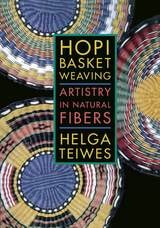
Hopi Basket Weaving
Artistry in Natural FibersHelga Teiwes
University of Arizona Press, 1996
Rising dramatically from the desert floor, Arizona's windswept mesas have been home to the Hopis for hundreds of years. A people known for protecting their privacy, these Native Americans also have a long and less known tradition of weaving baskets and plaques. Generations of Hopi weavers have passed down knowledge of techniques and materials from the plant world around them, from mother to daughter, granddaughter, or niece.
This book is filled with photographs and detailed descriptions of their beautiful baskets—the one art, above all others, that creates the strongest social bonds in Hopi life. In these pages, weavers open their lives to the outside world as a means of sharing an art form especially demanding of time and talent. The reader learns how plant materials are gathered in canyons and creek bottoms, close to home and far away. The long, painstaking process of preparation and dying is followed step by step. Then, using techniques of coiled, plaited, or wicker basketry, the weaving begins.
Underlying the stories of baskets and their weavers is a rare glimpse of what is called "the Hopi Way," a life philosophy that has strengthened and sustained the Hopi people through centuries of change. Many other glimpses of the Hopi world are also shared by author and photographer Helga Teiwes, who was warmly invited into the homes of her collaborators. Their permission and the permission of the Cultural Preservation Office of the Hopi Tribe gave her access to people and information seldom available to outsiders.
Teiwes was also granted access to some of the ceremonial observances where baskets are preeminent. Woven in brilliant reds, greens, and yellows as well as black and white, Hopi weavings, then, not only are an arresting art form but also are highly symbolic of what is most important in Hopi life. In the women's basket dance, for example, woven plaques commemorate and honor the Earth and the perpetuation of life. Other plaques play a role in the complicated web of Hopi social obligation and reciprocity.
Living in a landscape of almost surreal form and color, Hopi weavers are carrying on one of the oldest arts traditions in the world. Their stories in Hopi Basket Weaving will appeal to collectors, artists and craftspeople, and anyone with an interest in Native American studies, especially Native American arts. For the traveler or general reader, the book is an invitation to enter a little-known world and to learn more about an art form steeped in meaning and stunning in its beauty.
Horace Vernet and the Thresholds of Nineteenth-Century Visual Culture
Edited by Daniel Harkett and Katie Hornstein
Dartmouth College Press, 2017
Horn, or The Counterside of Media
Henning Schmidgen
Duke University Press, 2022
How Art Can Be Thought
A Handbook for ChangeAl-An deSouza
Duke University Press, 2018

How Color Became a Technology
The Making of Chromatic CapitalismLida Zeitlin-Wu
Duke University Press, 2027
How New York Stole the Idea of Modern Art
Serge Guilbaut
University of Chicago Press, 1985
How a Revolutionary Art Became Official Culture
Murals, Museums, and the Mexican StateMary K. Coffey
Duke University Press, 2012
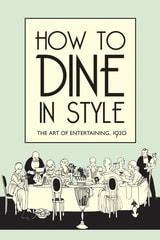
How to Dine in Style
The Art of Entertaining, 1920J. Rey
Bodleian Library Publishing, 2013
By turns a collection of practical advice and a catalog of eccentricities, The Whole Art of Dining, republished by the Bodleian Library as How to Dine in Style, contained everything the would-be socialite needed to know in order to elevate food to high art, from tricks for putting together a proper French menu or throwing a garden party to practical tips on serving wines in the correct order and at the right temperature. Throughout the book are stories of astonishing excess, such as the search for ever-more-elaborate themes and venues, and the more daring of the book’s devotees might have been tempted to emulate efforts like those of the intrepid hostess whose mountaineering-themed dinner party had guests rappel to the rooftop of her Chicago home or American millionaire George A. Kessler, whose infamous “Gondola Party” flooded— for the first and only time—the central courtyard of the Savoy.
A captivating glimpse into the golden age of fine dining, this book will be consumed with interest by discerning diners and fans of the Roaring Twenties—and it may even inspire readers to try their hand at throwing a stylish soiree of their own.
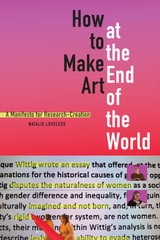
How to Make Art at the End of the World
A Manifesto for Research-CreationNatalie Loveless
Duke University Press, 2019

How to Protest
Lessons on Nonviolent ActionMegan Hershey, Illustrations by Matthew Cahill
University of Wisconsin Press, 2026
Many people around the world are frustrated with their governments yet do not know what actions to take. Protest may feel out of reach, like something only seasoned activists can do. This accessible guide explores the creativity, joy, and accessibility of peaceful protest. Megan Hershey introduces readers to twenty-five specific and inspiring nonviolent protest methods through real-life examples from the past fifty years. Each chapter includes a short, vivid description of a bold nonviolent action taken by everyday people who demanded that their leaders listen to them. From patriotic choir concerts in Estonia to live painted pigs at the Ugandan parliament, these unique protest strategies will inspire those looking to effect change and offer encouragement from past successes.
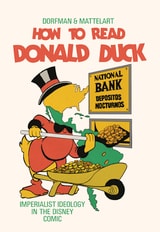
How to Read Donald Duck
Imperialist Ideology in the Disney ComicAriel Dorfman
Pluto Press, 2020
First published in 1971, How to Read Donald Duck shocked readers by revealing how capitalist ideology operates in our most beloved cartoons. Having survived bonfires, impounding and being dumped into the ocean by the Chilean army, this controversial book is once again back on our shelves.
Written and published during the blossoming of Salvador Allende's revolutionary socialism in Chile, the book examines how Disney products reflect capitalist ideology, and are active agents working in this ideology’s favor. Focusing on the hapless mice and ducks of Disney, curiously parentless, marginalized and always short of cash, Ariel Dorfman and Armand Mattelart expose how these characters established hegemonic ideas about capital, race, gender and the relationship between developed countries and the Third World.
A devastating indictment of a media giant, a document of twentieth-century political upheaval, and a reminder of the dark undercurrent of pop culture, How to Read Donald Duck is once again available, together with a new introduction by Ariel Dorfman in which he writes.
"It is that joy in liberation, that alegria, that spirit of resistance, that I wish to share with America, as the book that Pinochet’s soldiers could not liquidate or Disney’s lawyers stop from entering the United States finally finds its way to its new home, deep into the land that invented Donald Duck and Donald Trump. Is the same country that gave me such a warm welcome as a child, and perhaps may now equally greet with open arms this critique of oppression and it certainty that we don’t have to leave the world as it was when we first encountered it."
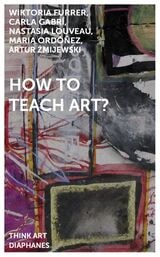
How to Teach Art?
Wiktoria Furrer, Carla Gabrí, Nastasia Louveau, Maria Ordoñez, and Artur Zmijewski
Diaphanes, 2021
How should art be taught? What kind of knowledge should artists absorb? How might an ordinary person become a creature addicted to the creative process? In other words, how can a non-artist become an artist? Such programmatic questions articulated by acclaimed Polish artist Artur Żmijewski were at the heart of the workshop “How to Teach Art?” Żmijewski invited a group of graduate and doctoral students from three Zurich universities—the Swiss Federal Institute of Technology, the University of Zurich, and the Zurich University of the Arts—to collectively reflect on their artistic practices. Over the course of four months, the group met several times a week for hourlong sessions, following individual and collective exercises induced by Żmijewski himself.
This book retraces the workshop and its process by showing inconclusive, fragmentary results between theory and practice. How to Teach Art? presents drawings, videos, photographs, 16mm films, and accompanying reflections on the central premise, “How to teach art?”
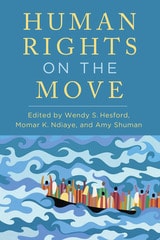
Human Rights on the Move
Edited by Wendy S. Hesford, Momar K. Ndiaye, and Amy Shuman
The Ohio State University Press, 2024
Contributing artists, activists, and scholars expose the fundamental paradox of human rights (namely that nation-states are violators and guarantors of rights) while also showing how people facing violence and persecution move with the hope of more livable and equitable futures. The assembled scholarly essays, interviews, and creative pieces demonstrate the importance of a more relational and contextual understanding of human rights—one that can destabilize current definitions and open space for new formulations.
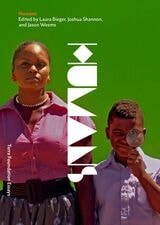
Humans
Edited by Laura Bieger, Joshua Shannon, and Jason Weems
Terra Foundation for American Art, 2021
Humans are organisms, but “the human being” is a term referring to a complicated, self-contradictory, and historically evolving set of concepts and practices. Humans explores competing versions, constructs, and ideas of the human being that have figured prominently in the arts of the United States. These essays consider a range of artworks from the colonial period to the present, examining how they have reflected, shaped, and modeled ideas of the human in American culture and politics. The book addresses to what extent artworks have conferred more humanity on some human beings than others, how art has shaped ideas about the relationships between humans and other beings and things, and in what ways different artistic constructions of the human being evolved, clashed, and intermingled over the course of American history. Humans both tells the history of a concept foundational to US civilization and proposes new means for its urgently needed rethinking.
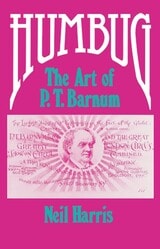
Humbug
The Art of P. T. BarnumNeil Harris
University of Chicago Press, 1981
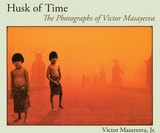
Husk of Time
The Photographs of Victor MasayesvaVictor Masayesva, Jr.; Introduction by Beverly R. Singer
University of Arizona Press, 2006
Hybrid Ecologies
Edited by Susanne Witzgall, Marietta Kesting, Maria Muhle, and Jenny Nachtigall
Diaphanes, 2021
The notion of ecology not only figures centrally in current debates around climate change, but also traverses contemporary discourses in the arts, the humanities, and the social and techno sciences. In this present form, ecology refers to the multilayered and multidimensional nexus of living processes and technological and media practices—that is, to the complex relations of human and nonhuman agents. Hybrid Ecologies understands ecology as an ambivalent notion, whose very broadness simultaneously opens up new fields of action and raises provocative questions, not least concerning its genealogy. This interdisciplinary volume explores the political and social effects of rethinking community in ecological terms, with a particular emphasis on what the contemporary notion of ecology might mean for artistic and design practices. The result of the fifth annual program of the cx centre for interdisciplinary studies, which was conceived in cooperation with the Chair of Philosophy | Aesthetic Theory at the Academy of Fine Arts in Munich, Hybrid Ecologies is a timely and thought-provoking study of one of the most important themes of our time.
Hybrid Renaissance
Culture, Language, ArchitecturePeter Burke
Central European University Press, 2016
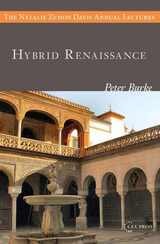
Hybrid Renaissance introduces the idea that the Renaissance in Italy, elsewhere in Europe, and in the world beyond Europe is an example of cultural hybridization.
The two key concepts used in this book are “hybridization” and “Renaissance”. Roughly speaking, hybridity refers to something new that emerges from the combination of diverse older elements. (The term “hybridization” is preferable to “hybridity” because it refers to a process rather than to a state, and also because it encourages the writer and the readers alike to think in terms of degree: where there is more or less, rather than presence versus absence.)
The book begins with a discussion of the concept of cultural hybridization and a cluster of other concepts related to it. Then comes a geography of cultural hybridization focusing on three locales: courts, major cities (whether ports or capitals) and frontiers. The following seven chapters describe the hybridity of the Renaissance in different fields: architecture, painting and sculpture, languages, literature, music, philosophy and law and finally religion. The essay concludes with a brief account of attempts to resist hybridization or to purify cultures or domains from what was already hybridized.
Hydrocommoning
Water, Art, and Collective Action in Latin AmericaLisa Blackmore
University of Minnesota Press, 2027
Reimagining watersheds as living hydrocommons through which artists and communities create more just and sustainable futures
Hydrocommoning explores how artists, activists, and curators coalesce around water in embodied efforts to contest entrenched and enduring forms of harm and degradation. Against the reduction of rivers, streams, and wetlands to mere resources to be managed, Hydrocommoning centers water as a living web of relations through which artists and communities forge creative means of reconnection by moving, weaving, pumping, eating, and listening.
By charting these aesthetic practices, Hydrocommoning shows how artists and organizers across Latin America oppose extractivism, unequal urbanization, ecological degradation, and the erasure of Indigenous water cultures. To cultivate widespread social attunement to vulnerable waters and raise the call for their defense and care, collectives in Brazil, Colombia, Guatemala, and Peru engage in communal meals, sound art, infrastructural interventions, and other practices that Lisa Blackmore theorizes as “hydrocommoning.”
Grounded in five years of experiential fieldwork, archival research, and curatorial projects in Latin America, Blackmore proposes a methodology to work with water as an analytical framework for collective action. Bridging the gap between theory, curating, and community-based practices, Hydrocommoning offers a promising vision of grassroots organizing that actively confronts some of today’s most urgent ecological threats.
Retail e-book files for this title are screen-reader friendly with images accompanied by short alt text and/or extended descriptions.
Hyecho's Journey
The World of BuddhismDonald S. Lopez Jr.
University of Chicago Press, 2017
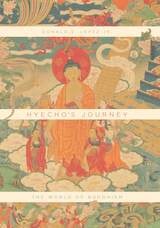
With Hyecho’s Journey, eminent scholar of Buddhism Donald S. Lopez Jr. re-creates Hyecho’s trek. Using the surviving fragments of Hyecho’s travel memoir, along with numerous other textual and visual sources, Lopez imagines the thriving Buddhist world the monk explored. Along the way, Lopez introduces key elements of Buddhism, including its basic doctrines, monastic institutions, works of art, and the many stories that have inspired Buddhist pilgrimage. Through the eyes of one remarkable Korean monk, we discover a vibrant tradition flourishing across a vast stretch of Asia. Hyecho’s Journey is simultaneously a rediscovery of a forgotten pilgrim, an accessible primer on Buddhist history and doctrine, and a gripping, beautifully illustrated account of travel in a world long lost.
Hélio Oiticica
Folding the FrameIrene V. Small
University of Chicago Press, 2016
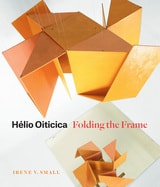
From Oiticica’s late 1950s experiments with painting and color to his mid-1960s wearable Parangolés, Small traces a series of artistic procedures that foreground the activation of the spectator. Analyzing works, propositions, and a wealth of archival material, she shows how Oiticica’s practice recast—in a sense “folded”—Brazil’s utopian vision of progress as well as the legacy of European constructive art. Ultimately, the book argues that the effectiveness of Oiticica’s participatory works stems not from a renunciation of art, but rather from their ability to produce epistemological models that reimagine the traditional boundaries between art and life.