Results by title
1882 books match the query 'Criticism and interpretation' and 63 start with h
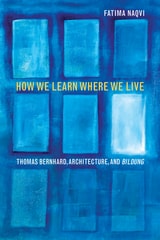
How We Learn Where We Live
Thomas Bernhard, Architecture, and BildungFatima Naqvi
Northwestern University Press, 2015
How We Learn Where We Live opens new avenues into thinking about one of the most provocative writers of the twentieth century, Thomas Bernhard. In one of the first English studies of his work, Fatima Naqvi focuses on the Austrian author’s critique of education (Bildung) through the edifices in which it takes place. She demonstrates that both literature and architecture are implicated in the concept of Bildung. His writings insist that learning has always been a life-long process that is helped—or hindered—by the particular buildings in which Bildung occurs. Naqvi offers close readings of Bernhard’s major prose works, from Amras (1964) to Old Masters (1985) and brings them into dialogue with major architectural debates of the times. She examines Bernard’s interrogation of the theoretical foundations underpinning the educational system and its actual sites.
How Will the Heart Endure
Elizabeth Bowen and the Landscape of WarHeather Bryant Jordan
University of Michigan Press, 1992
How the Russians Read the French
Lermontov, Dostoevsky, TolstoyPriscilla Meyer
University of Wisconsin Press, 2008
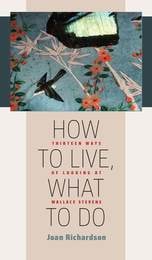
How to Live, What to Do
Thirteen Ways of Looking at Wallace StevensJoan Richardson
University of Iowa Press, 2018
How to Live, What to Do is an indispensable introduction to and guide through the work of a poet equal in power and sensibility to Shakespeare and Milton. Like them, Stevens shaped a new language, fashioning an instrument adequate to describing a completely changed environment of fact, extending perception through his poems to align what Emerson called our “axis of vision” with the universe as it came to be understood during his lifetime, 1879–1955, a span shared with Albert Einstein. Projecting his own imagination into spacetime as “a priest of the invisible,” persistently cultivating his cosmic consciousness through reading, keeping abreast of the latest discoveries of Einstein, Max Planck, Niels Bohr, Louis de Broglie, and others, Stevens pushed the boundaries of language into the exotic territories of relativity and quantum mechanics while at the same time honoring the continuing human need for belief in some larger order. His work records how to live, what to do in this strange new world of experience, seeing what was always seen but never seen before.
Joan Richardson, author of the standard two-volume critical biography of Stevens and coeditor with Frank Kermode of the Library of America edition of the Collected Poetry and Prose, offers concise, lucid captures of Stevens’s development and achievement. Over the ten years of researching her Stevens biography, Richardson read all that he read, as well as his complete correspondence, journals, and notebooks. She weaves the details drawn from this deep involvement into the background of American cultural history of the period. This fabric is further enlivened by her preparation in philosophy and the sciences, creating in these thirteen panels a contemporary version of a medieval tapestry sequence, with Stevens in the place of the unicorn, as it were, holding our attention and eliciting, as necessary angel, individual solutions to the riddles of our existence on this planet spinning and hissing around its cooling star at 18.5 miles per second.
How to Live/What to Do
H.D.'s Cultural PoeticsAdalaide Morris
University of Illinois Press, 2002
Ever since the publication of her first H.D. essay in 1985 (included here in an expanded version), Morris has eschewed prevailing literary trends in favor of new approaches that both challenge and overpass dominant critical constructs. As she argues in this volume, the writing and, crucially, the reading of poetry is a process in which meaning is produced by the interplay of words on a page and in the ear of the reader. This quality of being not heard but overheard, composed within the body, is crucial to an appreciation of H.D.
Morris shows H.D. to be a playful linguistic innovator whose writings bear on debates in science, technology, and cinema as well as on poetry. Foremost, however, H.D. was a profound reshaper of the boundaries and possibilities of poetry, a generative form that, as this book shows, can indeed serve the cultural work of survival and resistance against the violence of modern culture.
How to Make a Soul
The Wisdom of John KeatsEric G. Wilson
Northwestern University Press, 2015
In this innovative hybrid of biography, memoir, and criticism, Eric G. Wilson describes how John Keats gave him solace during a bout of mental illness in spring 2012. While on a tour of the principal sites in Keats’s life—ranging from his London medical school to the small room in Rome where he died—Wilson discovered analogies between the poet’s troubles and his own. He was most struck by Keats’s enlivening vision of the soul.
For Keats, we don’t possess but rather make a soul. We do this by imaginatively transforming our suffering into empathy toward humans and nature alike. Tracking this idea in Keats’s tumultuous yet exhilarating life and work, Wilson struggles to envision his depression anew, desperate to overcome the apathy alienating him from his family.
How to Make a Soul offers fresh perspectives on Keats’s pragmatism, irony, comedy, ethics, and aesthetics, but is above all a lyrical celebration of those galvanizing instances when life springs into art.

How to Read Barthes' Image-Music-Text
Ed White
Pluto Press, 2012
Roland Barthes remains one of the most influential cultural theorists of the postwar period and Image-Music-Text collects his most influential essays. Ed White provides students with a clear guide to this essential but difficult text.
As students are increasingly expected to write across a range of media, Barthes' work can be understood as an early mapping of what we now call interdisciplinary or multidisciplinary study. The book's detailed section-by-section readings makes Barthes' most important writings accessible to undergraduate readers.
This book is a perfect companion for teaching and learning Barthes' ideas in cultural studies and literary theory.
How to Revise a True War Story
Tim O'Brien's Process of Textual ProductionJohn K. Young
University of Iowa Press, 2017
How to Revise a True War Story is the first book-length study of O’Brien’s archival papers at the University of Texas’s Harry Ransom Center. Drawing on extensive study of drafts and other prepublication materials, as well as the multiple published versions of O’Brien’s works, John K. Young tells the untold stories behind the production of such key texts as Going After Cacciato, The Things They Carried, and In the Lake of the Woods. By reading not just the texts that have been published, but also the versions they could have been, Young demonstrates the important choices O’Brien and his editors have made about how to represent the traumas of the war in Viet Nam. The result is a series of texts that refuse to settle into a finished or stable form, just as the stories they present insist on being told and retold in new and changing ways. In their lack of textual stability, these variants across different versions enact for O’Brien’s readers the kinds of narrative volatility that is key to the American literature emerging from the war in Viet Nam. Perhaps in this case, you can tell a true war story if you just keep on revising it.
How “Indians” Think
Colonial Indigenous Intellectuals and the Question of Critical Race TheoryGonzalo Lamana
University of Arizona Press, 2019
Humanism and Classical Crisis
Anxiety, Intertexts, and the Miltonic MemoryJacob Blevins
The Ohio State University Press, 2014
Blevins grounds his approach in the theories of Jacques Lacan, whose work challenges the very notions of what identity is and, as a result, exposes the complexities of identity formation. Areas and authors covered include imitations and translations of classical works of the sixteenth and seventeenth centuries in England and France by Andrew Marvell, Edmund Spencer, Pierre Ronsard, Joachim Du Bellay, Ben Jonson, Sir Thomas Wyatt, and John Milton.
This book not only provides a new perspective on early modern poetic imitation, but also offers a foundational methodology for examining the classical presence within the modern self.
Humanism and Secularization
From Petrarch to VallaRiccardo Fubini
Duke University Press, 2003
Humanism and Secularization offers a nuanced account of humanists contesting medieval ideas about authority not in order to reject Christianity or even orthodoxy, but to claim for themselves the right to define what it meant to be a Christian. Fubini analyzes key texts by major humanists—isuch as Petrarch, Poggio, and Valla—from the first century of the movement. As he subtly works out these authors’ views on religion and the Church from both biographical and textual information, Fubini reveals in detail the new historical consciousness that animated the humanists in their reading of classical and patristic texts. His book as a whole shows convincingly just how radical the humanism of the first half of the fifteenth century was and how sharply it challenged well-entrenched ideas and institutions. Appearing here in English for the first time, his work provides a model set of readings of humanist texts and a critical perspective on Italian humanism that will alter and enrich discussion and understanding of the nature of the humanist movement.
Humor in the Historical Works of Tacitus
Emma Warhover
University of Michigan Press, 2026
In serious texts like Tacitus’ historical works, humor can expose hypocrisy in the powerful, demonstrate the absurdity of imperial pronouncements, and simultaneously communicate why such offenses were allowed to stand. Warhover argues that major elements of Tacitus’ distinctive style, such as variatio, appendix sentences, and sententiae, create humor, and that Tacitus used humor deliberately to emphasize the incongruities that emerged from the principate. By employing humor, Tacitus followed Roman rhetorical traditions evident in Cicero and Quintilian, who agree that humor is an important tool for criticism. For Tacitus, humor is therefore not an amusement or decoration, but an integral part of his historiographic construction.
Hélio Oiticica
Folding the FrameIrene V. Small
University of Chicago Press, 2016
From Oiticica’s late 1950s experiments with painting and color to his mid-1960s wearable Parangolés, Small traces a series of artistic procedures that foreground the activation of the spectator. Analyzing works, propositions, and a wealth of archival material, she shows how Oiticica’s practice recast—in a sense “folded”—Brazil’s utopian vision of progress as well as the legacy of European constructive art. Ultimately, the book argues that the effectiveness of Oiticica’s participatory works stems not from a renunciation of art, but rather from their ability to produce epistemological models that reimagine the traditional boundaries between art and life.