Results by title
1726 books match the query 'Film' and 62 start with h

Hong Kong Connections
Transnational Imagination in Action CinemaMeaghan Morris, Siu-Leung Li, and Stephen Chan Ching-kiu, eds.
Duke University Press, 2005
Hong Kong Connections brings leading film scholars together to explore the circulation of Hong Kong cinema in Japan, Korea, India, Australia, France, and the United States, as well as its links with Taiwan, Singapore, and the Chinese mainland. In the process, this collection examines diverse cultural contexts for action cinema’s popularity and the problems involved in the transnational study of globally popular forms, suggesting that in order to grasp the history of Hong Kong action cinema’s influence we need to bring out the differences as well as the links that constitute popularity.
Contributors. Nicole Brenez, Stephen Chan Ching-kiu, Dai Jinhua, David Desser, Laleen Jayamanne, Kim Soyoung, Siu Leung Li, Adrian Martin, S. V. Srinivas, Stephen Teo, Valentina Vitali, Paul Willemen, Rob Wilson, Wong Kin-yuen, Kinnia Yau Shuk-ting, Yung Sai-shing

Hong Kong New Wave Cinema (1978-2000)
Pak Tong Cheuk
Intellect Books, 2008
Drawing on the auteur and genre theories, Pak Tong Cheuk here examines the cinematic style and aesthetics of New Wave directors, most of whom were educated at British and U.S. film schools. In addition to investigating the narrative content, structure, and mise-en-scène of individual films, this volume traces the overall development of the film and television industries in Hong Kong in the 1960s and 1970s. Cheuk’s intriguing study of the rise and fall of Hong Kong’s golden age of film establishes the New Wave as an era of great historical significance for scholars of cinema, popular culture, and the arts.
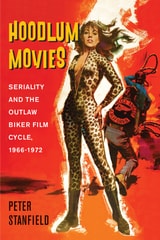
Hoodlum Movies
Seriality and the Outlaw Biker Film Cycle, 1966-1972Stanfield, Peter
Rutgers University Press, 2018
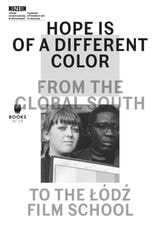
Hope Is of a Different Color
From the Global South to the Lodz Film SchoolEdited by Magda Lipska and Monika Talarczyk
Museum of Modern Art in Warsaw, 2020
As Poland’s second-largest city, Łódź was a hub for international students who studied in Poland from the mid-1960s to 1989. The Łódź Film School, a member of CILECT since 1955, was a favored destination, with students from Africa, Latin America, and the Middle East accounting for one-third of its international student body. Despite the school’s international reputation, the experience of its filmmakers from the Global South is little known beyond Poland.
Hope Is of a Different Color addresses the history of student exchanges between the Global South and the Polish People’s Republic during the Cold War. It sheds light on the experiences and careers of a generation of young filmmakers at Łódź, many of whom went on to achieve success as artists in their home countries, and provides insight into emerging areas of research and race relations in Central and Eastern Europe. The essays reflect on these issues from multiple perspectives, considering sociology, political science, art, and film history. The book also features previously unpublished photographs and film stills from private archives along with visual and written material collected at the Łódź Film School.
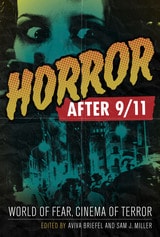
Horror after 9/11
World of Fear, Cinema of TerrorEdited by Aviva Briefel and Sam J. Miller
University of Texas Press, 2011
Horror films have exploded in popularity since the tragic events of September 11, 2001, many of them breaking box-office records and generating broad public discourse. These films have attracted A-list talent and earned award nods, while at the same time becoming darker, more disturbing, and increasingly apocalyptic. Why has horror suddenly become more popular, and what does this say about us? What do specific horror films and trends convey about American society in the wake of events so horrific that many pundits initially predicted the death of the genre? How could American audiences, after tasting real horror, want to consume images of violence on screen?
Horror after 9/11 represents the first major exploration of the horror genre through the lens of 9/11 and the subsequent transformation of American and global society. Films discussed include the Twilight saga; the Saw series; Hostel; Cloverfield; 28 Days Later; remakes of The Texas Chainsaw Massacre, Dawn of the Dead, and The Hills Have Eyes; and many more. The contributors analyze recent trends in the horror genre, including the rise of 'torture porn,' the big-budget remakes of classic horror films, the reinvention of traditional monsters such as vampires and zombies, and a new awareness of visual technologies as sites of horror in themselves. The essays examine the allegorical role that the horror film has held in the last ten years, and the ways that it has been translating and reinterpreting the discourses and images of terror into its own cinematic language.
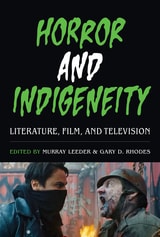
Horror and Indigeneity
Literature, Film, and TelevisionEdited by Murray Leeder and Gary D. Rhodes
University of Texas Press, 2026
A collection of essays about Indigeneity and horror in cinema, literature, and beyond.
How did Indigeneity come to be horrifying? Think of the “Indian burial ground” trope, a staple of 1970s horror cinema, not to mention decades of Western films and fictions that made “savage Indians” the face of fear in popular culture. Can horror do something else in the hands of Indigenous people? Creators such as Eden Robinson and Jeff Barnaby have self-consciously turned to horror to tell new kinds of stories, stories that question who is a monster and what constitutes the monstrous.
Horror and Indigeneity explores representations of Indigenous people in settler horror texts and in the growing corpus of horror by Indigenous writers and filmmakers. Widely spanning time periods and media, the contributors to this edited volume address themes such as cannibalism, eco-horror, historical trauma, and contemporary antiracism as they relate to classical horror cinema and recent works such as The Dead Can’t Dance, Lovecraft Country, and Stephen Graham Jones’s The Only Good Indians. Also featuring interviews with Jones and director T. J. Cuthand, Horror and Indigeneity rethinks the terror of the Other in potent and provocactive terms.
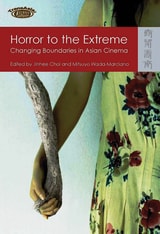
Horror to the Extreme
Changing Boundaries in Asian CinemaEdited by Jinhee Choi and Mitsuyo Wada-Marciano
Hong Kong University Press, 2009
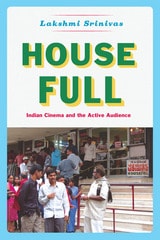
House Full
Indian Cinema and the Active AudienceLakshmi Srinivas
University of Chicago Press, 2016
With House Full, Lakshmi Srinivas takes readers deep into the moviegoing experience in India, showing us what it’s actually like to line up for a hot ticket and see a movie in a jam-packed theater with more than a thousand seats. Building her account on countless trips to the cinema and hundreds of hours of conversation with film audiences, fans, and industry insiders, Srinivas brings the moviegoing experience to life, revealing a kind of audience that, far from passively consuming the images on the screen, is actively engaged with them. People talk, shout, whistle, cheer; others sing along, mimic, or dance; at times audiences even bring some of the ritual practices of Hindu worship into the cinema, propitiating the stars onscreen with incense and camphor. The picture Srinivas paints of Indian filmgoing is immersive, fascinating, and deeply empathetic, giving us an unprecedented understanding of the audience’s lived experience—an aspect of Indian film studies that has been largely overlooked.
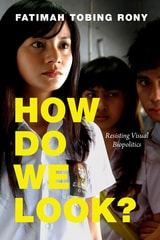
How Do We Look?
Resisting Visual BiopoliticsFatimah Tobing Rony
Duke University Press, 2022
How Scripts are Made
Inga Karetnikova
Southern Illinois University Press, 1990
Inga Karetnikova’s method is that of the art teacher: she asks students to study great works in detail, to analyze them, and then to create their own. She stresses that her examination is "interested only in how the scripts are written and what makes them work, not in a cultural or scholarly examination of them." Karetnikova analyzes eight screenplays—TheGodfather, Rashomon, La Strada, Bicycle Thief, Nosferatu, The Servant, Viridiana, Notorious—anda novel written in screenplay form, Kiss of the Spider Woman. Each serves as an example of a particular aspect of screenplay writing: composing scripts, developing characters, constructing suspense, adapting literature to cinematic space and time, and weaving details and motifs within a script.
Karetnikova urges film students to work on their own screenplays while studying her book, reading the suggested scripts and viewing the films based on them to get the most from her method. She provides a series of exercises for each chapter to help students master the skills of composing and writing film treatments, developing screen stories and their characters, organizing scenes, and writing dialogue. Each of the exercises has worked successfully in her own screenplay-writing classes.
How to Create a Universe
Jakob Ion Wille, Simon Jon Andreasen, and Gunnar Wille
University of Westminster Press, 2025
How to Win a Culture War
LGBTQ+ Social Change Through Pop CultureLisa M. Stulberg
University of Chicago Press, 2026
How elite athletes and entertainment industry movers and shakers work to win the culture war for LGBTQ+ social justice.
The unquestionable runaway television hit of late 2025 was Crave/HBO Max’s Heated Rivalry, a show that tells the love story of two queer ice hockey players. This show—and the wider social context around it—would have been unthinkable without the courageous writing, art, and advocacy of previous generations of LGBTQ+ people and their allies in the entertainment industry. In How to Win a Culture War, sociologist Lisa M. Stulberg argues that, despite substantial barriers, past and current creatives and athletes are changing American culture through their contributions to arts, sports, and politics.
Stulberg conducted in-depth interviews with 170 culture workers—including television, film, and theater actors and creators; musicians; elite athletes; and activists over the span of 14 years. These include stars such as Will & Grace's Eric McCormack, Orange Is the New Black’s Lea DeLaria, Olympic diver Greg Louganis, and several former NFL players, as well as the TV and movie writers, producers, and directors behind some of pop culture’s boldest moves. These culture makers take six primary steps toward LGBTQ+ social change: they become visible, use available platforms, change their workplaces, overachieve, become normal, and stay queer. In this work, they are opening up the culture, changing hearts and minds, and building community, even amid a fresh round of ruthless political attacks on LGBTQ+ people.
Providing rich behind-the-scenes insight and cultural material, Stulberg outlines an urgently needed playbook for how to win a culture war.