Results by title
1947 books match the query 'Music' and 56 start with h
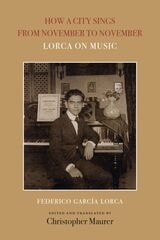
How a City Sings from November to November
Lorca on MusicFederico García Lorca
Swan Isle Press, 2026
“Yo ante todo, soy músico,” Federico García Lorca once remarked: “Before all else, I am a musician.” Whether seated at the piano, collecting folksongs on his travels through Spain, or composing music for his plays, few poets have lived music so deeply. For Lorca, songs were “living creatures.” How a City Sings from November to November: Lorca on Music brings together for the first time in English the poet’s writing on music and musicians. In these pages, through lectures, letters, and interviews, Lorca celebrates the musical seasons of Granada, “a city enclosed by mountains and made for music”; the sources of cante jondo (flamenco deep song); the haunting melodies of Spanish cradle songs; and the dance of La Argentina. He describes learning the guitar, staging Spanish ballads in Buenos Aires, and listening to spirituals in New York. In bed with a fever, he compares it to a “delicate tempo rubato of Chopin.” Based on recent archival research, edited and newly translated by noted Lorca scholar Christopher Maurer, this collection offers an intricate and enjoyable counterpoint to Lorca’s poetry and theater.

How to Go Mad without Losing Your Mind
Madness and Black Radical CreativityLa Marr Jurelle Bruce
Duke University Press, 2020

How to Read Barthes' Image-Music-Text
Ed White
Pluto Press, 2012
Roland Barthes remains one of the most influential cultural theorists of the postwar period and Image-Music-Text collects his most influential essays. Ed White provides students with a clear guide to this essential but difficult text.
As students are increasingly expected to write across a range of media, Barthes' work can be understood as an early mapping of what we now call interdisciplinary or multidisciplinary study. The book's detailed section-by-section readings makes Barthes' most important writings accessible to undergraduate readers.
This book is a perfect companion for teaching and learning Barthes' ideas in cultural studies and literary theory.

Hugo Wolf
Letters To Melanie KochertHugo Wolf
University of Wisconsin Press, 2003
Wolf’s letters to Köchert—he wrote 245 between 1887 and 1899—were composed during a period of almost unprecedented cultural upheaval in Europe, in the shadow of Vienna during the era of Freud, Mahler, and Klimt. They reveal Wolf at his most optimistic, celebrating his concert successes and the solitude he believed was so precious to his ability to compose. They follow Wolf through times of overwhelming despair, when his musical failures left him profoundly alienated, overcome, as he revealed to Köchert, "by a feeling of unspeakable emptiness and desolation." And they follow Wolf as he struggled to compose the 250 astounding art songs that are his creative legacy, and his almost simultaneous descent into madness.
Hugo Wolf: Letters to Melanie Köchert, sensitively translated by Wolf scholar and interpreter Louise McClelland Urban, is a literary and musical even of the highest order
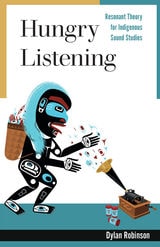
Hungry Listening
Resonant Theory for Indigenous Sound StudiesDylan Robinson
University of Minnesota Press, 2020
WInner of the Best First Book from the Native American and Indigenous Studies Association
Winner of the Labriola Center American Indian National Book Award
Winner of the Ann Saddlemyer Award from the Canadian Association for Theatre Research
Reimagining how we understand and write about the Indigenous listening experience
Hungry Listening is the first book to consider listening from both Indigenous and settler colonial perspectives. A critical response to what has been called the “whiteness of sound studies,” Dylan Robinson evaluates how decolonial practices of listening emerge from increasing awareness of our listening positionality. This, he argues, involves identifying habits of settler colonial perception and contending with settler colonialism’s “tin ear” that renders silent the epistemic foundations of Indigenous song as history, law, and medicine.
With case studies on Indigenous participation in classical music, musicals, and popular music, Hungry Listening examines structures of inclusion that reinforce Western musical values. Alongside this inquiry on the unmarked terms of inclusion in performing arts organizations and compositional practice, Hungry Listening offers examples of “doing sovereignty” in Indigenous performance art, museum exhibition, and gatherings that support an Indigenous listening resurgence.
Throughout the book, Robinson shows how decolonial and resurgent forms of listening might be affirmed by writing otherwise about musical experience. Through event scores, dialogic improvisation, and forms of poetic response and refusal, he demands a reorientation toward the act of reading as a way of listening. Indigenous relationships to the life of song are here sustained in writing that finds resonance in the intersubjective experience between listener, sound, and space.

Hymns / Inni
Giuseppe Verdi
University of Chicago Press, 2007
This newest volume in The Works of Giuseppe Verdi series comprises his only two surviving secular choral works: Inno popolare, or Hymn of the People, for unaccompanied male chorus, and Inno delle nazioni, or Hymn of the Nations, for tenor solo, chorus, and orchestra.
Verdi wrote the brief Inno popolare in 1848 at the behest of the Italian philosopher and patriot Giuseppe Mazzini, intending that it become an anthem for Italy at a time when the country had just driven away its Austrian overlords. He wrote no more independent patriotic pieces until he was asked in 1861 to represent his country with a patriotic composition at a musical jubilee during London’s International Exhibition of 1862. The resulting piece was Inno delle nazioni, the critical edition of which is based on Verdi’s autograph score, preserved at the British Library. Other important sources include the composer's musical sketches, recently discovered in the Verdi family villa, and the performing parts Toscanini used for a BBC broadcast in 1943.