Results by title
3785 books match the query 'Poetry' and 122 start with h

Here There Was Once a Country
Vénus Khoury-Ghata
Oberlin College Press, 2001
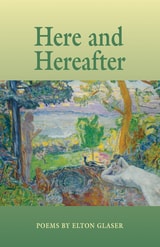
Here and Hereafter
PoemsElton Glaser
University of Arkansas Press, 2005
The poems in celebrated poet Elton Glaser’s sixth collection journey through the seasons, from spring to spring, a pilgrimage down to the South, over the Midwest of snow and roses, and across the Romance countries of Europe. If the poet often finds himself “[h]alfway between grief and longing,” that may be his natural condition, rooted in this world against the pull of the next, his faith in the “purple evidence of plums, the testimony of wild persimmon” weathering the stormy preachers and the droughts of middle age.
Within that tension, the range of tones is unlimited, sometimes in the same poem, from the serious to the sublime, from anguish to awe. Holding everything together is Glaser’s unmistakable voice, a warm idiom made pungent by wintry wit: “my tongue of odd American, my mongrel sublime.” Whether the poems speak of ripe pears or minor prophets, they invite the reader to a feast of language that lets us taste how it feels to live on this earth, in the shadow of the afterlife.
Heresy and the Ideal
On Contemporary PoetryDavid Baker
University of Arkansas Press, 2000
Hewing to Experience
Essays and Reviews on Recent American Poetry and Poetics, Nature and CultureSherman Paul
University of Iowa Press, 1989
Hieroglyphs of Another World
On Poetry, Swedenborg, and Other MattersIlya Kutik
Northwestern University Press, 2000
High Ground Coward
Alicia Mountain
University of Iowa Press, 2018
Alicia Mountain’s urgent and astonishing debut collection maps a new queer landscape through terrain alive and sensual, defiant and inviting. With a voice that beckons while it howls, Mountain nimbly traverses lyric, confessional, and narrative modes, leaving groundbreaking tracks for us to follow. High Ground Coward offers fists full of soil, leftovers for breakfast, road trip as ritual, twins of lovers and twins of ourselves. This world blooms with hunger-inducing detail, its speakers asking us to consider what it will take to satisfy our own appetites while simultaneously trying to nourish one another. “Ferocious, even the softest part,” Mountain shows us “a way to fall in love with wanting,” leaving us “ravenous, but gradually.”
Bearing witness to identity formation in solitude and communion, High Ground Coward is an almanac of emotional and relational seasons. Mountain’s speakers question the meaning of inheritance, illness, violence, mythology, and family architecture. Whether Mountain is at work revealing the divinity of doubt, the entanglement of devotion, or the dominion that place holds over us, High Ground Coward heralds a thrilling poetic debut.
From “Scavenger”
We three eat food and are in love. This is the easy way to say
there are stores beneath the floor.
Potatoes and shallots,
hard-necked garlic streaked purple,
jars beside jars, themselves
each staving globes of suction.
Preservation, a guardian hunger.
In the evening I whisper to the boiled beet,
like a naked organ in my flushed hand:
You are ground blood,
you are new born,
you have never been nothing—
thawfruit seedflower greenstart rootbulb
handpull shedscrub mouthsweet
and again.
Hijab
Three Modern Iranian Seminarian PerspectivesLloyd Ridgeon
Gingko, 2021
Ḥijāb addresses the differences of opinion among seminarians on the hijab in the Islamic Republic of Iran, focusing on three representative thinkers: Murtaza Mutahhari who held veiling to be compulsory, Ahmad Qabil who argued for the desirability of the hijab, and Muhsin Kadivar who considers it neither necessary nor desirable. In the first chapter, the views of these three scholars are contextualized within the framework known as ‘new religious thinking’ among the seminarians. Comprehending the hermeneutics of this new religious thinking is key to appreciating how and why the younger generation of scholars have offered divergent judgements about the hijab. Following the first chapter, the book is divided into three parallel sections, each devoted to one of the three seminarians. These present a chronological approach, and each scholar’s position on the hijab is assessed with reference to historical specificity and their own general jurisprudential perspective. Extensive examples of the writings of the three scholars on the hijab are also provided.
Hijra
Hala Alyan
Southern Illinois University Press, 2016
The reader sees war, diaspora, and immigration, and hears the marginalized voices of women of color. The poems use lyrical diction and striking imagery to evoke the weight of an emotional and visceral journey. They grow and build in length and form, reflecting the gains the women in the poems make in re-creating selfhood through endurance and strength.
In prose, narrative, and confessional-style poems, Alyan reflects on how physical space is refashioned, transmitted, and remembered. Her voice is distinct, fresh, relevant, and welcoming.
Hinge
Molly Spencer
Southern Illinois University Press, 2020
Finding joy and beauty in the face of suffering
Readers enter “a stunted world,” where landmarks—a river, a house, a woman’s own body—have become unrecognizable in a place as distorted and dangerous as any of the old tales poet Molly Spencer remasters in this elegant, mournful collection. In myth and memory, through familiar stories reimagined, she constructs poetry for anyone who has ever stumbled, unwillingly, into a wilderness. In these alluring poems, myth becomes part of the arsenal used to confront the flaws and failures of our fallible bodies. Shadowing the trajectory of an elegy, this poetry collection of lament, remembrance, and solace wrestles with how we come to terms with suffering while still finding joy, meaning, and beauty.
Spencer alternates between the clinical and the domestic, disorientation and reorientation, awe and awareness. With the onset of a painful chronic illness, the body and mental geography turn hostile and alien. In loss and grief, in physical and psychological landscapes, Spencer searches the relationship between a woman’s body and her house—places where she is both master and captive—and hunts for the meaning of suffering. Finally, with begrudging acceptance, we have a hypothesis for all seasons: there is suffering, there is mercy; they are not separate but are for and of one another.
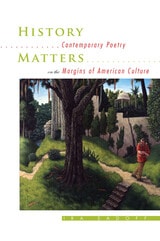
History Matters
Contemporary Poetry on the Margins of American CultureIra Sadoff
University of Iowa Press, 2009
Much of our most adventurous writing has occurred at history’s margins, simultaneously making use of and resisting tradition. By tracking key contemporary poets—including John Ashbery, Olena Kaltyiak Davis, Louise Glück, Czeslaw Milosz, Frank O’Hara, and C. K. Williams—as well as musing on jazz and other creative enterprises, Sadoff investigates the lively poetic art of those who have grappled with late twentieth-century attitudes about history, subjectivity, contingency, flux, and modernity. In plainspoken writing, he probes the question of the poet’s capacity to illuminate and universalize truth. Along the way, we are called to consider how and why art moves and transforms human beings.
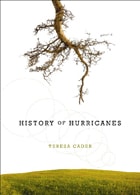
History of Hurricanes
PoemsTeresa Cader
Northwestern University Press, 2009
In her third collection of poems, Teresa Cader spins a complete universe of lyrical, probing verse that reaches out to readers and invites them to come inside. These poems deal with love and loss in particularly striking ways, as Cader uses rigorously controlled verse to express chaotic emotion. Stylistically adventurous, her work moves gracefully from intricate, slant-rhymed couplets to elliptical, lanky free verse. Geographically, she takes readers on a ride with stops in Kraków’s rock clubs, colonial New England’s sites, and shrines of contemporary Japan. The shadow of death, especially the loss of Cader’s mother, falls across many of her poems, but her verse reacts viscerally to such events, her emotion resounding out from each line to move through pain or desire.
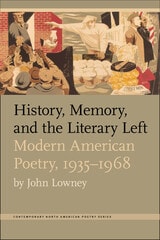
History, Memory, and the Literary Left
Modern American Poetry, 1935-1968John Lowney
University of Iowa Press, 2006
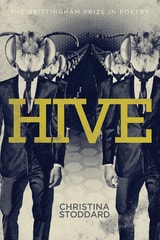
Hive
Christina Stoddard
University of Wisconsin Press, 2015
Winner, Poetry, Association for Mormon Letters Awards
Finalist, da Vinci Eye Book Design Award
Finalist, Washington State Book Award for Poetry, Washington Center for the Book
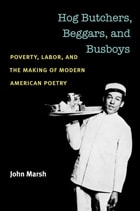
Hog Butchers, Beggars, and Busboys
Poverty, Labor, and the Making of Modern American PoetryJohn Marsh
University of Michigan Press, 2011
"Impressive—Marsh successfully rewrites the founding moment of American Modernist poetry."
---Mark Van Wienen, Northern Illinois University
"Cogently argued, instructive, and sensitive, Marsh’s revisionist reading opens new insights that will elicit lively comment and critical response."
---Douglas Wixson, University of Missouri–Rolla
Between 1909 and 1922, the genre of poetry was remade. Literary scholars have long debated why modern American poetry emerged when and how it did. While earlier poetry had rhymed, scanned, and dealt with conventional subjects such as love and nature, modern poetry looked and sounded very different and considered new areas of experience. Hog Butchers, Beggars, and Busboys: Poverty, Labor, and the Making of Modern American Poetry argues that this change was partially the result of modern poets writing into their verse what other poetry had suppressed: the gritty realities of modern life, including the problems of the poor and working class.
A closer look at the early works of the 20th century's best known poets (William Carlos Williams, T. S. Eliot, Edna St. Vincent Millay, Claude McKay, Langston Hughes, and Carl Sandburg) reveals the long-neglected role the labor problem—including sweatshops, strikes, unemployment, woman and child labor, and immigration---played in the formation of canonical modern American poetry. A revisionary history of literary modernism and exploration into how poets uniquely made the labor problem their own, this book will appeal to modernists in the fields of American and British literature as well as scholars in American studies and the growing field of working-class literature.
Hold-Outs
The Los Angeles Poetry Renaissance, 1948-1992Bill Mohr
University of Iowa Press, 2011
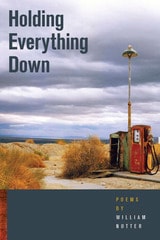
Holding Everything Down
William Notter
Southern Illinois University Press, 2009
William Notter’s stunning collection Holding Everything Down explores the everyday struggles, triumphs, and desires of rural Americans. With disarming humor and remarkable honesty, Notter delves into the most personal longings of those who inhabit America’s countrysides: places bound by secrets and ghosts, where joy is discovered in the most unlikely of locations, and even the land itself has a story to tell. These highly accessible poems traverse the world of weekend rodeos, lonely highways, and windswept battlefields; they follow the twin paths of addiction and obsession, and the trials of newfound sobriety. Connections are forged beneath weathered ceilings, and love can be found over a plate of barbecue. Also explored are the depths of humanity’s relationship with nature and freedom, be it the smell of freshly threshed wheat, the purple thunderheads of an approaching storm, or a sunset viewed from Mississippi’s highest peak.
From the muddy deltas of the deep South to the crags of the Big Horn Mountains, Notter’s deeply candid portraits transcend stereotypes to expose an often unseen side of Americana. Hairdresser or handyman, rodeo rider or rancher’s wife, each voice ultimately echoes with the most human of experiences, unveiling the common threads that bind us to our world and to each other.

Holding Ground
Bruce Willard
Four Way Books, 2013
Holiday
Susan Hahn
University of Chicago Press, 2001
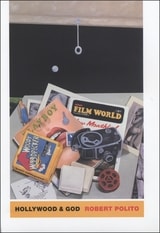
Hollywood & God
Robert Polito
University of Chicago Press, 2009
Hollywood & God is a virtuosic performance, filled with crossings back and forth from cinematic chiaroscuro to a kind of unsettling desperation and disturbing—even lurid—hallucination. From the Baltimore Catechism to the great noir films of the last century to today’s Elvis impersonators and Paris Hilton (an impersonator of a different sort), Robert Polito tracks the snares, abrasions, and hijinks of personal identities in our society of the spectacle, a place where who we say we are, and who (we think) we think we are fade in and out of consciousness, like flickers of light dancing tantalizingly on the silver screen. Mixing lyric and essay, collage and narrative, memoir and invention, Hollywood & God is an audacious book, as contemporary as it is historical, as sly and witty as it is devastatingly serious.
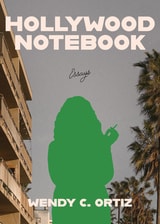
Hollywood Notebook
EssaysWendy C. Ortiz
Northwestern University Press, 2025
A daylight traipse through early-aughts Los Angeles, Hollywood Notebook encapsulates the powerful feelings and hopeful futures of twentysomething Wendy C. Ortiz. In this boundary-defying sister memoir to Bruja, Ortiz navigates internal maps as she traverses external palm-treed streets, moving through her youthful twenties and into the pensiveness of her thirties. Peering at what lies ahead while dipping her toes into the past, Ortiz shows us that there is no place like Hollywood to unearth the joys of success and the blows of mistakes—both realized and denied. An innovative and bold examination of the daytime roaming mind, Hollywood Notebook is a cartography of love, loss, and transformation in the face of a brilliant psyche in a vibrant city.
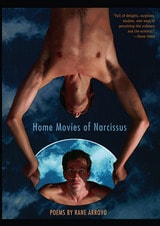
Home Movies of Narcissus
Rane Arroyo
University of Arizona Press, 2002
Using sophisticated language to inspect life from barrio childhood to cosmopolitan manhood, Arroyo explores themes of gay strength and alienation, linked to his experiences as both a Puerto Rican and an intellectual. Through a variety of approaches, he examines a major recurrent Latino paradox: the need to write about Latino issues while being criticized for being too self-centered.
Sometimes reserved, sometimes passionate, Arroyo writes with humor and a remarkable quickness of association, moving with a grace that makes seamless use of speech ranging from the formal to the vernacular. Taking in love and sexuality, world literature and history, and the exile's heritage of a shifting geography of identity, he invokes remarkable imagery with language that is economical, fresh, and mischievous. Some of Arroyo's poems take an autobiographical approach and show how poets have both the luxury and necessity of speaking for those in their lives.
Others create personas that take in the American experience from a variety of viewpoints—including gays, who are often marginalized by the larger Latino community. "The Ponce de León Poems" pit the poet against a ghost who seeks to direct his writing, while a final section, "The Black Moon Poems," deals with the many sleepless nights that Arroyo has spent struggling with questions over the worth of his art and whether he has betrayed those he loves by writing-or not writing-about them. "In his home movies," he writes, "Narcissus is both the seen and the seer." As Arroyo's insightful words demonstrate, the writer must come to value his own image but not fall in love with it, for it will change, age, and, if he is fortunate, finally grow wise. As readers will discover in Home Movies of Narcissus, Rane Arroyo has seen past the mirror and charted a new territory of self-discovery.
Home by Now
Meg Kearney
Four Way Books, 2009
Homer's Text and Language
Gregory Nagy
University of Illinois Press, 2004
In Homeric studies, there has been an ongoing debate centering on different ways to establish the text of Homer and the different ways to appreciate the poetry created in the language of Homer. Gregory Nagy, a lifelong Homer scholar, takes a stand in the midst of this debate. He presents an overview of millennia of scholarly engagement with Homer's poetry, shows the different editorial principles that have been applied to the texts, and evaluates their impact.
Hometown for an Hour
PoemsJennifer Rose
Ohio University Press, 2006
In her second collection of poems, Jennifer Rose writes primarily of places and displacement. Using the postcard’s conventions of brevity, immediacy, and, in some instances, humor, these poems are greetings from destinations as disparate as Cape Cod, Kentuckiana, and Croatia. Rich in imagery, deftly crafted, and imbued with a lightness of voice, these poems are also postmarked from poetry’s more familiar provinces of love, nature, and loss.
Homosexual Tradition in American Poetry
Robert K. Martin
University of Iowa Press, 1998
Honey with Tobacco
Peg Boyers
University of Chicago Press, 2007
Pietà
This time the migraine came with a vision
bathed in night sweat:
I was sitting on the Eames chair,
your man’s body on my lap, legs
and arms white as casein draped over
mine, spilling onto the cassock, new sores
on your legs, dried blood
on your feet and hands,
from your chalk mouth
the words forgive me,
from mine, the impossible
no
Hard Bread,Peg Boyers’s debut poetry collection, with verse spoken in the imagined voice of the Italian writer Natalia Ginzburg, was widely praised for its inspired ventriloquism and its brilliant lyricism. In Honey with Tobacco, Boyers’s own intensely personal voice emerges in three strikingly distinctive variants. The first part of the book is the most explicitly autobiographical, bringing together poems that explore the poet’s Cuban American experience and a childhood marked by travel, the tropics, and varieties of disenchantment. The middle sequence of poems concerns a mother, a father, and a son, a postmodern holy family whose ordeals are evoked in a terse, terrifying narrative. In familiar tableaux drawn from the Bible that have inspired great works of art—the Annunciation, the Pieta, and Judgment Day—Boyers explores what it means in contemporary America to be “blessed among women” and whether and how art can contain grief. The final section of the book confronts age, desire, and regret in a series of personal poems that plumb baser human instincts and the speakers’ determination to dwell in darkness, when necessary, without abandoning the sacred.
Praise for Hard Bread:
“A great achievement of poetic voice . . . . It’s absolutely clear what these poems are ‘about,’ and they are unapologetic in their devotion to subject, clarity, precision, and accessibility.”—Steven Cramer, Poetry
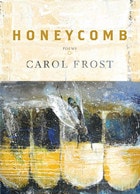
Honeycomb
PoemsCarol Frost
Northwestern University Press, 2010
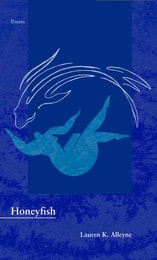
Honeyfish
Lauren K. Alleyne
New Issues Poetry and Prose, 2018
days that we want to remember. Or forget. But don’t. Thus in our
sister’s memory, we survive in the luxury of dying. The courage of
loving. The re-imagining of our souls for another generation. Thank
you, my dear sister for your words saluting our living, our lives.”
—Sonia Sanchez, winner of the 2018 Lifetime Achievement Award
from the Academy of American Poets
“In exquisitely crafted poems of heart-accelerating candor and
clarity, Lauren K. Alleyne says to all the black bodies slain by hatred
and militarized fear, ‘Nothing I say will save you, but how can I say
nothing?’ Honeyfish is an elegy for all the countless lost, and a praise
song for the many black lives that persist in their wish to give and
receive love.”
— Tracy K. Smith, Poet Laureate of the United States of America
“Even in the places we think of as most beautiful, the endless gong
of the body being broken and defiled will find us. How can we see
the sun and the ocean and the clear blue sky as anything other than
a kind of cruel joke in the face of so much suffering? The extraordinary gift of Lauren K Alleyne’s, Honeyfish is that she shows
the world in all its brutality and loss and somehow lets us mourn within the poems, which in
turn allows us to begin some kind of healing. These are poems whose elegy is ongoing, whose
elegy need never happened but for hatred. The waves go in and out and so many people keep
being killed. And here is this extraordinary poet, making a heaven that is freedom, that is the
dream of being welcomed and loved and tended to. This is a book for our times and for the
day when these times are over and we can rejoice.”
— Gabrielle Calvacoressi, author of Rocket Fantastic
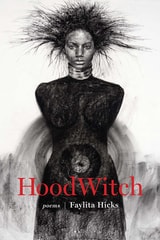
HoodWitch
Faylita Hicks
Acre Books, 2019
In this collection about resilience, Hicks speaks about giving her child up for adoption, mourning the death of her fiancé, and embracing the nonbinary femme body—persevering in the face of medical malpractice, domestic abuse, and police violence. The poems find people transformed, “remade out of smoke & iron” into cyborgs and wolves, machines and witches—beings capable of seeking justice in a world that refuses them the option.
Exploring the intersections of Christianity, modern mysticism, and Afrofuturism in a sometimes urban, sometimes natural setting, Hicks finds a place where “everyone everywhere is hands in the air,” where “you know they gonna push & pull it together. / Just like they learned to.” It is a place of natural magick—where someone like Hicks can have more than one name: where they can be both dead and alive, both a mortal and a god.
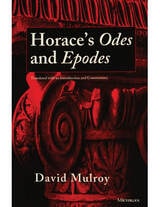
Horace's Odes and Epodes
Translated with an Introduction and CommentaryDavid Mulroy
University of Michigan Press, 1994
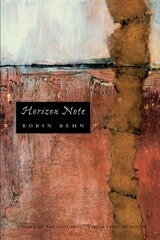
Horizon Note
Robin Behn
University of Wisconsin Press, 2001
A son is born too early, as if coming up over the horizon before his own dawn. An elderly father lingers at life’s other horizon. In language dense and clear, playful and somber, and with a formal exactitude and emotional amplitude suggestive of her own musical training, Behn traverses these horizons “extracting,” like the horizon note that drones through traditional Indian music, “a red needle from the sky.”
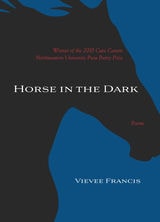
Horse in the Dark
PoemsVievee Francis
Northwestern University Press, 2012
In the next chapter of the Cave Canem/Northwestern University Poetry Prize, we enter the poetic world of Vievee Francis. Bold and skilled, Francis takes us into the still landscapes of Texas and the fluid details of the African American South. Her poems become panhandle folktales revealing the weight of memories so clear and on the cusp. Her creative tangle of metaphors, people and geography will keep the reader rooted in a good earth of extraordinary verse.
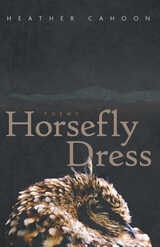
Horsefly Dress
PoemsHeather Cahoon
University of Arizona Press, 2020
Horsefly Dress is a meditation on the experience and beauty of suffering, questioning its triggers and ultimate purpose through the lens of historical and contemporary interactions and complications of Séliš, Qĺispé, and Christian beliefs. Heather Cahoon’s collection explores dark truths about the world through first-person experiences, as well as the experiences of her family and larger tribal community. As a member of the Confederated Salish and Kootenai Tribes, Cahoon crafts poems that recount traditional stories and confront Coyote’s transformation of the world, including his decision to leave certain evils present, such as cruelty, greed, hunger, and death.
By weaving together stories of Cahoon’s family and tribal community with those of Coyote and his family, especially Coyote’s daughter, Horsefly Dress, the interactions and shared experiences show the continued relevance of traditional Séliš and Qĺispé culture to contemporary life. Rich in the imagery of autumnal foliage, migrating birds, and frozen landscapes, Horsefly Dress calls forth the sensory experience of grief and transformation. As the stories and poems reveal, the transformative powers associated with the human experience of loss belong to the past, present, and future, as do the traditional Salish-Pend d’Oreille stories that create the backbone of this intricate collection.

Host
Lisa Fay Coutley
University of Wisconsin Press, 2024
light can pour warm through a cold bay
window while water under sun is dark
as a closed door. A man’s hand
erases a girl’s thigh. The trees start starving
themselves into everyone’s favorite color.
Her darkest room digs itself
below her throne. The body knows no
wrong move. The more love, the more.
—Excerpt from “Oubliette”
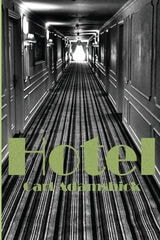
Hotel
Carl Adamshick
Four Way Books, 2021
Adamshick’s poems are characteristically accessible and navigable. From the political to the erotic and everywhere in between, these poems take us on a sometimes sober, sometimes raunchy ride.

Hotel Malabar
Brendan Galvin
University of Iowa Press, 1998
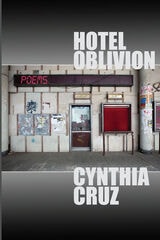
Hotel Oblivion
Cynthia Cruz
Four Way Books, 2022
A specter, haunting the edges of society: because neoliberalism insists there are no social classes, thus, there is no working class, the main subject of Hotel Oblivion, a working class subject, does not exist. With no access to a past, she has no home, no history, no memory. And yet, despite all this, she will not assimilate. Instead, this book chronicles the subject’s repeated attempts at locating an exit from capitalist society via acts of negative freedom and through engagement with the death drive, whose aim is complete destruction in order to begin all over again. In the end, of course, the only true exit and only possibility for emancipation for the working class subject is through a return to one’s self. In Hotel Oblivion, through a series of fragments and interrelated poems, Cruz resists invisibilizing forces, undergoing numerous attempts at transfiguration in a concerted effort to escape her fate.
House A
Jennifer S. Cheng
Omnidawn, 2016
House A is the winner of the 2015 Omnidawn 1st/2nd Poetry Book Prize, selected by Claudia Rankine.
House of Grace, House of Blood
PoemsDenise Low
University of Arizona Press, 2024
In a personal poetic treatment of documents, oral tradition, and images, the author embodies the contradictions she unravels. From a haunting first-person perspective, Low’s formally inventive archival poetry combines prose and lyric, interweaving verse with historical voices in a dialogue with the source material. Each poem builds into a larger narrative on American genocide, the ways in which human loss corresponds to ecological destruction, and how intimate knowledge of the past can enact healing.
Ultimately, these poems not only reconstruct an important historical event, but they also put pressure on the gaps, silences, and violence of the archive. Low asks readers to question not only what is remembered, but how history is remembered—and who is forgotten from it. Reflecting on the injustice of the massacre, the Shawnee leader Tecumseh lamented that though “the Americans murdered all the men, women, and children, even as they prayed to Jesus . . . no American ever was punished, not one.” These poems challenge this attempted erasure.
House of McQueen
Valerie Wallace
Four Way Books, 2018
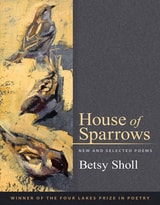
House of Sparrows
New and Selected PoemsBetsy Sholl
University of Wisconsin Press, 2019
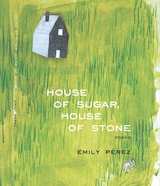
House of Sugar, House of Stone
Emily Pérez
University Press of Colorado, 2016
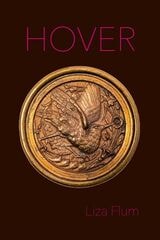
Hover
Liza Flum
Omnidawn, 2025
Liza Flum’s Hover focuses on queer polyamorous families, considering the ways people in radical family structures are both highly visible and erased. From hummingbirds to stars, historical records, and cemetery monuments, Flum searches for images to represent lives and loves like her own and to find lasting traces of queer and chosen family. In the poetic lexicon of Hover, hummingbirds become emblems of ungraspable survival and vitality, while records on paper and in stone afford enduring, though limited, representations.
The book explores sexuality, love, reproductive choice, and infertility in sonnets and expansive prose meditations. Linked stanzas, which act as little rooms, suggest the intermingling of bedrooms, doctor’s offices, and hospital rooms. The many forms in this collection claim space, both on the page and in poetic discourse, to make the intimate outwardly visible.
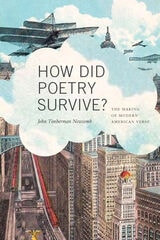
How Did Poetry Survive?
The Making of Modern American VerseJohn Timberman Newcomb
University of Illinois Press, 2013
This book traces the emergence of modern American poetry at the turn of the nineteenth century. With a particular focus on four "little magazines"--Poetry, The Masses, Others, and The Seven Arts--John Timberman Newcomb shows how each advanced ambitious agendas combining urban subjects, stylistic experimentation, and progressive social ideals. While subsequent literary history has favored the poets whose work made them distinct--individuals singled out usually on the basis of a novel technique--Newcomb provides a denser, richer view of the history that hundreds of poets made.
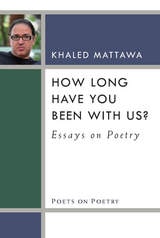
How Long Have You Been With Us?
Essays on PoetryKhaled Mattawa
University of Michigan Press, 2016
A volume in the Poets on Poetry series, which collects critical works by contemporary poets, gathering together the articles, interviews, and book reviews by which they have articulated the poetics of a new generation.
“Like the myriad companions and comrades that he summons from their exile, Khaled Mattawa is himself a ‘poet-stranger.’ In the essays, ‘written in a poet’s prose,’ collected in How Long Have You Been With Us, Mattawa evokes a powerful amalgam of the personal intimacy of the solitary and the political challenge of solidarity.”
—Barbara Harlow, University of Texas at Austin
“If you’ve read about exile, you’ve read about Brodsky and Milosz—just as, if you’ve read about translation, you’ve read about Walter Benjamin and George Steiner. While Khaled Mattawa has mastered these masters, his essays about world literature serve as a tour of the rest of the world. He introduces you to the writers you haven’t heard of but should from contemporary Libya and colonial South Asia to Latin America and China. When Mattawa invokes Saadi Youssef or Rabinidrath Tagore, Mohja Kahf or Toru Dutt, the effect is to deprovincialize American literature.”
—Ken Chen, The Asian American Writers’ Workshop
Khaled Mattawa, an American poet of Libyan origin, explores various dynamic developments shaping American poetry as it is being practiced today. Arising from an incredibly diverse range personal backgrounds, lyric traditions, and even languages, American poetry is transforming into a truly international form. Mattawa, who also translates Arabic poetry into American English and American poetry into Arabic, explores the poetics and politics of cross-cultural exchange and literary translation that fostered such transformation. The essays in this collection also shed light on Mattawa’s development as a poet and provide numerous portraits of the poets who helped shaped his poetry.
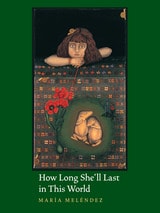
How Long She'll Last in This World
Maria Melendez
University of Arizona Press, 2006
With this invocation, María Meléndez beckons us on a journey—an exotic expedition through life’s mysteries in search of the finer strands of experience. In a Latina voice laced with a naturalist’s sense of wonder, she weaves bold images reflecting a world threaded by unseen wounds, now laid before us with an unflinching love of life and an exquisite precision of language. Adopting multiple guises—field researcher, laboring mother, grief-stricken lover—Meléndez casts aside stereotypes and expectations to forge a new language steeped in life and landscape. Whether meditating on a controlled prairie burn or contemplating the turquoise cheek of a fathead minnow, she weaves words and memories into a rich tapestry that resonates with sensual detail and magnifies her sense of maternal wildness, urging us to “Love as much as you / can, don’t throw your heart / away to just one god.” In her paean to the Aztec deity Tonacacihuatl, mother of the gods, Meléndez muses that “How many spirits she’s twin to, and how long she’ll last in this world, / are secrets stashed in the rattle / of corn ears, in the coils / of venomous snakes.”
Through stunning images and stark realism, her poems embrace motherhood and vocation, love and grief, land and life, to bring new meaning to the natural world and how we experience it.
How Poems Think
Reginald Gibbons
University of Chicago Press, 2015
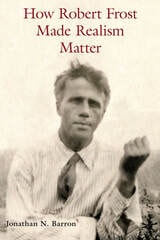
How Robert Frost Made Realism Matter
Jonathan N. Barron
University of Missouri Press, 2015
Robert Frost stood at the intersection of nineteenth-century romanticism and twentieth-century modernism and made both his own. Frost adapted the genteel values and techniques of nineteenth-century poetry, but Barron argues that it was his commitment to realism that gave him popular as well as scholarly appeal and created his enduring legacy. This highly researched consideration of Frost investigates early innovative poetry that was published in popular magazines from 1894 to 1915 and reveals a voice of dissent that anticipated “The New Poetry” – a voice that would come to dominate American poetry as few others have.
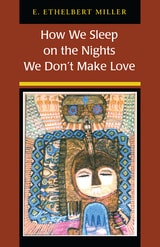
How We Sleep on the Nights We Don't Make Love
E. Ethelbert Miller
Northwestern University Press, 2004
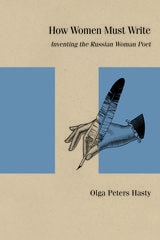
How Women Must Write
Inventing the Russian Woman PoetOlga Peters Hasty
Northwestern University Press, 2019
In How Women Must Write, Olga Peters Hasty takes us from an emphatically male Romantic age to a modernist period preoccupied with women’s creativity but also with its containment. In late nineteenth and early twentieth-century Russia, the woman poet was invented: by women poets themselves, by readers who projected gender biases into their poems, and by male poets who wrote posing as women. Examining Karolina Pavlova and Evdokiia Rostopchina, who inspired those writing after them, as well as two women invented by men, Cherubina de Gabriak and Briusov’s Nelli, and challenges to male authority by Marina Tsvetaeva and Anna Akhmatova, this book shows women as purposeful actors realizing themselves creatively and advancing the woman poet’s cause. It will appeal to the general reader and to specialists in Russian literature, women’s studies, and cultural history.