Results by title
1761 books match the query 'Public Policy' and 53 start with h

How to Respond Better to the Next Pandemic
Remedying Institutional FailuresAllen Buchanan, with contributions by Cécile Fabre and Sir Paul Tucker
University of Utah Press, 2024
There is no shortage of criticisms of U.S. COVID-19 policy. This book argues that officials at the highest levels lied to the public or deliberately suppressed relevant information, shamelessly over-sold the efficacy of masks and vaccines, and enacted lock-down policies of unproven value that caused massive economic, educational, and psycho-social damage.
In How to Respond Better to the Next Pandemic Allen Buchanan argues that, contrary to widespread opinion, the primary cause of flawed COVID-19 policy was not defective leadership, but rather institutional failure. Decisions were made through processes that lacked the most basic safeguards against the large-institution “yes-man” and group-think phenomena and included virtually no provisions for holding decision makers accountable. More fundamentally, policy makers did not fulfill the crucial duty to provide plausible public justifications for their decisions. They disguised the fact that scientific opinion was divided on the appropriateness of the policies they endorsed and labeled those who disagreed with them as anti-scientific. In some cases, they responded to criticism, not by engaging it on the issues, but by branding their critics as quacks.
In How to Respond Better to the Next Pandemic Allen Buchanan argues that, contrary to widespread opinion, the primary cause of flawed COVID-19 policy was not defective leadership, but rather institutional failure. Decisions were made through processes that lacked the most basic safeguards against the large-institution “yes-man” and group-think phenomena and included virtually no provisions for holding decision makers accountable. More fundamentally, policy makers did not fulfill the crucial duty to provide plausible public justifications for their decisions. They disguised the fact that scientific opinion was divided on the appropriateness of the policies they endorsed and labeled those who disagreed with them as anti-scientific. In some cases, they responded to criticism, not by engaging it on the issues, but by branding their critics as quacks.
[more]

Human Capital versus Basic Income
Ideology and Models for Anti-Poverty Programs in Latin AmericaFabián A. Borges
University of Michigan Press, 2022
Latin America underwent two major transformations during the 2000s: the widespread election of left-leaning presidents (the so-called left turn) and the diffusion of conditional cash transfer programs (CCTs)—innovative social programs that award regular stipends to poor families on the condition that their children attend school. Combining cross-national quantitative research covering the entire region and in-depth case studies based on field research, Human Capital versus Basic Income: Ideology and Models for Anti-Poverty Programs in Latin America challenges the conventional wisdom that these two transformations were unrelated. In this book, author Fabián A. Borges demonstrates that this ideology greatly influenced both the adoption and design of CCTs.
There were two distinct models of CCTs: a “human capital” model based on means-tested targeting and strict enforcement of program conditions, exemplified by the program launched by Mexico’s right, and a more universalistic “basic income” model with more permissive enforcement of conditionality, exemplified by Brazil’s program under Lula. These two models then spread across the region. Whereas right and center governments, with assistance from international financial institutions, enacted CCTs based on the human capital model, the left, with assistance from Brazil, enacted CCTs based on the basic income model.
The existence of two distinct types of CCTs and their relation to ideology is supported by quantitative analyses covering the entire region and in-depth case studies based on field research in three countries. Left-wing governments operate CCTs that cover more people and spend more on those programs than their center or right-wing counterparts. Beyond coverage, a subsequent analysis of the 10 national programs adopted after Lula’s embrace of CCTs confirms that program design—evaluated in terms of scope of the target population, strictness of conditionality enforcement, and stipend structure—is shaped by government ideology. This finding is then fleshed out through case studies of the political processes that culminated in the adoption of basic income CCTs by left-wing governments in Argentina and Bolivia and a human capital CCT by a centrist president in Costa Rica.
[more]
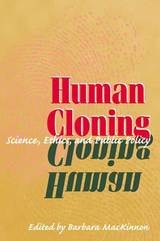
Human Cloning
Science, Ethics, and Public PolicyEdited by Barbara MacKinnon
University of Illinois Press, 2000
Is human cloning a science fiction nightmare come true? Or is it a practical avenue toward beneficial new medical treatments and techniques?
In this concise volume, experts on all sides of the debate make arguments for why we should either pursue, regulate, or ban the cloning of human beings. From this collection, readers will gain a clearer picture of the history of cloning in agriculture and animal science, the various biological procedures that are encompassed by the term "cloning," the philosophical arguments in support of and opposed to cloning humans, and the considerations that should inform discussions about public policy matters related both the cloning research and to human cloning itself.
Balancing scientific detail with philosophical argument, Human Cloning succinctly outlines what cloning is and is not (e.g., cloning does not produce identical individuals), what has led to recent scientific developments, what is now possible, and what ethical dilemmas cloning presents. Opponents claim that cloning subverts human dignity, makes a mockery of spousal love, and poses serious safety hazards. Proponents cite a range of potential benefits, such as producing transplant tissue that is less likely to be rejected, extending current techniques of artificial insemination, and controlling genetic abnormalities to prevent birth defects.
Cloning itself is not new, but as the science of cloning continues to advance--and as human cloning thus inches closer to reality--we are compelled to consider its implications for society. Human Cloning is a lucid, substantive guide to this contentious and potentially revolutionary issue.
[more]