Results by title
8642 books match the query '20th century' and 252 start with h
Heroes and Scoundrels
The Image of the Journalist in Popular CultureMatthew C. Ehrlich and Joe Saltzman
University of Illinois Press, 2015
Drawing on portrayals of journalists in television, film, radio, novels, comics, plays, and other media, Matthew C. Ehrlich and Joe Saltzman survey how popular media has depicted the profession across time. Their creative use of media artifacts provides thought-provoking forays into such fundamental issues as how pop culture mythologizes and demythologizes key events in journalism history and how it confronts issues of race, gender, and sexual orientation on the job.
From Network to The Wire, from Lois Lane to Mikael Blomkvist, Heroes and Scoundrels reveals how portrayals of journalism's relationship to history, professionalism, power, image, and war influence our thinking and the very practice of democracy.

Heterosexual Africa?
The History of an Idea from the Age of Exploration to the Age of AIDSMarc Epprecht
Ohio University Press, 2008
Heterosexual Africa? The History of an Idea from the Age of Exploration to the Age of AIDS builds from Marc Epprecht’s previous book, Hungochani (which focuses explicitly on same-sex desire in southern Africa), to explore the historical processes by which a singular, heterosexual identity for Africa was constructed—by anthropologists, ethnopsychologists, colonial officials, African elites, and most recently, health care workers seeking to address the HIV/AIDS pandemic. This is an eloquently written, accessible book, based on a rich and diverse range of sources, that will find enthusiastic audiences in classrooms and in the general public.
Epprecht argues that Africans, just like people all over the world, have always had a range of sexualities and sexual identities. Over the course of the last two centuries, however, African societies south of the Sahara have come to be viewed as singularly heterosexual. Epprecht carefully traces the many routes by which this singularity, this heteronormativity, became a dominant culture. In telling a fascinating story that will surely generate lively debate, Epprecht makes his project speak to a range of literatures—queer theory, the new imperial history, African social history, queer and women’s studies, and biomedical literature on the HIV/AIDS pandemic. He does this with a light enough hand that his story is not bogged down by endless references to particular debates.
Heterosexual Africa? aims to understand an enduring stereotype about Africa and Africans. It asks how Africa came to be defined as a “homosexual-free zone” during the colonial era, and how this idea not only survived the transition to independence but flourished under conditions of globalization and early panicky responses to HIV/AIDS.
Hewing to Experience
Essays and Reviews on Recent American Poetry and Poetics, Nature and CultureSherman Paul
University of Iowa Press, 1989

Hidden Histories of Unauthorized Migrations from Europe to the United States
Edited by Danielle Battisti and S. Deborah Kang
University of Illinois Press, 2025
Often depicted as the nation’s iconic legal immigrant, unauthorized European migrants are often overlooked by scholars, policymakers, and the media. This volume tells the stories of European migrants who adopted irregular migration strategies to enter and remain in the United States throughout the twentieth century. Contributors explore facets of this history with essays on migration patterns from Russia, Italy, Ireland, the Ottoman Empire, and Poland. They also offer important arguments about the treatment of unauthorized European migrants by states and societies on both sides of the Atlantic and how the reception of undocumented immigrants has been and continues to be impacted by the dynamics of racial, class, and gender constructions in the United States and abroad. As the contributors show, the reception accorded unauthorized European migrants frequently obscured and even normalized their irregular migration strategies, easing their access to American citizenship.
Revealing and insightful, Hidden Histories of Unauthorized Migrations from Europe to the United States sheds new light our intertwined notions of race, legality, and immigration.
Contributors: Danielle Battisti, Ashley Johnson Bavery, Mary Patrice Erdmans, Polina Ermoshkina, Torsten Feys, Carly Goodman, S. Deborah Kang, E. Kyle Romero, Randa Tawil, and Joanna Wojdon
Hidden Illness in the White House
Kenneth R. Crispell and Carlos Gomez
Duke University Press, 1988
Hidden Illness in the White House contains startling new information on the severity of Roosevelt’s illness during the crucial Yalta negotiations and the fact that Kennedy suffered from Addison’s disease, a life-threatening illness, long before he was elected to the presidency. In each case the authors demonstrate that a largely successful effort was made to conceal the president’s true medical condition from the public.
Hidden Out in the Open
Spanish Migration to the United States (1875-1930)Phylis Cancilla Martinelli
University Press of Colorado, 2018
The chapters in this volume are geographically wide-ranging, reflecting the transnational nature of the Spanish diaspora in the Americas, encompassing networks that connected Spain, Cuba, Latin American countries, the United States, and American-controlled territories in Hawai’i and Panama. The geographic diversity reveals the different jobs immigrants engaged in, from construction gangs in the Panama Canal to mining crews in Arizona and West Virginia. Contributors analyze the Spanish experience in the United States from a variety of perspectives, discussing rural and urban enclaves, the role of the state, and the political mobilization of migrants, using a range of methodological approaches that examine ethnicity, race, gender, and cultural practices through the lenses of sociology, history, and cultural studies.
The mention of the Spanish influence in the United States often conjures up images of conquistadores and padres of old. Forgotten in this account are the Spanish immigrants who reached American shores in the late nineteenth and early twentieth centuries. Hidden Out in the Open reveals the role of the modern migration of Spaniards in this "land of immigrants" and rectifies the erasure of Spain in the American narrative. The book will be of interest to scholars and students of US history and the history of modern Spain and Europe, as well as those interested ethnic and migration/diaspora studies, Hispanic/Latino studies, and the study of working class and radicalism.
Contributors: Brian D. Bunk, Christopher J. Castañeda, Thomas Hidalgo, Beverly Lozano, Phylis Cancilla Martinelli, Gary R. Mormino, George E. Pozzetta†, Ana Varela-Lago.

Hidden Transfers
How Rural Women’s Reproductive Work Paid for Industrialization in Mao’s ChinaJacob Eyferth
University of Chicago Press, 0
Provides a striking, new interpretation of the importance of rural women’s cloth production in collective-era China.
Based on extensive archival research, fieldwork across multiple villages, and hundreds of interviews, Hidden Transfers offers a material history of the working lives of rural women in communist China from 1949 to 1983.
Focusing on cotton cultivation and manual textile production in rural households, historian Jacob Eyferth examines the relationship between domestic labor and socialist development by recovering the story of the millions of women who spent countless hours spinning yarn, weaving cloth, and making clothes for their families. He shows how the “hidden transfers” from the domestic economy to fund accumulation rested, as with capitalist economies, on women’s unpaid domestic work. But state socialism went even further, celebrating the future-making work of production while disparaging work that reproduced life at home. Through careful research, Eyferth tracks how the Chinese state’s project of primitive accumulation, in turn, created the conditions for the spectacular growth experienced in the post-Mao years.
Hidden
A Sister and Brother in Nazi PolandFay Walker
University of Wisconsin Press, 2002
Of the Rosenbluth family, only the older children, Faiga and Luzer, had gone into hiding before the SS rounded up the Jews of Kanczuga, Poland. Hidden is Faiga and Luzer’s story, a memoir whose intimate and quiet particularity makes the incomprehensible enormity of the Holocaust immediate, human, and devastatingly real.
In alternating first-person narratives, Faiga (Fay) and Luzer (Leo) take readers into their very different but inextricably linked experiences in Nazi-occupied Poland. Faiga, the once-dignified young lady from a good home with servants and a seat by the eastern wall of the synagogue, spends two years wandering the perilous countryside, hoping to be taken for a peasant. Mere miles away, knowing nothing of his sister’s fate, Luzer, the leather wholesaler’s only son, lies silent all day in the stifling dark corner of a barn, where the smell of the cows’ warm hides are a piquant reminder of his lost world. Hidden deftly summons that world, as the familiar comforts and squabbles of life in a well-to-do, religious Jewish family are slowly overwhelmed by the grim news coming out of Germany. We follow Faiga and Luzer through the early forebodings and deprivations of the war, into hiding among righteous Poles and erstwhile neighbors-turned-betrayers, and finally, at war’s end, back once more into the world—but not necessarily into safety. Told in a confident, clear, and unsentimental prose, this is a story of heroism and tragedy writ large and small, of two young people coming of age in a world in chaos and then trying to return to "normal" after experiences as unimaginable as they are unforgettable.
High Country Summers
The Early Second Homes of Colorado, 1880–1940Melanie Shellenbarger
University of Arizona Press, 2012
High Country Summers considers the emergence of the “summer home” in Colorado’s Rocky Mountains as both an architectural and a cultural phenomenon. It offers a welcome new perspective on an often-overlooked dwelling and lifestyle. Writing with affection and insight, Melanie Shellenbarger shows that Colorado’s early summer homes were not only enjoyed by the privileged and wealthy but crossed boundaries of class, race, and gender. They offered their inhabitants recreational and leisure experiences as well as opportunities for individual re-invention—and they helped shape both the cultural landscapes of the American West and our ideas about it.
Shellenbarger focuses on four areas along the Front Range: Rocky Mountain National Park and its easterly gateway town, Estes Park; “recreation residences” in lands managed by the US Forest Service; Lincoln Hills, one of only a few African-American summer home resorts in the United States; and the foothills west of Denver that drew Front Range urbanites, including Denver’s social elite. From cottages to manor houses, the summer dwellings she examines were home to governors and government clerks; extended families and single women; business magnates and Methodist ministers; African-American building contractors and innkeepers; shop owners and tradespeople. By returning annually, Shellenbarger shows, they created communities characterized by distinctive forms of kinship.
High Country Summers goes beyond history and architecture to examine the importance of these early summer homes as meaningful sanctuaries in the lives of their owners and residents. These homes, which embody both the dwelling (the house itself) and dwelling (the act of summering there), resonate across time and place, harkening back to ancient villas and forward to the present day.
High Desert Blood
The 1980 New Mexico Prison Riot and the Tragedy of the Williams BrothersAndrew Brininstool
University of Iowa Press, 2025
Through meticulous research and compelling storytelling, Andrew Brininstool unveils the conditions that led to the infamous 1980 riot, a catastrophic event that left a permanent scar on the American penal landscape. Snaking through the storyline, we meet Gary Williams, a nonviolent first-time offender thrust into a world of chaos, and his brother, Jeff, a career criminal who mysteriously vanishes during the riot. After his release, Gary’s relentless quest for the truth about his brother’s disappearance leads him to a similar tragic fate.
This book offers an unflinching look at the brutality and corruption that plagued the prison, shedding light on the systemic issues that made such a disaster inevitable. High Desert Blood is not just a chronicle of violence and despair; it’s a call for reform.
High, Wide, and Handsome
The River Journals of Norman D. Nevillsedited by Roy Webb
Utah State University Press, 2005
When he started taking paying passengers by boat through the rapids of the Colorado River's canyons, Norman Nevills invented whitewater tourism and the commercial river business. For twelve years, from 1938 until his death in a plane crash in 1949, he safely took, without a single life lost, friends, explorers, and customers down the Colorado, Green, San Juan, Salmon, and Snake Rivers in boats he designed. National media found him and his adventures irresistible and turned him into the personification of river running. Logging seven trips through the Grand Canyon when no one else had completed more than two, he was called the Fast Water Man. Boatmen he trained went on to found their own competing operations. Always controversial, Nevills had important critics and enemies as well as friends and supporters, but no one can dispute his tremendous impact on the history of western rivers and recreation.
Nevills's complete extant journals of those river expeditions are published for the first time in High, Wide, and Handsome. They contain vivid stories and images of still untamed-by-dams rivers and canyons in the Colorado River system and elsewhere, of wild rides in wooden boats, and of the few intrepid pioneers of adventure tourism who paid Nevills so they could experience it all. They have been transcribed and edited by river historian Roy Webb, author of If We Had a Boat: Green River Explorers, Adventurers, and Runners and Call of the
Colorado.
High-Flying Birds
The 1942 St. Louis CardinalsJerome M. Mileur
University of Missouri Press, 2009
Highbrow/Lowdown
Theater, Jazz, and the Making of the New Middle ClassDavid Savran
University of Michigan Press, 2010

Hijra
Hala Alyan
Southern Illinois University Press, 2016
The reader sees war, diaspora, and immigration, and hears the marginalized voices of women of color. The poems use lyrical diction and striking imagery to evoke the weight of an emotional and visceral journey. They grow and build in length and form, reflecting the gains the women in the poems make in re-creating selfhood through endurance and strength.
In prose, narrative, and confessional-style poems, Alyan reflects on how physical space is refashioned, transmitted, and remembered. Her voice is distinct, fresh, relevant, and welcoming.
Hill Farms
Surviving Modern Times in Early Twentieth-Century VermontDona Brown
University of Massachusetts Press, 2025
There is a stubborn myth that has persisted for almost two centuries: the narrative of the abandoned farm in the rural American northeast. In Hill Farms, historian Dona Brown confronts this myth of rural decline with a focus on Jamaica, Vermont, a small town in the hills west of Brattleboro. Through this town’s history, she reveals a more complex economic and environmental narrative, a story of the continued use of traditional farm methods despite the growing power of modernization and demands for increased efficiencies.
Brown examines the records of a 1930 study by the University of Vermont’s now infamous Eugenics Survey, part of a flood of problematic investigations of Vermont rural life at the time, wherein eugenicists interviewed residents in every Jamaica household about crops, incomes, and housing conditions. These researchers from various disciplines saw in Jamaica and towns like it poverty and ignorance rather than a commitment to farming as a modest but sustainable way of life. Extensive handwritten notes from the Eugenics Survey provide a remarkable glimpse into the daily lives and practices of these upland farmers, revealing the value in maintaining older, less intensive farming practices and shedding new light on the social and environmental history of the time. As debates around farming and rural life intensified during the Great Depression, advocates beyond Vermont rose to the defense of traditional farms. Though industrialized agriculture ultimately prevailed, the old farming strategies cultivated by these upcountry residents continue to attract adherents in the face of new challenges to traditional farming in our own times.

Hillbilly Maidens, Okies, and Cowgirls
Women's Country Music, 1930-1960Stephanie Vander Wel
University of Illinois Press, 2020
From the 1930s to the 1960s, the booming popularity of country music threw a spotlight on a new generation of innovative women artists. These individuals blazed trails as singers, musicians, and performers even as the industry hemmed in their potential popularity with labels like woman hillbilly, singing cowgirl, and honky-tonk angel.
Stephanie Vander Wel looks at the careers of artists like Patsy Montana, Rose Maddox, and Kitty Wells against the backdrop of country music's golden age. Analyzing recordings and appearances on radio, film, and television, she connects performances to real and imagined places and examines how the music sparked new ways for women listeners to imagine the open range, the honky-tonk, and the home. The music also captured the tensions felt by women facing geographic disruption and economic uncertainty. While classic songs and heartfelt performances might ease anxieties, the subject matter underlined women's ambivalent relationships to industrialism, middle-class security, and established notions of femininity.
Hillel at Michigan, 1926/27-1945
Struggles of Jewish Identity in a Pivotal EraAndrei S. Markovits and Kenneth Garner
Michigan Publishing Services, 2016
The study analyzes Hillel's challenges as a big-tent, catch-all institution trying to represent all Jewish students on campus regardless of their religious orientation, cultural preferences, and ideological predilections. It looks at Hillel's interactions with the then powerful Jewish fraternities and sororities that provided the main locus of Jewish life on campus at the time, as well as its relations with the University's leadership and many of its cultural and political constituencies. Most of these activities occurred at a time when anti-Semitism was rife in the United States, particularly in the larger Detroit area, home to Henry Ford and Father Charles Edward Coughlin.
Hillside Fields
A History of Sports in West VirginiaBob Barnett
West Virginia University Press, 2013
Hillside Fields provides a broad view of the development of sports in West Virginia, from one of the first golf clubs in America at Oakhurst Links to the Greenbrier Classic; from the first girls basketball championship in 1919 to post Title IX; from racially segregated sports to integrated teams; and from the days when West Virginia Wesleyan and Davis & Elkins beat the big boys in football to the championship teams at WVU, Marshall, West Virginia State and West Liberty.
Hillside Fields explains how major national trends and events, as well as West Virginia’s economic, political, and demographic conditions, influenced the development of sports in the state. The story of the growth of sports in West Virginia is also a story of the tribulations, hopes, values and triumphs of a proud people.
Hinterland
America's New Landscape of Class and ConflictPhil A. Neel
Reaktion Books, 2018
Urgent and unsparing, this book opens our eyes to America’s new heart of darkness. Driven by an ever-expanding socioeconomic crisis, America’s class structure is recomposing itself in new geographies of race, poverty, and production. The center has fallen. Riots ricochet from city to city led by no one in particular. Anarchists smash financial centers as a resurgent far right builds power in the countryside. Drawing on his direct experience of recent popular unrest, from the Occupy movement to the wave of riots and blockades that began in Ferguson, Missouri, Phil A. Neel provides a close-up view of this landscape in all its grim but captivating detail. Inaugurating the new Field Notes series, published in association with the Brooklyn Rail, Neel’s book tells the intimate story of a life lived within America’s hinterland.

Hints And Disguises
Marianne Moore ContemporariesCeleste Goodridge
University of Iowa Press, 1989
The first book-length exploration of Marianne Moore's prose focuses on her private and public critical exchanges with Wallace Stevens, Ezra Pound, William Carlos Williams, and T.S. Eliot. Drawing on previously unpublished material from the Moore Archive—correspondence, notebooks, manuscript notes, and books—Celeste Goodridge establishes Moore's central role as both poet-critic and prose stylist, providing a new perspective for considering Moore in relation to her contemporaries.
With clarity and elegance, Goodridge shows that Moore's most compelling critical judgments can best be recovered by examining the relationship between her private disclosures and her public pronouncements; her aesthetic of "hints and disguises" reveals a tension between what she felt free to voice and what she chose to veil.
In writing about these four poets, Moore made her greatest contribution to modernist criticism. With unusual perspicacity, she anticipated and defined many of the critical debates which still surround these writers' projects. Furthermore, Moore's critical exchanges indicated that her deepest alliances were with Stevens and Pound and not, as most have argued, with Williams and Eliot.
Hip Sublime
Beat Writers and the Classical TraditionEdited by Sheila Murnaghan and Ralph M. Rosen
The Ohio State University Press, 2018
In this volume, a diverse group of contributors explore for the first time the fascinating tensions and paradoxes that arose from interactions between these avant-garde writers and a literary tradition often seen as conservative and culturally hegemonic. With essays that cover the canonical Beat authors—such as Allen Ginsberg, Jack Kerouac, and William Burroughs—along with less well-known figures—including Kenneth Rexroth, Ed Sanders, and Diane di Prima—Hip Sublime: Beat Writers and the Classical Tradition brings long overdue attention to the Beat movement’s formative appropriation of the Greek and Latin classics.
Hipbillies
Deep Revolution in the Arkansas OzarksJared M. Phillips
University of Arkansas Press, 2019

Hired Pens
Professional Writers in America’s Golden Age of PrintRonald Weber
Ohio University Press, 1997
Just as mass-market magazines and cheap books have played important roles in the creation of an American identity, those skilled craftsmen (and women) whose careers are the subjects of Ronald Weber’s narrative profoundly influenced the outlook and strategies of the high-culture writers who are generally the focus of literary studies.
Hired Pens, a history of the writing profession in the United States, recognizes the place of independent writers who wrote for their livelihood from the 1830s and 1840s, with the first appearance of a broad-based print culture, to the 1960s.
Many realist authors began on this American Grub Street. Jack London turned out hackwork for any paying market he could find, while Scott Fitzgerald’s stories in slick magazines in the 1920s and early ’30s established his name as a writer.
From Edgar Allen Poe’s earliest forays into writing for pay to Sylvia Plath’s attempts to produce fiction for mass-circulation journals, Hired Pens documents without agenda the evolution of professional writing in all its permutations—travel accounts, sport, popular biography and history, genre and series fiction—and the culture it fed.
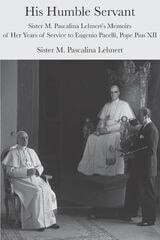
His Humble Servant
Sister M. Pascalina Lehnert's Memoirs of Her Years of Service to Eugenio Pacelli, Pope Pius XIIM. Pascalina Lehnert
St. Augustine's Press, 2012
This is a personal and insightful portrait of Pope Pius XII, the memories of Sister M. Pascalina Lehnert, who served as his housekeeper for forty years. Her book, most of it written just a few months after the Pope’s death, shares insights into the person, the life, and the thinking of Pius XII, from his time as Nuncio in Munich until his death. Much of Sister’s motivation in writing this work was to correct the many distortions of fact and interpretation regarding this great pope.
This book was a best seller in the original German, as well as in the Italian and French translations. This is the first edition in English.
These reminiscences were written down at the instructions of Sister’s Superior General, but were not made known to the public until 1982, when it was published in German at the express wishes of Pope John Paul II to publish the work without any changes. So the work remained a lively, flowing account of memories and anecdotes in a simple, spontaneous style. It is a powerful and insightful account of Pius’s daily life, his treatment of those around him, and his concern for the upholding of the traditional teaching of the Church in the face of his awesome burden to lead the Church during World War II.
Historians in Public
The Practice of American History, 1890-1970Ian Tyrrell
University of Chicago Press, 2005
Tyrrell's elegant history of the practice of American history traces debates, beginning shortly after the profession's emergence in American academia, about history's role in school curricula. He also examines the use of historians in and by the government and whether historians should utilize mass media such as film and radio to influence the general public. As Historians in Public shows, the utility of history is a distinctive theme throughout the history of the discipline, as is the attempt to be responsive to public issues among pressure groups.
A superb examination of the practice of American history since the turn of the century, Historians in Public uncovers the often tangled ways history-makers make history-both as artisans and as actors.
Historic Architecture in Alabama
A Guide to Styles and Types, 1810-1930Robert S. Gamble
University of Alabama Press, 2001
Discover the stories behind Alabama’s timeless structures.
Robert Gamble outlines in detail the primary architectural currents and styles that have surfaced in Alabama over the years and defined the state's built landscape. The structures and styles, all well-illustrated,range from folk houses and early settlement buildings to railway terminals, churches, libraries, municipal and university buildings, palatial private mansions, and modest homes. Structures from every period and every major stylistic era—Federal, Greek Revival, Gothic Revival, Italianate, Romanesque and Mission Revival, and the Richardsonian—are documented meticulously, along with examples of early—Modern buildings, including Alabama's only Frank Lloyd Wright structure and skyscrapers from the Chicago school.
More than 200 photographs, supplemented by sketches, plans, and etchings, provide the general reader and the design professional with images of Alabama architecture in all its variety and range. Many illustrations offer rare views of buildings long since demolished. A substantial glossary of architectural terms and a thorough bibliography enhance this standard sure to be welcomed anew by any lover of old buildings, whether weekend rambler or serious student.

Historic Structures
The Prague School Project, 1928–1946By F. W. Galan
University of Texas Press, 1985
In this first book-length study of Czech structuralism and semiotics in English, F. W. Galan explores one of the most important intellectual currents of the twentieth century, filling the gap between what has been written of the Russian formalism of the twenties and the French structuralism of the sixties and seventies. He records the evolution within the Prague Linguistic Circle of those theories which concern literature's change in time and the place of literature in society. In doing so, he reveals how the work of the Prague Linguistic Circle in the years 1928 to 1946 vindicate structuralism against its critics' charges that the structuralist approach—in linguistics, literary theory, film studies, and related fields—is inherently unhistorical. Overcoming this apparent methodological impasse was the main challenge confronted by the scholars of the Prague School–Roman Jakobson and Jan Mukarovsky, in particular.
Historical Distance and the Holocaust
Interactions Between Historians and Middle-Class Western Europeans in Memory EducationThomas Van de Putte
Central European University Press, 2026
A detailed interactional analysis and thick ethnographic description demonstrate how the temporal, moral and emotional distancing practices reenforce the lay moralities and political subjectivities of the white middle-class. This comes with (mostly unintended) consequences. Distanced approaches to the Holocaust in non-academic environments reduce empathy for victims and survivors, normalize violence, disconnect the meaning of the Holocaust from contemporary conflict, and re-activate stereotypes about groups who employ more ‘close’ approaches to the Holocaust.

History And 9/11
Joanne Meyerowitz
Temple University Press, 2003
History Matters
Contemporary Poetry on the Margins of American CultureIra Sadoff
University of Iowa Press, 2009
Much of our most adventurous writing has occurred at history’s margins, simultaneously making use of and resisting tradition. By tracking key contemporary poets—including John Ashbery, Olena Kaltyiak Davis, Louise Glück, Czeslaw Milosz, Frank O’Hara, and C. K. Williams—as well as musing on jazz and other creative enterprises, Sadoff investigates the lively poetic art of those who have grappled with late twentieth-century attitudes about history, subjectivity, contingency, flux, and modernity. In plainspoken writing, he probes the question of the poet’s capacity to illuminate and universalize truth. Along the way, we are called to consider how and why art moves and transforms human beings.
History after Apartheid
Visual Culture and Public Memory in a Democratic South AfricaAnnie E. Coombes
Duke University Press, 2003
History after Apartheid explores the dilemmas posed by a wide range of visual and material culture including key South African heritage sites. How prominent should Nelson Mandela and the African National Congress be in the museum at the infamous political prison on Robben Island? How should the postapartheid government deal with the Voortrekker Monument mythologizing the Boer Trek of 1838? Coombes highlights the contradictory investment in these sites among competing constituencies and the tensions involved in the rush to produce new histories for the “new” South Africa.
She reveals how artists and museum officials struggled to adequately represent painful and difficult histories ignored or disavowed under apartheid, including slavery, homelessness, and the attempted destruction of KhoiSan hunter-gatherers. Describing how contemporary South African artists address historical memory and the ambiguities uncovered by the Truth and Reconciliation Commission, Coombes illuminates a body of work dedicated to the struggle to simultaneously remember the past and move forward into the future.
History and Hope in the Heart of Dixie
Scholarship, Activism, and Wayne Flynt in the Modern SouthEdited by Gordon E. Harvey, Richard D. Starnes and Glenn Feldman
University of Alabama Press, 2006
Exploring the history, challenges, and promise of a changing South through the legacy of Wayne Flynt.
This collection of essays on the social and political history of the modern South consider the region’s poor, racial mores and race relations, economic opportunity, Protestant activism, political coalitions and interest groups, social justice, and progressive reform. History and Hope in the Heart of Dixie illuminates the dual role of historian and public advocate in modern America. In a time when the nation’s eyes have been focused by Hurricanes Katrina and Rita onto the vulnerability and dire condition of poor people in the South, the applicability of research, teaching, and activism for this voiceless element seems all the more relevant.
Responding to the example of Wayne Flynt, whose fierce devotion to his state of Alabama and its region has not blinded his recognition of the inequities and despair that define southern life for so many, the scholars assembled in this work present contributions to the themes Flynt so passionately explored in his own work.Two seasoned observers of southern history and culture—John Shelton Reed and Dan T. Carter—offer assessments of Flynt’s influence on the history profession as a whole and on the region of the South in particular.
History and Memory in the Two Souths
Recent Southern and Spanish American FictionDeborah Cohn
Vanderbilt University Press, 1999
First, Cohn proposes that Faulkner's appeal derives from Spanish American authors' perception of similarities between the South's history and the experiences of their own respective nations. She delineates historical experiences common to the South and Spanish America, including civil wars, defeat and dispossession, regional marginalization, and socio-economic hardship. She also suggests that Spanish American authors found in Faulkner a set of concerns with which they could identify and that, as a result, they were inspired to take up the stylistic innovations characteristic of his writing. The resulting assimilation and adaptation of Euro-American modernism through Faulkner has been an indispensable part of what is known as la nueva narrativa, "the new narrative," as well as of successive movements in Spanish American literature.
From another perspective, Cohn's book shows points of contact between works by other southern and Spanish American novelists without positing relations of influence. Specifically, after identifying common, recurrent themes in modern southern and Spanish American literature in general, Cohn reveals levels of a shared understanding of regional history in Faulkner and Mario Vargas Llosa, in Ralph Ellison and Isabel Allende, as well as in Katherine Anne Porter and Juan Rulfo. Her analyses compare and contrast these authors' shared attempts to provide correctives to official, mainstream historical discourse through alternate, parallel strategies for reconstructing, recording, and reclaiming the past.
In yoking together the South and Spanish America as neighboring spaces with similar personalities, Cohn advances a daring and controversial thesis that both narrows and enhances the frame of comparison between the literatures of the South and Spanish America.
History and Myth in Romanian Consciousness
Lucian Boia
Central European University Press, 2001
There is a considerable difference between real history and discourse history - this book stems from this idea. The author points out that history is constantly reconstructed, adapted and sometimes mythified from the perspective of the present day, of present states of mind and ideologies. Boia closely examines the process of historical culture and conscience in nineteenth and twentieth century Romania, particularly concentrating on the impact of the national ideology on history. Based upon his findings, the author identifies several key mythical configurations and analyses the manner in which Romanians have reconstituted their own highly ideologized history over the last two centuries.
The strength of History and Myth in Romanian Consciousness lies in the author's ability to fully deconstruct the entire Romanian historiographic system and demonstrate the increasing acuteness of national problems in general, and in particular the exploitation of history to support national ideology.
History from the Bottom Up and the Inside Out
Ethnicity, Race, and Identity in Working-Class HistoryJames R. Barrett
Duke University Press, 2017

History of the American Newspaper Publishers Association
Edwin Emery, Editor
University of Minnesota Press, 1950
History of the American Newspaper Publishers Association was first published in 1950. Minnesota Archive Editions uses digital technology to make long-unavailable books once again accessible, and are published unaltered from the original University of Minnesota Press editions.
The dramatic story of the association that for sixty-three years has held a position of major importance in the development of our free press. For the first time the full story of the activities of this influential daily newspaper trade association is told by a scholar who was given access to the association's files of publications.
The story of the ANPA is primarily one of the advancement of the business interests of daily newspapers and of resulting conflicts and adjustments with labor unions, communications competitors, advertisers, newsprint makers, and the government. The author analyzes these areas of activity and integrates the history of the ANPA with the economic, political, and social developments that have transformed America and its daily newspapers since 1887.
Of major interest and importance is the discussion of the labor relations policy of the daily newspapers who are ANPA members.
Other major topics include the association's opposition to federal legislation which the ANPA asserted imperiled the freedom of the press; the association's battles to eliminate tariff charges on newsprint and to maintain favorable postal rates; competition with radio, magazines, and other communications media; business problems of daily newspapers in the field of advertising; and mechanical developments which have revolutionized the printing industry.
History of the Surrealist Movement
Gérard Durozoi
University of Chicago Press, 2002
From Dada to the Automatists, and from Max Ernst to André Breton, Gérard Durozoi here provides the most comprehensive history of the Surrealist movement. Tracing the movement from its origins in the 1920s to its decline in the 1950s and 1960s, Durozoi tells the history of Surrealism through its activities, publications, and reviews, demonstrating its close ties to some of the most explosive political, as well as creative, debates of the twentieth century.
Drawing on a staggering amount of documentary and visual evidence—including 1,000 photos—Durozoi illuminates all the intellectual and artistic facets of the movement, from literature and philosophy to painting, photography, and film, thus making History of the Surrealist Movement its definitive encyclopedia.
History's Babel
Scholarship, Professionalization, and the Historical Enterprise in the United States, 1880 - 1940Robert B. Townsend
University of Chicago Press, 2012
History's Erratics
Irish Catholic Dissidents and the Transformation of American Capitalism, 1870-1930David M. Emmons
University of Illinois Press, 2024
As Ice Age glaciers left behind erratics, so the external forces of history tumbled the Irish into America. Existing both out of time and out of space, a diverse range of these Roman-Catholic immigrants saw their new country in a much different way than did the Protestants who settled and claimed it. These erratics chose backward looking tradition and independence over assimilation and embraced a quintessentially Irish form of subversiveness that arose from their culture, faith, and working-class outlook. David M. Emmons draws on decades of research and thought to plumb the mismatch of values between Protestant Americans hostile to Roman Catholicism and the Catholic Irish strangers among them. Joining ethnicity and faith to social class, Emmons explores the unique form of dissidence that arose when Catholic Irish workers and their sympathizers rejected the beliefs and symbols of American capitalism.
A vibrant and original tour de force, History’s Erratics explores the ancestral roots of Irish nonconformity and defiance in America.
History, Memory, and the Literary Left
Modern American Poetry, 1935-1968John Lowney
University of Iowa Press, 2006
Hitler in History
Eberhard Jäckel
Brandeis University Press, 2000
Hitler's Library
Ambrus Miskolczy
Central European University Press, 2003
Hitting A Straight Lick with a Crooked Stick
Race and Gender in the Work of Zora Neale HurstonSusan E Meisenhelder
University of Alabama Press, 2001
Hmong America
Reconstructing Community in DiasporaChia Youyee Vang
University of Illinois Press, 2010
Vang depicts Hmong experiences in Asia and examines aspects of community building in America to reveal how new Hmong identities have been formed and how they have challenged popular assumptions about race and ethnicity in multicultural America. Combining participant observation and archival research with personal experience, Vang constructs a nuanced and complex portrait of the more than 130,000 Hmong people who came to the United States as political refugees beginning in the mid-1970s. Her critique of previous representations of the Hmong community provides the sociological underpinnings for a bold reassessment of Hmong history in the greater context of globalization. This new understanding redefines concepts of Hmong homogeneity and characterizes ordinary Hmong migrants not as passive victims but as dynamic actors who have exercised much power over their political and social destinies.
Hmong Means Free
Life in Laos and AmericaSucheng Chan
Temple University Press, 1994
This collection of evocative personal testimonies by three generations of Hmong refugees is the first to describe their lives in Laos as slash-and-burn farmers, as refugees after a Communist government came to power in 1975, and as immigrants in the United States. Reflecting on the homes left behind, their narratives chronicle the difficulties of forging a new identity.
From Jou Yee Xiong's Life Story:
"I stopped teaching my sons many of the Hmong ways because I felt my ancestors and I had suffered enough already. I thought that teaching my children the old ways would only place a burden on them."
From Ka Pao Xiong's (Jou Yee Xiong's son) Life Story:
"It has been very difficult for us to adapt because we had no professions or trades and we suffered from culture shock. Here in America, both the husband and wife must work simultaneously to earn enough money to live on. Many of our children are ignorant of the Hmong way of life…. Even the old people are forgetting about their life in Laos, as they enjoy the prosperity and good life in America."
From Xang Mao Xiong's Life Story:
"When the Communists took over Laos and General Vang Pao fled with his family, we, too, decided to leave. Not only my family, but thousands of Hmong tried to flee. I rented a car for thirty thousand Laotian dollars, and it took us to Nasu…. We felt compelled to leave because many of us had been connected to the CIA…. Thousands of Hmong were traveling on foot. Along the way, many of them were shot and killed by Communist soldiers. We witnessed a bloody massacre of civilians."
From Vue Vang's Life Story:
"Life was so hard in the [Thai refugee] camp that when we found out we could go to the United States, we did not hesitate to grasp the chance. We knew that were we to remain in the camp, there would be no hope for a better future. We would not be able to offer our children anything better than a life of perpetual poverty and anguish."
Hog Butchers, Beggars, and Busboys
Poverty, Labor, and the Making of Modern American PoetryJohn Marsh
University of Michigan Press, 2011
"Impressive—Marsh successfully rewrites the founding moment of American Modernist poetry."
---Mark Van Wienen, Northern Illinois University
"Cogently argued, instructive, and sensitive, Marsh’s revisionist reading opens new insights that will elicit lively comment and critical response."
---Douglas Wixson, University of Missouri–Rolla
Between 1909 and 1922, the genre of poetry was remade. Literary scholars have long debated why modern American poetry emerged when and how it did. While earlier poetry had rhymed, scanned, and dealt with conventional subjects such as love and nature, modern poetry looked and sounded very different and considered new areas of experience. Hog Butchers, Beggars, and Busboys: Poverty, Labor, and the Making of Modern American Poetry argues that this change was partially the result of modern poets writing into their verse what other poetry had suppressed: the gritty realities of modern life, including the problems of the poor and working class.
A closer look at the early works of the 20th century's best known poets (William Carlos Williams, T. S. Eliot, Edna St. Vincent Millay, Claude McKay, Langston Hughes, and Carl Sandburg) reveals the long-neglected role the labor problem—including sweatshops, strikes, unemployment, woman and child labor, and immigration---played in the formation of canonical modern American poetry. A revisionary history of literary modernism and exploration into how poets uniquely made the labor problem their own, this book will appeal to modernists in the fields of American and British literature as well as scholars in American studies and the growing field of working-class literature.
Hogs, Mules, and Yellow Dogs
Growing Up on a Mississippi Subsistence FarmJimmye Hillman; Foreword by Robert Hass
University of Arizona Press, 2012
"It's in the nature of things that whole worlds disappear," writes the poet Robert Hass in the foreword to Jimmye Hillman's insightful memoir. "Their vanishings, more often than not, go unrecorded or pass into myth, just as they slip from the memory of the living."
To ensure that the world of Jimmye Hillman's childhood in Greene County, Mississippi during the Great Depression doesn't slip away, he has gathered together accounts of his family and the other people of Old Washington village. There are humorous stories of hog hunting and heart-wrenching tales of poverty set against a rural backdrop shaded by the local social, religious, and political climate of the time. Jimmye and his family were subsistence farmers out of bare-bones necessity, decades before discussions about sustainability made such practices laudable.
More than just childhood memories and a family saga, though, this book serves as a snapshot of the natural, historical, and linguistic details of the time and place. It is a remarkable record of Southern life. Observations loaded with detail uncover broader themes of work, family loyalty, and the politics of changing times.
Hillman, now eighty-eight, went on to a distinguished career as an economist specializing in agriculture. He realizes the importance of his story as an example of the cultural history of the Deep South but allows readers to discover the significance on their own by witnessing the lives of a colorful cast of characters. Hogs, Mules, and Yellow Dogs is unique, a blend of humor and reflection, wisdom and sympathy—but it's also a hard-nosed look at the realities of living on a dirt farm in a vanished world.
Hold On to Your Dreams
Arthur Russell and the Downtown Music Scene, 1973-1992Tim Lawrence
Duke University Press, 2009
Tim Lawrence traces Russell's odyssey from his hometown of Oskaloosa, Iowa, to countercultural San Francisco, and eventually to New York, where he lived from 1973 until his death from AIDS-related complications in 1992. Resisting definition while dreaming of commercial success, Russell wrote and performed new wave and disco as well as quirky rock, twisted folk, voice-cello dub, and hip-hop-inflected pop. “He was way ahead of other people in understanding that the walls between concert music and popular music and avant-garde music were illusory,” comments the composer Philip Glass. "He lived in a world in which those walls weren't there." Lawrence follows Russell across musical genres and through such vital downtown music spaces as the Kitchen, the Loft, the Gallery, the Paradise Garage, and the Experimental Intermedia Foundation. Along the way, he captures Russell's openness to sound, his commitment to collaboration, and his uncompromising idealism.
Hold-Outs
The Los Angeles Poetry Renaissance, 1948-1992Bill Mohr
University of Iowa Press, 2011
Hollywood Exiles in Europe
The Blacklist and Cold War Film CulturePrime, Rebecca
Rutgers University Press, 2014
Rebecca Prime documents the untold story of the American directors, screenwriters, and actors who exiled themselves to Europe as a result of the Hollywood blacklist. During the 1950s and 1960s, these Hollywood émigrés directed, wrote, or starred in almost one hundred European productions, their contributions ranging from crime film masterpieces like Du rififi chez les hommes (1955, Jules Dassin, director) to international blockbusters like The Bridge on the RiverKwai (1957, Carl Foreman and Michael Wilson, screenwriters) and acclaimed art films like The Servant (1963, Joseph Losey, director).
At once a lively portrait of a lesser-known American “lost generation” and an examination of an important transitional moment in European cinema, the book offers a compelling argument for the significance of the blacklisted émigrés to our understanding of postwar American and European cinema and Cold War relations. Prime provides detailed accounts of the production and reception of their European films that clarify the ambivalence with which Hollywood was regarded within postwar European culture. Drawing upon extensive archival research, including previously classified material, Hollywood Exiles in Europe suggests the need to rethink our understanding of the Hollywood blacklist as a purely domestic phenomenon. By shedding new light on European cinema’s changing relationship with Hollywood, the book illuminates the postwar shift from national to transnational cinema.