Results by title
3369 books match the query 'Cultural & Social' and 119 start with h
How “Indians” Think
Colonial Indigenous Intellectuals and the Question of Critical Race TheoryGonzalo Lamana
University of Arizona Press, 2019
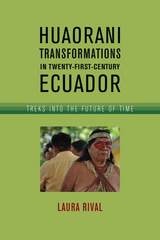
Huaorani Transformations in Twenty-First-Century Ecuador
Treks into the Future of TimeLaura Rival
University of Arizona Press, 2016
Rival’s intimate knowledge of Huaorani culture spans twenty-five years. Here in a collection of broad-ranging essays, she offers a fascinating and provocative study. The first section, “Among Forest Beings,” shows that the Huaorani have long adapted to life in the tropical rain forest with minimal reliance on horticulture, yet have developed a complex relationship with plants. In “In the Longhouse,” the second section, Rival focuses on the intimate relations that create human persons and enact kinship relations. She also discusses women’s lives and perspectives. The third section, “In the Midst of Enemies,” considers how Huaorani society fits in larger political and economic contexts, illustrating how native values shape their encounters with oil companies, the state, and other external forces. Rival carefully analyzes insider/outsider dialectics wherein Huaorani people re-create meaningful and valued worlds in the face of alien projects, such as petroleum development, carbon trading, or intercultural education.
Capitalizing on the author’s decades-long study and interactions in the community, Huaorani Transformations in Twenty-First-Century Ecuador brings new insights to the Huaorani’s unique way of relating to humans, to other-than-humans, and to the forest landscape they have inhabited for centuries.
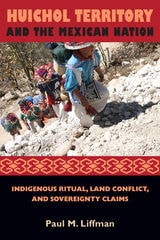
Huichol Territory and the Mexican Nation
Indigenous Ritual, Land Conflict, and Sovereignty ClaimsPaul M. Liffman
University of Arizona Press, 2011
Liffman writes that “the cultural grounds for territorial claims were what the people I wanted to study wanted me to work on.” Based on six years of collaboration with a land-rights organization, interviews, and participant observation in meetings, ceremonies, and extended stays on remote rancherías, Huichol Territory and the Mexican Nation analyzes the sites where people define Huichol territory. The book’s innovative structure echoes Huichols’ own approach to knowledge and examines the nation and state, not just the community. Liffman’s local, regional, and national perspective informs every chapter and expands the toolkit for researchers working with indigenous communities. By describing Huichols’ ceremonially based placemaking to build a theory of “historical territoriality,” he raises provocative questions about what “place” means for native peoples worldwide.
Human Organizations and Social Theory
Pragmatism, Pluralism, and AdaptationMurray J. Leaf
University of Illinois Press, 2008
Human Rights in the Maya Region
Global Politics, Cultural Contentions, and Moral EngagementsPedro Pitarch, Shannon Speed, and Xochitl Leyva Solano, eds.
Duke University Press, 2008
The collection includes a reflection on the effects of truth-finding and documenting particular human rights abuses, a look at how Catholic social teaching validates the human rights claims advanced by indigenous members of a diocese in Chiapas, and several analyses of the limitations of human rights frameworks. A Mayan intellectual seeks to bring Mayan culture into dialogue with western feminist notions of women’s rights, while another contributor critiques the translation of the United Nations Declaration of Human Rights into Tzeltal, an indigenous language in Chiapas. Taken together, the essays reveal a broad array of rights-related practices and interpretations among the Mayan population, demonstrating that global-local-state interactions are complex and diverse even within a geographically limited area. So too are the goals of indigenous groups, which vary from social reconstruction and healing following years of violence to the creation of an indigenous autonomy that challenges the tenets of neoliberalism.
Contributors: Robert M. Carmack, Stener Ekern, Christine Kovic, Xochitl Leyva Solano, Julián López García, Irma Otzoy, Pedro Pitarch, Álvaro Reyes, Victoria Sanford, Rachel Sieder, Shannon Speed, Rodolfo Stavenhagen, David Stoll, Richard Ashby Wilson
Human* Being
On Otherkin Identity and Digital CommunityDevin Proctor
Lever Press, 2026
Human* Being: On Otherkin Identity and Digital Community is an ethnographic exploration of the Otherkin—a technologically-mediated community of practice whose members identify as other-than-human—breaking down barriers of identity and calling into question assumptions about what it means to be a human. Based on a decade of ethnographic research, Human* Being examines Otherkin engagement with the techno-virtuality afforded by the internet—through chat forums, personal blogs, 3D virtual worlds, Facebook, YouTube, Tumblr, Discord, TikTok, and Reddit—troubling conventional notions about our relationships with the virtual and our understandings of the Self. The Otherkin represent a larger shift in body identity, shown by increasing numbers of people identifying as trans, nonbinary, fluid, and neurodiverse; bodies open to nuance, complication, and multiplicity. Devin Proctor closely examines internal community debates about the limits of non-human identity, avatar creation practices in virtual worlds to approximate inner realities, and the policing of identity constructs toward a stable definition of the phenomenon. However anomalistic, even fantastical they may seem, the Otherkin offer a window into our own complex notions of bodies, Selves, and technologies.
Humane Insight
Looking at Images of African American Suffering and DeathCourtney Baker
University of Illinois Press, 2017
Humanitarian Aftershocks in Haiti
Schuller, Mark
Rutgers University Press, 2016
The 2010 earthquake in Haiti was one of the deadliest disasters in modern history, sparking an international aid response—with pledges and donations of $16 billion—that was exceedingly generous. But now, five years later, that generous aid has clearly failed. In Humanitarian Aftershocks in Haiti, anthropologist Mark Schuller captures the voices of those involved in the earthquake aid response, and they paint a sharp, unflattering view of the humanitarian enterprise.
Schuller led an independent study of eight displaced-persons camps in Haiti, compiling more than 150 interviews ranging from Haitian front-line workers and camp directors to foreign humanitarians and many displaced Haitian people. The result is an insightful account of why the multi-billion-dollar aid response not only did little to help but also did much harm, triggering a range of unintended consequences, rupturing Haitian social and cultural institutions, and actually increasing violence, especially against women. The book shows how Haitian people were removed from any real decision-making, replaced by a top-down, NGO-dominated system of humanitarian aid, led by an army of often young, inexperienced foreign workers. Ignorant of Haitian culture, these aid workers unwittingly enacted policies that triggered a range of negative results. Haitian interviewees also note that the NGOs “planted the flag,” and often tended to “just do something,” always with an eye to the “photo op” (in no small part due to the competition over funding). Worse yet, they blindly supported the eviction of displaced people from the camps, forcing earthquake victims to relocate in vast shantytowns that were hotbeds of violence.
Humanitarian Aftershocks in Haiti concludes with suggestions to help improve humanitarian aid in the future, perhaps most notably, that aid workers listen to—and respect the culture of—the victims of catastrophe.
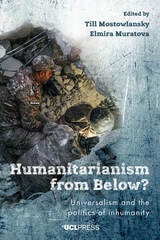
Humanitarianism from Below?
Universalism and the Politics of InhumanityEdited by Till Mostowlansky and Elmira Muratova
University College London, 2026
The first global comparative analysis of the role of humanitarianism from below in political and social change.
Drawing on original ethnographic and historical research, Humanitarianism from Below? addresses a wide audience of scholars and students in humanitarian and development studies, anthropology, and political science. Drawing from timely case studies on the war in Ukraine, the Ebola pandemic in West Africa, the 2023 Turkey-Syria earthquakes, and the global flows of aid from Arab states to the Persian Gulf, the book considers humanitarianism’s multiple histories and offers a profound reassessment of humanitarian pluralism today. It critically discusses humanitarianism as a historically, politically, and culturally contingent phenomenon that entails unequal relations of power and multiple forms of universalism, as well as issues of dehumanization and inhumanity.

Humanity's Last Stand
Confronting Global CatastropheMark Schuller
Rutgers University Press, 2021
Humanity’s Last Stand dares to ask these big questions, exploring the interconnections between climate change, global capitalism, xenophobia, and white supremacy. As it unearths how capitalism was born from plantation slavery and the slaughter of Indigenous people, it also invites us to imagine life after capitalism. The book teaches its readers how to cultivate an anthropological imagination, a mindset that remains attentive to local differences even as it identifies global patterns of inequality and racism.
Surveying the struggles of disenfranchised peoples around the globe from frontline communities affected by climate change, to #BlackLivesMatter activists, to Indigenous water protectors, to migrant communities facing increasing hostility, anthropologist Mark Schuller argues that we must develop radical empathy in order to move beyond simply identifying as “allies” and start acting as “accomplices.” Bringing together the insights of anthropologists and activists from many cultures, this timely study shows us how to stand together and work toward a more inclusive vision of humanity before it’s too late.
More information and instructor resources (https://humanityslaststand.org)

Humans and Other Animals
Cross-Cultural Perspectives on Human-Animal InteractionsSamantha Hurn
Pluto Press, 2012
Humans and Other Animals is about the myriad and evolving ways in which humans and animals interact, the divergent cultural constructions of humanity and animality found around the world, and individual experiences of other animals.
Samantha Hurn explores the work of anthropologists and scholars from related disciplines concerned with the growing field of anthrozoology. Case studies from a wide range of cultural contexts are discussed, and readers are invited to engage with a diverse range of human-animal interactions including blood sports (such as hunting, fishing and bull fighting), pet keeping and ‘petishism’, eco-tourism and wildlife conservation, working animals and animals as food. The idea of animal exploitation raised by the animal rights movements is considered, as well as the anthropological implications of changing attitudes towards animal personhood, and the rise of a posthumanist philosophy in the social sciences more generally.
Key debates surrounding these issues are raised and assessed and, in the process, readers are encouraged to consider their own attitudes towards other animals and, by extension, what it means to be human.
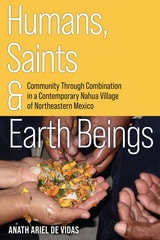
Humans, Saints, and Earth Beings
Community Through Combination in a Contemporary Nahua Village of Northeastern MexicoAnath Ariel De Vidas
University Press of Colorado, 2025
In her work, Ariel de Vidas demonstrates how villagers blend traditional earth-based rituals with Catholic practices, creating a sophisticated system of coexistence between humans and nonhuman entities. These ritual combinations serve as the primary mechanism for social production, cultural continuity, and political authority. The book challenges conventional anthropological binaries of tradition versus modernity and continuity versus acculturation through “thick” ethnographic descriptions that focus on the ethics of coexistence among humans themselves as well as between humans and the peculiar nonhuman inhabitants of their environment.
Originally published in Spanish as Combinar para convivir (2021), Humans, Saints, and Earth Beings contributes to contemporary theoretical discussions about Indigenous ontologies, ritual practice, and social cohesion. It offers crucial insights into how rural communities worldwide might navigate the tensions between maintaining cultural particularities and participating in broader social transformations, making it essential reading for anthropologists, Latin American studies scholars, and anyone interested in Indigenous resilience and adaptation.
Hunted
Predation and Pentecostalism in GuatemalaKevin Lewis O'Neill
University of Chicago Press, 2019
Hunted is based on more than ten years of fieldwork among these centers and the drug users that populate them. Over time, as Kevin Lewis O’Neill engaged both those in treatment and those who surveilled them, he grew increasingly concerned that he, too, had become a hunter, albeit one snatching up information. This thoughtful, intense book will reframe the arc of redemption we so often associate with drug rehabilitation, painting instead a seemingly endless cycle of hunt, capture, and release.
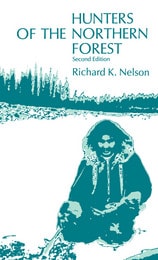
Hunters of the Northern Forest
Designs for Survival among the Alaskan KutchinRichard K. Nelson
University of Chicago Press, 1986
Hunting the Ethical State
The Benkadi Movement of Côte d'IvoireJoseph Hellweg
University of Chicago Press, 2011
In the 1990s a nationwide crime wave overtook Côte d’Ivoire. The Ivoirian police failed to control the situation, so a group of poor, politically marginalized, and mostly Muslim men took on the role of the people’s protectors as part of a movement they called Benkadi. These men were dozos—hunters skilled in ritual sacrifice—and they applied their hunting and occult expertise, along with the ethical principles implicit in both forms of knowledge, to the tracking and capturing of thieves. Meanwhile, as Benkadi emerged, so too did the ethnic, regional, and religious divisions that would culminate in Côte d’Ivoire’s 2002–07 rebellion.
Hunting the Ethical State reveals how dozos worked beyond these divisions to derive their new roles as enforcers of security from their ritual hunting ethos. Much as they used sorcery to shape-shift and outwit game, they now transformed into unofficial police, and their ritual networks became police bureaucracies. Though these Muslim and northern-descended men would later resist the state, Joseph Hellweg demonstrates how they briefly succeeded at making a place for themselves within it. Ultimately, Hellweg interprets Benkadi as a flawed but ingenious and thoroughly modern attempt by non-state actors to reform an African state.
Hustle Urbanism
Making Life Work in NairobiTatiana Thieme
University of Minnesota Press, 2025
Exploring hustle as a social, cultural, and economic phenomenon in contemporary Nairobi
In Nairobi’s underserved neighborhoods, “hustle” has emerged as both a vital survival strategy and a way of life for youth. Exploring the multiple meanings and manifestations of the hustle economy across different scenarios of provisioning, distribution, exchange, learning, and mobilizing, Hustle Urbanism draws on more than a decade of ethnographic engagement to center the logics, perspectives, and inventive strategies of a group of youth who constantly navigate job scarcity, inadequate basic services, and climate-induced harms.
Tatiana Thieme shows how young people develop tools of resistance against the legacies of colonial violence and uneven urban development while carving out spaces of opportunity for themselves and their peers. The stories she includes bring thick ethnographic detail and longitudinal perspective to the lives and livelihoods of youth whose diverse skill sets and knowledges span from circular economies and eco-activism to hip hop and local leadership. Filling a significant gap in both existing scholarship and popular discussion, Hustle Urbanism offers critical theorization of precarious urban environments and the affirmative modes of making life work in the city against the odds.
While Thieme cautions against fetishizing hustle as a form of social and economic uplift, she calls for a greater recognition of the ingenuity and skill involved in hustle urbanism, arguing that studying hustle narratives and practices opens up timely empirical and theoretical questions about overlapping urban struggles and possibilities that coexist in the everyday city.
Retail e-book files for this title are screen-reader friendly with images accompanied by short alt text and/or extended descriptions.
Hustling Is Not Stealing
Stories of an African Bar GirlJohn M. Chernoff
University of Chicago Press, 2003
In Hustling Is Not Stealing and its follow-up, Exchange Is Not Robbery, a chronicle of exploitation is transformed by verbal art into an ebullient comedy. In Hustling Is Not Stealing, Hawa is a playful warrior struggling against circumstances in Ghana and Togo. In Exchange Is Not Robbery, Hawa returns to her native Burkina Faso, where she achieves greater control over her life but faces new difficulties. As a woman making sacrifices to live independently, Hawa sees her own situation become more complex as she confronts an atmosphere in Burkina Faso that is in some ways more challenging than the one she left behind, and the moral ambiguities of her life begin to intensify.
Combining elements of folklore and memoir, Hawa’s stories portray the diverse social landscape of West Africa. Individually the anecdotes can be funny, shocking, or poignant; assembled together they offer a sweeping critical and satirical vision.

Hybrid Renaissance
Culture, Language, ArchitecturePeter Burke
Central European University Press, 2016
Hybrid Renaissance introduces the idea that the Renaissance in Italy, elsewhere in Europe, and in the world beyond Europe is an example of cultural hybridization.
The two key concepts used in this book are “hybridization” and “Renaissance”. Roughly speaking, hybridity refers to something new that emerges from the combination of diverse older elements. (The term “hybridization” is preferable to “hybridity” because it refers to a process rather than to a state, and also because it encourages the writer and the readers alike to think in terms of degree: where there is more or less, rather than presence versus absence.)
The book begins with a discussion of the concept of cultural hybridization and a cluster of other concepts related to it. Then comes a geography of cultural hybridization focusing on three locales: courts, major cities (whether ports or capitals) and frontiers. The following seven chapters describe the hybridity of the Renaissance in different fields: architecture, painting and sculpture, languages, literature, music, philosophy and law and finally religion. The essay concludes with a brief account of attempts to resist hybridization or to purify cultures or domains from what was already hybridized.
Hydraulic City
Water and the Infrastructures of Citizenship in MumbaiNikhil Anand
Duke University Press, 2017