Results by title
395 books match the query 'How' and 153 start with h
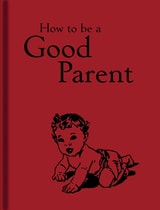
How to be a Good Parent
Compiled by Jaqueline Mitchell
Bodleian Library Publishing, 2015
To keep children clean is something that should never be attempted. It cannot be done.
The mere provision of the vegetable is not sufficient; it must be actually eaten.
If there is room enough for somersaults, the child can be satisfied.
These are just a few of the words of wisdom on offer in How to be a Good Parent, the latest in a series of delightful advice books from the Bodleian Library that also includes How to be a Good Husband and How to be a Good Wife. As developmental psychology began to show promise, beleaguered parents were drawn to the nascent discipline with the sorts of questions that will be familiar to any parent: How does one tell a toddler “no” without triggering a tantrum? Are there circumstances in which it’s acceptable to extract good behavior with bribery?
How to be a Good Parent brings together bits from the best of advice books of the 1920s and ’30s, taking readers through all the challenges involved in raising a child. Among the topics discussed are good—and bad—behavior, how to dress one’s dear son or darling daughter, mealtime, and the dreaded morning and bedtime routines. A section on taking medicine offers sage advice: “Gargling is a useful accomplishment” (while perhaps not appropriate for the dinner table). In a section on playtime, parents tasked with planning their child’s birthday will warmly welcome the book’s advice to “let the children give their own parties!”
By turns humorously old-fashioned and timeless, How to be a Good Parent is a charmingly illustrated guide to what any parent can tell you is the world's most difficult job.
[more]
How to be a Peer Research Consultant
A Guide for Librarians and StudentsMaglen Epstein
Assoc of College & Research Libraries, 2022
Every student brings their own individual set of educational and personal experiences to a research project, and peer research consultants are uniquely able to reveal this “hidden curriculum” to the researchers they assist.
In seven highly readable chapters, How to Be a Peer Research Consultant provides focused support for anyone preparing undergraduate students to serve as peer research consultants, whether you refer to these student workers as research tutors, reference assistants, or research helpers. Inside you’ll find valuable training material to help student researchers develop metacognitive, transferable research skills and habits, as well as foundational topics like what research looks like in different disciplines, professionalism and privacy, ethics, the research process, inclusive research consultations, and common research assignments. It concludes with an appendix containing 30 activities, discussion questions, and written reflection prompts to complement the content covered in each chapter, designed to be easily printed or copied from the book.
How to Be a Peer Research Consultant can be read in its entirety to gather ideas and activities, or it can be distributed to each student as a training manual. It pays particular attention to the peer research consultant-student relationship and offers guidance on flexible approaches for supporting a wide range of research needs. The book is intended to be useful in a variety of higher education settings and is designed to be applicable to each institution’s unique library resources and holdings. Through mentoring and coaching, undergraduate students can feel confident in their ability to help their peers with research and may be inspired to continue this work as professional librarians in the future.
[more]
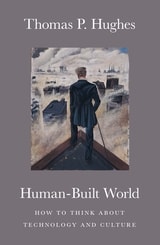
Human-Built World
How to Think about Technology and CultureThomas P. Hughes
University of Chicago Press, 2004
To most people, technology has been reduced to computers, consumer goods, and military weapons; we speak of "technological progress" in terms of RAM and CD-ROMs and the flatness of our television screens. In Human-Built World, thankfully, Thomas Hughes restores to technology the conceptual richness and depth it deserves by chronicling the ideas about technology expressed by influential Western thinkers who not only understood its multifaceted character but who also explored its creative potential.
Hughes draws on an enormous range of literature, art, and architecture to explore what technology has brought to society and culture, and to explain how we might begin to develop an "ecotechnology" that works with, not against, ecological systems. From the "Creator" model of development of the sixteenth century to the "big science" of the 1940s and 1950s to the architecture of Frank Gehry, Hughes nimbly charts the myriad ways that technology has been woven into the social and cultural fabric of different eras and the promises and problems it has offered. Thomas Jefferson, for instance, optimistically hoped that technology could be combined with nature to create an Edenic environment; Lewis Mumford, two centuries later, warned of the increasing mechanization of American life.
Such divergent views, Hughes shows, have existed side by side, demonstrating the fundamental idea that "in its variety, technology is full of contradictions, laden with human folly, saved by occasional benign deeds, and rich with unintended consequences." In Human-Built World, he offers the highly engaging history of these contradictions, follies, and consequences, a history that resurrects technology, rightfully, as more than gadgetry; it is in fact no less than an embodiment of human values.
[more]