163 books match the query '1945-1989' and 3 start with i
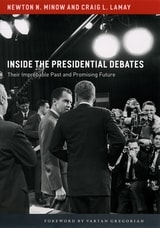
cover of Inside the Presidential Debates: Their Improbable Past and Promising Future

Inside the Presidential Debates

Their Improbable Past and Promising Future

Newton N. Minow and Craig L. LaMay

University of Chicago Press, 2008
Newton Minow’s long engagement with the world of television began nearly fifty years ago when President Kennedy appointed him chairman of the Federal Communications Commission. As its head, Minow would famously dub TV a “vast wasteland,” thus inaugurating a career dedicated to reforming television to better serve the public interest. Since then, he has been chairman of PBS and on the board of CBS and elsewhere, but his most lasting contribution remains his leadership on televised presidential debates. He was assistant counsel to Illinois governor Adlai Stevenson when Stevenson first proposed the idea of the debates in 1960; he served as cochair of the presidential debates in 1976 and 1980; and he helped create and is currently vice chairman of the Commission on Presidential Debates, which has organized the debates for the last two decades.
 
Written with longtime collaborator Craig LaMay, this fascinating history offers readers for the first time a genuinely inside look into the origins of the presidential debates and the many battles—both legal and personal—that have determined who has been allowed to debate and under what circumstances. The authors do not dismiss the criticism of the presidential debates in recent years but do come down solidly in favor of them, arguing that they are one of the great accomplishments of modern American electoral politics. As they remind us, the debates were once unique in the democratic world, are now emulated across the globe, and they offer the public the only real chance to see the candidates speak in direct response to one another in a discussion of major social, economic, and foreign policy issues.
 
Looking to the challenges posed by third-party candidates and the emergence of new media such as YouTube, Minow and LaMay ultimately make recommendations for the future, calling for the debates to become less formal, with candidates allowed to question each other and citizens allowed to question candidates directly. They also explore the many ways in which the Internet might serve to broaden the debates’ appeal and informative power. Whether it’s Clinton or Obama vs. McCain, Inside the Presidential Debates will be welcomed in 2008 by anyone interested in where this crucial part of our democracy is headed—and how it got there.
[more]
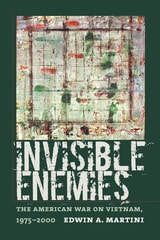
cover of Invisible Enemies: The American War on Vietnam, 1975-2000

Invisible Enemies

The American War on Vietnam, 1975-2000

Edwin A. Martini

University of Massachusetts Press, 2007

Beginning where most histories of the Vietnam War end, Invisible Enemies examines the relationship between the United States and Vietnam following the American pullout in 1975. Drawing on a broad range of sources, from White House documents and congressional hearings to comic books and feature films, Edwin Martini shows how the United States continued to wage war on Vietnam “by other means” for another twenty-five years. In addition to imposing an extensive program of economic sanctions, the United States opposed Vietnam's membership in the United Nations, supported the Cambodians, including the Khmer Rouge, in their decade-long war with the Vietnamese, and insisted that Vietnam provide a “full accounting” of American MIAs before diplomatic relations could be established. According to Martini, such policies not only worked against some of the stated goals of U.S. foreign policy, they were also in opposition to the corporate economic interests that ultimately played a key role in normalizing relations between the two nations in the late 1990s. 

Martini reinforces his assessment of American diplomacy with an analysis of the “cultural front”—the movies, myths, memorials, and other phenomena that supported continuing hostility toward Vietnam while silencing opposing views of the war and its legacies. He thus demonstrates that the “American War on Vietnam” was as much a battle for the cultural memory of the war within the United States as it was a lengthy economic, political, and diplomatic campaign to punish a former adversary.

[more]
cover of Israel and the American National Interest: A Critical Examination

Israel and the American National Interest

A Critical Examination

Cheryl A. Rubenberg

University of Illinois Press, 1986

"Israel's special relationship with the united States has come under close public scrutiny in recent months following revelations about Israeli involvement in the Iran-Contra and Jonathan Pollard spy scandals. Cheryl Rubenberg's controversial new book traces the evolution of that relationship from the Truman through the Reagan administrations and challenges the widely held view that close ties between Tel Aviv and Washington have served U. S. interests well in the Middle East. Indeed, she makes a convincing case that, in the two decades since 1967, U.S. policymakers have tended to confuse what is best for Israel with what is best for the United States and to ignore what she regards as the most pressing problem in the Middle East, the quest for a Palestinian homeland." -- Douglas Little, International History Review
 
[more]