Results by title
159 books match the query 'Academic writing' and 2 start with i

Insiders, Outliers
Centering Adult Student Writers at an HBCUCollie Fulford
Rutgers University Press, 2025
Winner of the 2026 Outstanding Book Award in the Monograph category from the Conference on College Composition and Communication
Insiders, Outliers invites readers into the lives of adult HBCU students for whom college is one meaningful activity among many. Although adults over the age of twenty-four comprise a quarter of all undergraduates, they are institutionally segregated and only partially served by a US higher education system that remains organized around traditional-aged learners. Even as such students are regarded as a market for postsecondary institutions, they are routinely marginalized by institutional barriers. Students’ stories of their personal, professional, community, and academic writing experiences illuminate a critical need for more age-inclusive practices across academia. Their cases also offer new conceptual models of writing as an ethical and emotional practice that fuels changes for individuals and the people and institutions that they care about—including higher education. What adult students reveal about writing across their life domains has powerful implications for conceptualizing writing as a complex form of agency and for teaching writing across the curriculum.
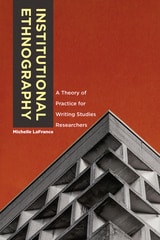
Institutional Ethnography
A Theory of Practice for Writing Studies ResearchersMichelle LaFrance
Utah State University Press, 2019
In this book, Michelle LaFrance introduces the theories, rhetorical frames, and methods that ground and animate institutional ethnography. Three case studies illustrate key aspects of the methodology in action, tracing the work of writing assignment design in a linked gateway course, the ways annual reviews coordinate the work of faculty and writing center administrators and staff, and how the key term “information literacy” socially organizes teaching in a first-year English program. Through these explorations of the practice of ethnography within sites of writing and writing instruction, LaFrance shows that IE is a methodology keenly attuned to the material relations and conditions of work in twenty-first-century writing studies contexts, ideal for both practiced and novice ethnographers who seek to understand the actualities of social organization and lived experience in the sites they study.
Institutional Ethnography expands the field’s repertoire of research methodologies and offers the grounding necessary for work with the IE framework. It will be invaluable to writing researchers and students and scholars of writing studies across the spectrum—composition and rhetoric, literacy studies, and education—as well as those working in fields such as sociology and cultural studies.