Results by title
784 books match the query 'American Government' and 33 start with i

I Hate It Here, Please Vote for Me
Essays on Rural Political DecayMatthew Ferrence
West Virginia University Press, 2024
The Best Narrative & Biography Books of 2024, Selected by Porchlight
When a progressive college professor runs for the Pennsylvania House of Representatives in a deeply conservative rural district, he loses. That’s no surprise. But the story of how Ferrence loses and, more importantly, how American political narratives refuse to recognize the existence and value of nonconservative rural Americans offers insight into the political morass of our nation.
In essays focused on showing goats at the county fair, planting native grasses in the front lawn, the political power of poetry, and getting wiped out in an election, Ferrence offers a counter-narrative to stereotypes of monolithic rural American voters and emphasizes the way stories told about rural America are a source for the bitter divide between Red America and Blue America.
Illinois Politics
A Citizen's GuideJames D. Nowlan, Samuel K. Gove, and Richard J. Winkel
University of Illinois Press, 2009
Illinois has produced presidents and leading members of Congress. It also has a long history of political corruption, including, in recent years, the federal indictments of two consecutive governors. The population of the state is exceptionally diverse, with a significant number of new immigrants. Its political allegiance, once firmly Republican, has trended ever more Democratic. Illinois can be divided neatly into three distinct regions: Chicago, the suburban collar surrounding the city, and the ninety-five downstate counties.
Based on the research and experience of respected veterans of Illinois politics, this book shows how the government runs, how politics operates, and what obstacles and opportunities exist for change. It explains how power is exercised and how parties compete for it. For engaged citizens, scholars, and students, Illinois Politics: A Citizen's Guide is a timely and much-needed roadmap for positive change.
Illinois Politics
A Citizen's Guide to Power, Politics, and GovernmentMelissa Mouritsen, Kent D. Redfield, and James D. Nowlan
University of Illinois Press, 2024
Shifting demographics. Downstate versus Chicago. Billionaires and bribery. Even veteran observers need a roadmap to track Illinois’ ever-changing political landscape. Melissa Mouritsen, Kent D. Redfield, and James D. Nowlan provide an up-to-date primer on Prairie State politics, government, and policies. Features include:
- Discussions of recent events like the 2015-2017 budget disaster, the response to COVID-19, and the fall of longtime House Speaker Michael Madigan;
- New chapters on corruption, social policies, and the political rules of the game;
- Perspectives on the nuts-and-bolts of campaign funding, the ways political actors acquire power or influence, and many other topics;
- Close examinations of complex issues like the state’s increased polarization and its ongoing fiscal recovery.
Fully revised and expanded, <i>Illinois Politics</i> blends detailed information with expert analysis to offer an essential resource for citizens, students, and public servants alike.
Imagining Politics
Interpretations in Political Science and Political TelevisionStephen Benedict Dyson
University of Michigan Press, 2019
Imagining Politics critically examines two interpretations of government. The first comes from pop culture fictions about politics, the second from academic political science. Stephen Benedict Dyson argues that televised political fictions and political science theories are attempts at meaning-making, reflecting and shaping how a society thinks about its politics.
By taking fiction seriously, and by arguing that political science theory is homologous to fiction, the book offers a fresh perspective on both, using fictions such as The West Wing, House of Cards, Borgen, Black Mirror, and Scandal to challenge the assumptions that construct the discipline of political science itself.
Imagining Politics is also about a political moment in the West. Two great political shocks—Brexit and the election of Donald Trump—are set in a new context here. Dyson traces how Brexit and Trump campaigned against our image of politics as usual, and won.
Implementing Term Limits
The Case of the Michigan LegislatureMarjorie Sarbaugh-Thompson and Lyke Thompson
University of Michigan Press, 2017
In Implementing Term Limits, Marjorie Sarbaugh-Thompson and Lyke Thompson bring thirteen years of intensive research and 460 interviews to assess changes since Michigan’s implementation of term limits in 1993 and explore their implications. Paying special attention to term limits’ institutional effects, they also consider legislative representation, political accountability, and the role of the bureaucracy and interest groups in state legislatures.
Their thorough study suggests that legislators are less accessible to officials and that there is a larger gap between legislators and their voters. Moreover, legislators become much more politically ambitious after term limits and spend more time on political activities. The selection of top chamber leaders is complicated by newcomers’ lack of knowledge about and experience working with the leaders they elect before being sworn in. As a result, term limits in Michigan fail to deliver on many of the “good government” promises that appeal to citizens.
Implementing Term Limits makes a unique and valuable contribution to the debate over the best means by which to obtain truly democratic institutions.

Implementing the Endangered Species Act on the Platte Basin Water Commons
David M. Freeman
University Press of Colorado, 2010
Implementing the Endangered Species Act on the Platte Basin Water Commons tells of the negotiations among the U.S. Department of the Interior, the environmental community, and the states of Wyoming, Colorado, and Nebraska that took place from the mid-1970s to 2006. Ambitious talks among rival water users, environmentalists, state authorities, and the Department of the Interior finally resulted in the Platte River Habitat Recovery Program.
Documenting how organizational interests found remedies within the conditions set by the Endangered Species Act, describing how these interests addressed habitat restoration, and advancing sociological propositions under which water providers transcended self-interest and produced an agreement benefiting the environment, this book details the messy process that took place over more than thirty years. Presenting important implications for the future of water management in arid and semi-arid environments, this book will be of interest to anyone involved in water management, as well as academics interested in the social organization of common property.
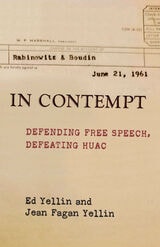
In Contempt
Defending Free Speech, Defeating HUACEd Yellin and Jean Fagan Yellin
University of Michigan Press, 2022
So began a decade of hardship for Ed and Jean Yellin and their three young children as the repressive weight of the U.S. government, caught up in the throes of McCarthyism, crashed down upon their careers, their daily household budget, and their relationships to colleagues, neighbors, and their country. In Contempt is a faithful, factual testament to the enduring quality of patriotic dissent in our evolving democracy—and a loving reconstruction of what it meant to be labeled “unAmerican” for defending the Constitution.
Inconsistency and Indecision in the United States Supreme Court
Matthew P. Hitt
University of Michigan Press, 2019
Yet a Court that prioritizes resolving many disputes will at times produce contradictory sets of opinions or fail to provide a rationale and legal precedent for its decision at all. In either case, it produces an unreasoned judgment. Conversely, a Court that prioritizes logically consistent doctrine will fail to resolve many underlying disputes in law and society. Inconsistency and Indecision in the United States Supreme Court demonstrates that over time, institutional changes, lobbied for by the justices, substantially reduced unreasoned judgments in the Court’s output, coinciding with a reduction in the Court’s caseload. Hence, the Supreme Court historically emphasized the first goal of dispute resolution, but evolved into a Court that prioritizes the second goal of logically consistent doctrine. As a result, the Court today fails to resolve more underlying questions in law and society in order to minimize criticism of its output from other elites. In so doing, the modern Court often fails to live up to its Constitutional obligation.
Indecision in American Legislatures
Jeffrey J. Harden and Justin H. Kirkland
University of Michigan Press, 2018
Lawmaking provides many opportunities for proposals to be altered, amended, tabled, or stopped completely. The ideal legislator should assess evidence, update his or her beliefs with new information, and sometimes be willing to change course. In practice, however, lawmakers face criticism from the media, the public, and their colleagues for “flip-flopping.” Legislators may also only appear to change positions in some cases as a means of voting strategically.
This book presents a systematic examination of legislative indecision in American politics. This might occur via “waffling”—where a legislator cosponsors a bill, then votes against it at roll call. Or it might occur when a legislator votes one way on a bill, then switches her vote to the other side. In Indecision in American Legislatures, Jeffrey J. Harden and Justin H. Kirkland develop a theoretical framework to explain indecision itself, as well as the public’s attitudes toward indecision. They test their expectations with data sources from American state legislatures, the U.S. Congress, and survey questions administered to American citizens. Understanding legislative indecision from both the legislator and citizen perspectives is important for discussions about the quality of representation in American politics.
Independence Corrupted
How America's Judges Make Their DecisionsCharles Benjamin Schudson
University of Wisconsin Press, 2018
As political attacks on judges increase, Schudson calls for reforms to protect judicial independence and for vigilance to ensure justice for all. Independence Corrupted is invaluable for students and scholars, lawyers and judges, and all citizens concerned about the future of America's courts.
Indiana Political Heroes
Geoff Paddock
Indiana Historical Society Press, 2008

Information and Democratic Processes
Edited by John A. Ferejohn and James H. Kuklinski
University of Illinois Press, 1990
The golden democratic tradition of an informed and involved electorate freely and rationally choosing its public officials seems to be at odds with American political reality. Thus the questions: On what basis do people vote and form opinions? How does the lack of information at the individual level affect system performance?
In this collection twenty-six distinguished political scientists discuss, debate, and define the relationship between information and the democracy it supposedly serves. The contributors address both the empirical and normative aspects of governing in the United States, employing psychological, sociological, and economic perspectives.
Information and Legislative Organization
Keith Krehbiel
University of Michigan Press, 1992
In this controversial book, Keith Krehbiel investigates and casts doubt upon a view of Congress held by many academics, journalists, and members of the lay public: that Congress is organized primarily to facilitate logrolling or "gains from trade" between legislators. The author puts forward an alternative "informational" theory that, unlike previous formal theories, highlights institutional needs and individual incentives for acquiring policy expertise. Using games with incomplete information, Krehbiel derives a set of unique and testable predictions about the organization of legislatures -- including the composition of committees and the procedures under which legislation is considered.
Krehbiel's creative illustrations and nonmathematical presentation of formal theories make this book accessible to a diverse set of readers. The political relevance and testability of games with incomplete information will be appreciated by game theorists and economists, while the book's findings make it essential reading for political scientists who study American politics, political institutions, or democratic legislatures.
Initiatives without Engagement
A Realistic Appraisal of Direct Democracy’s Secondary EffectsJoshua J. Dyck and Edward L. Lascher, Jr.
University of Michigan Press, 2019
When political scientists began to systematically examine whether the state ballot initiative process had spillover consequences, they found the initiative process had a positive impact on civic engagement. Recent scholarship casts doubt on these conclusions, determining the ballot initiative process did not make people believe they could influence the political process, trust the government, or be more knowledgeable about politics in general. However, in some circumstances, it got them to show up at the polls, and increased interest groups’ participation in the political arena. In Initiatives without Engagement, Dyck and Lascher develop and test a theory that can explain the evidence that the ballot initiative process fails to provide the civic benefits commonly claimed for it, and the evidence that it increases political participation. This theory argues that the basic function of direct democracy is to create more conflict in society.
Insecure Majorities
Congress and the Perpetual CampaignFrances E. Lee
University of Chicago Press, 2016
With Insecure Majorities, Frances E. Lee offers a controversial new perspective on the rise of congressional party conflict, showing how the shift in competitive circumstances has had a profound impact on how Democrats and Republicans interact. For nearly half a century, Democrats were the majority party, usually maintaining control of the presidency, the House, and the Senate. Republicans did not stand much chance of winning majority status, and Democrats could not conceive of losing it. Under such uncompetitive conditions, scant collective action was exerted by either party toward building or preserving a majority. Beginning in the 1980s, that changed, and most elections since have offered the prospect of a change of party control. Lee shows, through an impressive range of interviews and analysis, how competition for control of the government drives members of both parties to participate in actions that promote their own party’s image and undercut that of the opposition, including the perpetual hunt for issues that can score political points by putting the opposing party on the wrong side of public opinion. More often than not, this strategy stands in the way of productive bipartisan cooperation—and it is also unlikely to change as long as control of the government remains within reach for both parties.
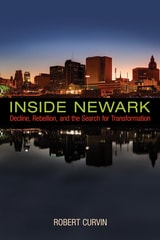
Inside Newark
Decline, Rebellion, and the Search for TransformationCurvin, Robert
Rutgers University Press, 2014
Based on historical records and revealing interviews with over one hundred residents and officials, Inside Newark traces Newark’s history from the 1950s, when the city was a thriving industrial center, to the era of Mayor Cory Booker. Along the way, Curvin covers the disturbances of July 1967, called a riot by the media and a rebellion by residents; the administration of Kenneth Gibson, the first black mayor of a large northeastern city; and the era of Sharpe James, who was found guilty of corruption. Curvin examines damaging housing and mortgage policies, the state takeover of the failing school system, the persistence of corruption and patronage, Newark’s shifting ethnic and racial composition, positive developments in housing and business complexes, and the reign of ambitious mayor Cory Booker.
Inside Newark reveals a central weakness that continues to plague Newark—that throughout this history, elected officials have not risen to the challenges they have faced. Curvin calls on those in positions of influence to work for the social and economic improvement of all groups and concludes with suggestions for change, focusing on education reform, civic participation, financial management, partnerships with agencies and business, improving Newark’s City Council, and limiting the term of the mayor. If Newark’s leadership can encompass these changes, Newark will have a chance at a true turnaround.
Inspectors-General
Junkyard Dogs or Man's Best Friend?Mark Moore
Russell Sage Foundation, 1986
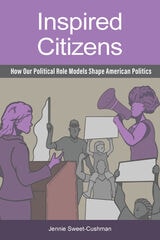
Inspired Citizens
How Our Political Role Models Shape American PoliticsJennie Sweet-Cushman
Temple University Press, 2024
Sweet-Cushman develops Inspired Citizenship Theory to show that political role models can have motivating effects on one’s political citizenship and may, in some case, insulate those who have been traditionally marginalized in American politics. Moreover, she asserts that citizens who have political role models possess very different political behaviors and attitudes than those who do not.
Inspired Citizens also considers the often-conflicting pressures and messages political role models project to citizens. Sweet-Cushman posits that role models inspire political action most effectively when they fulfill highly individualized expectations for role model identity, spurring deeper connection and a desire to emulate.
Inspired Citizens strengthens our understanding of what we should (and should not) look to political figures for in guiding democratic behaviors and inspiring productive citizenship.
Institutional Change, Discretion, and the Making of Modern Congress
An Economic InterpretationGlenn R. Parker
University of Michigan Press, 1992
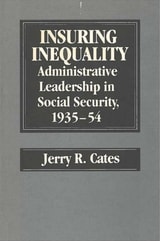
Insuring Inequality
Administrative Leadership in Social Security, 1935-54Jerry R. Cates
University of Michigan Press, 1983
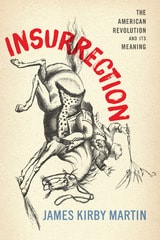
Insurrection
The American Revolution and Its MeaningJames Kirby Martin
Westholme Publishing, 2019
The Revolutionary generation believed they were living in dangerous, turbulent times. Their uprising against British imperial authority beginning in the 1760s represented an attempt to preserve their liberties in the face of what they perceived as a conspiracy from above, ultimately brought on by a tyrannical king and Parliament. The actual number of insurgents—we call them rebels or patriots—represented no more than 20 to 25 percent of the populace. Approximately the same number of persons refused to renounce their loyalty to the British Crown; and thousands of them joined British arms to crush the patriot insurrection. Not committed to supporting either side were large numbers of neutrals whose allegiance varied with their proximity to competing military forces. Once independence was secured, however, a great shift occurred. Some key Revolutionary leaders began to worry that the common people, if given too much political authority, would produce agitation from below that could destroy the delicate fabric of the newly established republic. Reckoning with this social and political disorder resulted in a series of constitutional settlements. What emerged was a more democratic system of government operating, at least theoretically, in the name of a sovereign people who had replaced the king and Parliament.
In Insurrection: The American Revolution and Its Meaning, award-winning historian James Kirby Martin discusses the causes, course, and consequences of the War for Independence. While interpretations of the Revolution and its short- and long-term meaning abound, Martin emphasizes that the insurrection against British monarchism led to more profound changes in human institutions and ideals than many of the Revolutionary leaders actually envisioned or wanted. Once unleashed, the genie of greater freedom and liberty for all could not be forced back into the bottle, no matter how much some persons would have desired.

Intergovernmental Fiscal Relations
William Anderson
University of Minnesota Press, 1956
Intergovernmental Relations as Seen by Public Officials
Edward Weidner
University of Minnesota Press, 1960
Intergovernmental Relations in Education
Robert Morlan
University of Minnesota Press, 1950
Intergovernmental Relations in Public Health
Laurence Wyatt
University of Minnesota Press, 1951
Intergovernmental Relations in Review
William Anderson
University of Minnesota Press, 1960
Intergovernmental Relations in Social Welfare
Ruth Raup
University of Minnesota Press, 1952
Intergovernmental Relations in the American Administrative State
The Johnson PresidencyBy David M. Welborn and Jesse Burkhead
University of Texas Press, 1989
During the 1960s, President Lyndon Johnson and his administration substantially altered the structure of the American administrative state. Creating intergovernmental programs to forward the goal of the Great Society, they changed the contours of national-state-local relationships, and these changes largely have remained, despite the attempts of later administrations to reverse them. Intergovernmental Relations in the American Administrative State is the first comprehensive study of how and why these changes occurred.
Drawn from a wealth of primary material in the Lyndon Baines Johnson Library, the study probes the objectives of the president and other framers of new policies and programs, within the institutional and political context of the time. The authors give special attention to the inherent incongruities that arise when intergovernmental programs are used to address problems defined in national terms. In addition, they reveal how certain programs actually challenged the power of established national bureaucracies. They conclude with a thoughtful overview of the Johnson legacy in intergovernmental relations during subsequent administrations.

Intimate States
Gender, Sexuality, and Governance in Modern US HistoryEdited by Margot Canaday, Nancy F. Cott, and Robert O. Self
University of Chicago Press, 2021
The last few decades have seen a surge of historical scholarship that analyzes state power and expands our understanding of governmental authority and the ways we experience it. At the same time, studies of the history of intimate life—marriage, sexuality, child-rearing, and family—also have blossomed. Yet these two literatures have not been considered together in a sustained way. This book, edited and introduced by three preeminent American historians, aims to close this gap, offering powerful analyses of the relationship between state power and intimate experience in the United States from the Civil War to the present.
The fourteen essays that make up Intimate States argue that “intimate governance”—the binding of private daily experience to the apparatus of the state—should be central to our understanding of modern American history. Our personal experiences have been controlled and arranged by the state in ways we often don’t even see, the authors and editors argue; correspondingly, contemporary government has been profoundly shaped by its approaches and responses to the contours of intimate life, and its power has become so deeply embedded into daily social life that it is largely indistinguishable from society itself. Intimate States makes a persuasive case that the state is always with us, even in our most seemingly private moments.

Inventing Congress
Origins and Establishment of the First Federal CongressKenneth R. Bowling
Ohio University Press, 1999
On March 4, 1789, New York City's church bells pealed, cannons fired, and flags snapped in the wind to celebrate the date set for the opening of the First Federal Congress. In many ways the establishment of Congress marked the culmination of the American Revolution as the ship of state was launched from the foundation of the legislative system outlined in Article I of the Constitution.
Inventing Congress presents the latest scholarship on the interrelated intellectual, institutional, cultural, and political antecedents of the formation of the First Federal Congress. The first section covers the origins of the body, ranging in discussion from the question of how the founders' understanding of classical Greek and Roman republican precedent shaped their thinking, to the political lessons learned during the Continental and Confederation Congresses.
The second section concerns itself with the establishment of the First Federal Congress, examining several heretofore little-treated aspects of the most important Congress in history, including its relationship to the press, morality, the arts and sciences, and economic philosophy.
Inventing Congress represents the papers from the first two conferences sponsored by the United States Capitol Historical Society in its series, “Perspectives on the History of Congress, 1789-1801.”
Is Administrative Law Unlawful?
Philip Hamburger
University of Chicago Press, 2014
With Is Administrative Law Unlawful?, Philip Hamburger answers this question in the affirmative, offering a revisionist account of administrative law. Rather than accepting it as a novel power necessitated by modern society, he locates its origins in the medieval and early modern English tradition of royal prerogative. Then he traces resistance to administrative law from the Middle Ages to the present. Medieval parliaments periodically tried to confine the Crown to governing through regular law, but the most effective response was the seventeenth-century development of English constitutional law, which concluded that the government could rule only through the law of the land and the courts, not through administrative edicts. Although the US Constitution pursued this conclusion even more vigorously, administrative power reemerged in the Progressive and New Deal Eras. Since then, Hamburger argues, administrative law has returned American government and society to precisely the sort of consolidated or absolute power that the US Constitution—and constitutions in general—were designed to prevent.
With a clear yet many-layered argument that draws on history, law, and legal thought, Is Administrative Law Unlawful? reveals administrative law to be not a benign, natural outgrowth of contemporary government but a pernicious—and profoundly unlawful—return to dangerous pre-constitutional absolutism.
Isolation and Engagement
Presidential Decision Making on China from Kennedy to NixonWilliam Waltman Newmann
University of Michigan Press, 2022
It's Not Personal
Politics and Policy in Lower Court Confirmation HearingsLogan Dancey, Kjersten R. Nelson, and Eve M. Ringsmuth
University of Michigan Press, 2020
In order to be confirmed to a lifetime appointment on the federal bench, all district and circuit court nominees must appear before the Senate Judiciary Committee for a confirmation hearing. Despite their relatively low profile, these lower court judges make up 99 percent of permanent federal judgeships and decide cases that relate to a wide variety of policy areas. To uncover why senators hold confirmation hearings for lower federal court nominees and the value of these proceedings more generally, the authors analyzed transcripts for all district and circuit court confirmation hearings between 1993 and 2012, the largest systematic analysis of lower court confirmation hearings to date. The book finds that the time-consuming practice of confirmation hearings for district and circuit court nominees provides an important venue for senators to advocate on behalf of their policy preferences and bolster their chances of being re-elected. The wide variation in lower court nominees’ experiences before the Judiciary Committee exists because senators pursue these goals in different ways, depending on the level of controversy surrounding a nominee. Ultimately, the findings inform a (re)assessment of the role hearings play in ensuring quality judges, providing advice and consent, and advancing the democratic values of transparency and accountability.