Results by title
51 books match the query 'American Sign Language' and 4 start with i
In Our Hands
Educating Healthcare InterpretersLaurie Swabey
Gallaudet University Press, 2012
Deaf Americans have identified healthcare as the most difficult setting in which to obtain a qualified interpreter. Yet, relatively little attention has been given to developing evidence-based resources and a standardized body of knowledge to educate healthcare interpreters. In Our Hands: Educating Healthcare Interpreters addresses these concerns by delineating the best practices for preparing interpreters to facilitate full access for deaf people in healthcare settings.
The first section of this volume begins with developing domains and competencies toward a teaching methodology for medical and mental health interpreters. The next chapter describes a discourse approach that relies on analyzing actual transcripts and recordings to train healthcare interpreters. Other chapters feature a model mental health interpreter training program in Alabama; using a Demand-Control Schema for experiential learning; the risk of vicarious trauma to interpreters; online educational opportunities; and interpreting for deaf health care professionals. The second section offers four perspectives on education, including healthcare literacy of the clients; the education of Deaf interpreters; the development of standards for spoken-language healthcare interpreters; and the perspectives of healthcare interpreter educators in Europe. The range and depth of In Our Hands takes significant strides in presenting educational opportunities that can enhance the critical services provided by healthcare interpreters to deaf clients.
Innovative Practices for Teaching Sign Language Interpreters
Cynthia B. Roy
Gallaudet University Press, 2000
Researchers now understand interpreting as an active process between two languages and cultures, with social interaction, sociolinguistics, and discourse analysis as more appropriate theoretical frameworks. Roy’s penetrating new book acts upon these new insights by presenting six dynamic teaching practices to help interpreters achieve the highest level of skill.
Jeffrey Davis illustrates the translation skills that form the basis for teaching consecutive and simultaneous interpreting to help students understand the intended meaning of the source message, and also the manner in which listeners understand it. Rico Peterson demonstrates the use of recall protocols, which can be used to teach metacognitive skills and to assess the student’s sign language comprehension. Finally, Janice Humphrey details the use of graduation portfolios, a valuable assessment tool used by faculty to determine a student’s level of competency. These imaginative techniques in Innovative Practices promise gains in sign language interpreting that will benefit teachers, students, and clients alike in the very near future.
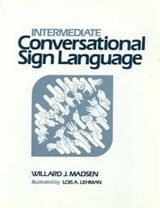
Intermediate Conversational Sign Language
Willard J Madsen
Gallaudet University Press, 1982
This fully illustrated text offers a unique approach to using American Sign Language (ASL) and English in a bilingual setting. Each of the 25 lessons involve sign language conversation using colloquialisms that are prevalent in informal conversations. Each lesson includes equivalent expressions in English, plus:
- Glossed Vocabulary Review
- Translation Exercises from ASL to English to ASL
- Grammatical Notes
- Substitution Drills
- Suggested Activities
The text also includes practice tests, a bibliography, and a glossed alphabetical index.

It’s Not What You Sign, It’s How You Sign It
Politeness in American Sign LanguageJack Hoza
Gallaudet University Press, 2007
The general stereotype regarding interaction between American Sign Language and English is a model of oversimplification: ASL signers are direct and English speakers are indirect. Jack Hoza’s study It’s Not What You Sign, It’s How You Sign It: Politeness in American Sign Language upends this common impression through an in-depth comparison of the communication styles between these two language communities. Hoza investigates relevant social variables in specific contexts and explores the particular linguistic strategies ASL signers and English speakers employ when they interact in these contexts.
It’s Not What You Sign, It’s How You Sign It is framed within politeness theory, an apt model to determine various interpretations of what speakers or signers mean in respect to the form of that which they say or sign. The variations reveal how linguistic and cultural differences intersect in ways that are often misinterpreted or overlooked in cross-cultural communication. To clarify these cross-linguistic differences, this volume explores two primary types of politeness and the linguistic strategies used by English speakers and ASL signers to express politeness concerns in face-to-face interaction. Hoza’s final analysis leads to a better understanding of the rich complexity of the linguistic choices of these language groups.