76 books match the query 'Animal rights' and 6 start with i
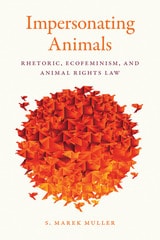
cover of Impersonating Animals: Rhetoric, Ecofeminism, and Animal Rights Law

Impersonating Animals

Rhetoric, Ecofeminism, and Animal Rights Law

S. Marek Muller

Michigan State University Press, 2020
In 2011, in one sign of a burgeoning interest in the morality of human interactions with nonhuman animals, a panel hosted by the American Association for the Advancement of Science declared that dolphins and orcas should be legally regarded as persons. Multiple law schools now offer classes in animal law and have animal law clinics, placing their students with a growing range of animal rights and animal welfare advocacy organizations. But is legal personhood the best means to achieving total interspecies liberation? To answer that question, Impersonating Animals evaluates the rhetoric of animal rights activists Steven Wise and Gary Francione, as well as the Earth jurisprudence paradigm. Deploying a critical ecofeminist stance sensitive to the interweaving of ideas about race, gender, class, sexuality, ability, and species, author S. Marek Muller places animal rights rhetoric in the context of discourses in which some humans have been deemed more animal than others and some animals have been deemed more human than others. In bringing rhetoric and animal studies together, she shows that how we communicate about nonhuman beings necessarily affects relationships across species boundaries and among people. This book also highlights how animal studies scholars and activists can and should use ideological rhetorical criticism to investigate the implications of their tactics and strategies, emphasizing a critical vegan rhetoric as the best means of achieving liberation for human and nonhuman animals alike.
[more]
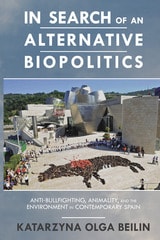
cover of In Search of an Alternative Biopolitics: Anti-Bullfighting, Animality, and the Environment in Contemporary Spain

In Search of an Alternative Biopolitics

Anti-Bullfighting, Animality, and the Environment in Contemporary Spain

Katarzyna Olga Beilin

The Ohio State University Press, 2015

In Search of an Alternative Biopolitics: Anti-Bullfighting, Animality, and the Environment in Contemporary Spain by Katarzyna Olga Beilin takes readers on a journey through the history of alternative thought that challenges mainstream understandings of the relations between the human and nonhuman realms. Weaving through the works of Mariano José de Larra, Eugenio Noel, Luis Buñuel, Luis Martín-Santos, Pedro Almodóvar, Pablo Bérguer, Juan Mayorga, and Rosa Montero, Beilin convincingly demonstrates that “the question of the animal” has long been of particular significance for Spanish culture.

Analyses of the synergy of press debates on bullfighting and the War on Terror, as well as media debates on King Juan Carlos’s hunt in Botswana and his resignation, reveal how the concepts structuring human/animal relations condition national biopolitics. Beilin traces a main principle, where sacrifice of some lives is deemed necessary for the sake of others, from bullfighting, through environmental destruction and immigration policies, to bioeconomy. Ultimately, In Search of an Alternative Biopolitics argues that to address ever-increasing threats of global warming and future catastrophes, we urgently need to redefine concepts structuring the human and the nonhuman realms.
[more]
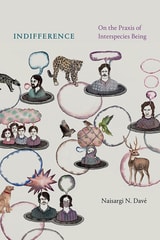
cover of Indifference: On the Praxis of Interspecies Being

Indifference

On the Praxis of Interspecies Being

Naisargi N. Davé

Duke University Press, 2023
In Indifference, Naisargi N. Davé examines the complex worlds of animalists and animalism in India. Through ethnographic fieldwork with animal healers, animal activists, farmers, laborers, transporters, and animals themselves, and moving across animal shelters and dairy farms to city streets and abattoirs, Davé shows how human-animal relations often manifest through care and violence. More surprisingly, what Davé also finds animating interspecies relationality in India is an ethic of indifference---that is, an orientation of mutual regard rather than curiosity, love, desire, or animus. For Davé, indifference is a respect for others in their otherness that allows human and nonhuman animals to flourish in immanent encounters. Indifference, then, becomes the basis for an interspecies ethics and a method of care and practice in everyday life. With indifference, Davé describes both a mode of relationality in the world and a scholarly approach: seeking what is possible when we approach ethico-political concepts with indifference rather than commitment or antagonism. Moments of indifference, Davé contends, offer the promise of otherwise worlds.
[more]
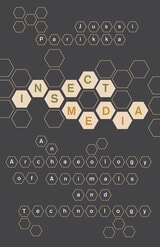
cover of Insect Media: An Archaeology of Animals and Technology

Insect Media

An Archaeology of Animals and Technology

Jussi Parikka

University of Minnesota Press, 2010

Since the early nineteenth century, when entomologists first popularized the unique biological and behavioral characteristics of insects, technological innovators and theorists have proposed insects as templates for a wide range of technologies. In Insect Media, Jussi Parikka analyzes how insect forms of social organization-swarms, hives, webs, and distributed intelligence-have been used to structure modern media technologies and the network society, providing a radical new perspective on the interconnection of biology and technology.

Through close engagement with the pioneering work of insect ethologists, including Jakob von Uexküll and Karl von Frisch, posthumanist philosophers, media theorists, and contemporary filmmakers and artists, Parikka develops an insect theory of media, one that conceptualizes modern media as more than the products of individual human actors, social interests, or technological determinants. They are, rather, profoundly nonhuman phenomena that both draw on and mimic the alien lifeworlds of insects.
 
Deftly moving from the life sciences to digital technology, from popular culture to avant-garde art and architecture, and from philosophy to cybernetics and game theory, Parikka provides innovative conceptual tools for exploring the phenomena of network society and culture. Challenging anthropocentric approaches to contemporary science and culture, Insect Media reveals the possibilities that insects and other nonhuman animals offer for rethinking media, the conflation of biology and technology, and our understanding of, and interaction with, contemporary digital culture.
[more]
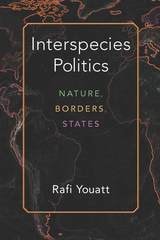
cover of Interspecies Politics: Nature, Borders, States

Interspecies Politics

Nature, Borders, States

Rafi Youatt

University of Michigan Press, 2020

This book explores the ways that international politics is a form of interspecies politics, one that involves the interactions, ideas, and practices of multiple species, both human and nonhuman, to generate differences and create commonalities. While we frequently think of having an international politics “of” the environment, a deep and thoroughgoing anthropocentrism guides our idea of what political life can be, which prevents us from thinking about a politics “with” the environment. This anthropocentric assumption about politics drives both ecological degradation and deep forms of interhuman injustice and hierarchy.

Interspecies Politics challenges that assumption, arguing that a truly ecological account of interstate life requires us to think about politics as an activity that crosses species lines. It therefore explores a postanthropocentric account of international politics, focusing on a series of cases and interspecies practices in the American borderlands, ranging from the US-Mexico border in southern Texas, to Guantánamo Bay in Cuba, to Isle Royale, near the US-Canadian border. The book draws on international relations, environmental political theory, anthropology, and animal studies, to show how key international dimensions of states—sovereignty, territory, security, rights—are better understood as forms of interspecies assemblage that both generate new forms of multispecies inclusion, and structure forms of violence and hierarchy against human and nonhuman alike.

[more]
cover of Introduction to Animal Rights: Your Child or the Dog?

Introduction to Animal Rights

Your Child or the Dog?

Gary L. Francione, foreword by Alan Watson

Temple University Press, 2000

Two-thirds of Americans  polled by the Associated Press agree with the following statement: "An animal's right to live free of suffering should be just as important as a person's right to live free of suffering." More than 50 percent of Americans believe that it is wrong to kill animals to make fur coats or to hunt them for sport. But these same Americans eat hamburgers, take their children to circuses and rodeos, and use products developed with animal testing. How do we justify our inconsistency?

In this easy-to-read introduction, animal rights advocate Gary Francione looks at our conventional moral thinking bout animals. Using examples, analogies, and thought-experiments, he reveals the dramatic inconsistency between what we say we believe about animals and how we actually treat them.

Introduction to Animal Rights: Your Child or the Dog? provides a guidebook to examining our social and personal ethical beliefs. It takes us through concepts of property and equal consideration to arrive at the basic contention of animal rights: that everyone -- human and  non-human -- has the right not to be treated as a means to an end. Along the way, it illuminates concepts and theories that all of us use but few of us understand -- the nature of "rights" and "interests," for example, and the theories of Locke, Descartes, and Bentham.

Filled with fascinating information and cogent arguments, this is a book that you may love or hate, but that will not fail to inform, enlighten, and educate.
[more]