Results by title
653 books match the query 'Animals' and 21 start with i
If You Tame Me
Understanding Our Connection With AnimalsLeslie Irvine, foreword by Marc Bekoff
Temple University Press, 2004
Illinois Insects and Spiders
Paintings by Peggy Macnamara
University of Chicago Press, 2005
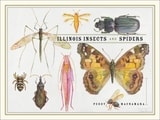
Marrying art and entomology, Illinois Insects and Spiders is a unique introduction to local biodiversity. Artist Peggy Macnamara celebrates the state's burgeoning insect and spider populations with twenty-seven color plates of beautiful renderings of numerous species, organized both taxonomically and thematically. The insects on each plate are depicted true to scale in relation to one another and are displayed approximately ten times larger than life size. Accompanying each plate are lively captions-written by Field Museum curators and collection managers-that identify the species and reveal their interesting behaviors and unique habitats.
Illinois Insects and Spiders encourages readers to explore the biodiversity at their feet-in the shiny beetles on the ground-and in the air-in the glint of a lightning bug in summer. More than a traditional field guide, Illinois Insects and Spiders is the rare book that combines lush artwork with the science of natural history, bringing both closer to the general reader.
Illustrated Guide to the Mountain Stream Insects of Colorado, Second Edition
J. V. Ward
University Press of Colorado, 2002
Images Of Animals
Eileen Crist
Temple University Press, 2000
Images of Animals examines the literature of behavioral science, revealing how works with the common aim of documenting animal lives, habits, and instincts describe "realities that are worlds apart." Whether the writer affirms the Cartesian verdict of an unbridgeable chasm between animals and humans or the Darwinian panorama of evolutionary continuity, the question of animal mind is ever present and problematic in behavioral thought. Comparing the naturalist writings of Charles Darwin, Jean Henri Fabre, and George and Elizabeth Peckham to works of classical ethology by Konrad Lorenz and Nikolaas Tinbergen and of contemporary sociobiology, Crist demonstrates how words matter. She does not attempt to defend any of these constructions as a faithful representation of animal existence, but to show how each internally coherent view molds the reader's understanding of animals. Rejecting the notion that "a neutral language exists, or can be constructed, which yields incontestably objective accounts of animal behavior," Crist argues that "language is not instrumental in the depiction of animals and, in particular, it is never impartial with respect to the question of animal mind."
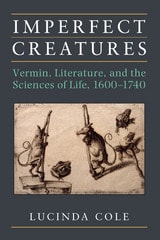
Imperfect Creatures
Vermin, Literature, and the Sciences of Life, 1600-1740Lucinda Cole
University of Michigan Press, 2016
As Cole illustrates, human health and demographic problems—notably those of feeding populations periodically stricken by hunger, disease, and famine—were tied to larger questions about food supplies, property laws, national identity, and the theological imperatives that underwrote humankind’s claim to dominion over the animal kingdom. In this context, Cole’s study indicates, so-called “vermin” occupied liminal spaces between subject and object, nature and animal, animal and the devil, the devil and disease—even reason and madness. This verminous discourse formed a foundational category used to carve out humankind’s relationship to an unpredictable, irrational natural world, but it evolved into a form for thinking about not merely animals but anything that threatened the health of the body politic—humans, animals, and even thoughts.
Impersonating Animals
Rhetoric, Ecofeminism, and Animal Rights LawS. Marek Muller
Michigan State University Press, 2020
In Pursuit of Giants
One Man's Global Search for the Last of the Great FishMatt Rigney
University Press of New England, 2017

In Search of the Golden Frog
Marty Crump
University of Chicago Press, 2000
The book is a detailed and fascinating chronicle of Crump's adventures as a field biologist—and as a wife and mother—in South and Central America. Following Crump on her research trips through Costa Rica, Ecuador, Brazil, Argentina, and Chile, we learn of amazingly diverse landscapes, equally diverse national traditions and customs, and the natural history of her subject of study, the frog. In leading us through rain forests and onto windswept coasts, Crump introduces us to such compelling creatures as female harlequin frogs, who pounce on males and pound their heads against the ground, and also sounds an alarm about the precipitous decline in amphibian populations around the globe.
Crump's perspectives as both a scientist and a mother, juggling the demands of family and professional life, make this highly readable account of fieldwork simultaneously close to home and wildly exotic. A combination of nature writing and travel writing, the richly illustrated In Search of the Golden Frog will whet travelers' appetites, affirm the experiences of seasoned field biologists, and offer the armchair naturalist vivid descriptions of amphibians and their habitats.
In Search of the Rain Forest
Candace Slater, ed.
Duke University Press, 2004
From diverse disciplines—history, archaeology, sociology, literature, law, and cultural anthropology—the contributors provide case studies from Latin America, Asia, and Africa. They point the way toward a search for a rain forest that is both a natural entity and a social history, an inhabited place and a shifting set of ideas. The essayists demonstrate how the single image of a wild and yet fragile forest became fixed in the popular mind in the late twentieth century, thereby influencing the policies of corporations, environmental groups, and governments. Such simplistic conceptions, In Search of the Rain Forest shows, might lead companies to tout their “green” technologies even as they try to downplay the dissenting voices of native populations. Or they might cause a government to create a tiger reserve that displaces peaceful peasants while opening the doors to poachers and bandits. By encouraging a nuanced understanding of distinctive, constantly evolving forests with different social and natural histories, this volume provides an important impetus for protection efforts that take into account the rain forest in all of its complexity.
Contributors. Scott Fedick, Alex Greene, Paul Greenough, Nancy Peluso, Suzana Sawyer, Candace Slater, Charles Zerner
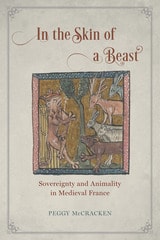
In the Skin of a Beast
Sovereignty and Animality in Medieval FrancePeggy McCracken
University of Chicago Press, 2017
Peggy McCracken discusses a range of literary texts and images from medieval France, including romances in which animal skins appear in symbolic displays of power, fictional explorations of the wolf’s desire for human domestication, and tales of women and snakes converging in a representation of territorial claims and noble status. These works reveal that the qualities traditionally used to define sovereignty—lineage and gender among them—are in fact mobile and contingent. In medieval literary texts, as McCracken demonstrates, human dominion over animals is a disputed model for sovereign relations among people: it justifies exploitation even as it mandates protection and care, and it depends on reiterations of human-animal difference that paradoxically expose the tenuous nature of human exceptionalism.
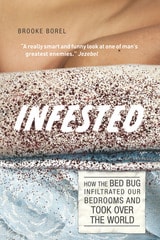
Infested
How the Bed Bug Infiltrated Our Bedrooms and Took Over the WorldBrooke Borel
University of Chicago Press, 2015
In Infested, Borel introduces readers to the biological and cultural histories of these amazingly adaptive insects, and the myriad ways in which humans have responded to them. She travels to meet with scientists who are rearing bed bug colonies—even by feeding them with their own blood (ouch!)—and to the stages of musicals performed in honor of the pests. She explores the history of bed bugs and their apparent disappearance in the 1950s after the introduction of DDT, charting how current infestations have flourished in direct response to human chemical use as well as the ease of global travel. She also introduces us to the economics of bed bug infestations, from hotels to homes to office buildings, and the expansive industry that has arisen to combat them.
Hiding during the day in the nooks and seams of mattresses, box springs, bed frames, headboards, dresser tables, wallpaper, or any clutter around a bed, bed bugs are thriving and eager for their next victim. By providing fascinating details on bed bug science and behavior as well as a captivating look into the lives of those devoted to researching or eradicating them, Infested is sure to inspire at least a nibble of respect for these tenacious creatures—while also ensuring that you will peek beneath the sheets with prickly apprehension.
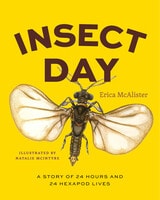
Insect Day
A Story of 24 Hours and 24 Hexapod LivesErica McAlister
University of Chicago Press, 2026
An hourly guide that follows twenty-four insects as they find food, mates, and safety from predators.
In this short book, celebrated scientist and award-winning author Erica McAlister leads readers on a worldwide field trip in search of insects. Each chapter of Insect Day introduces a single insect during a single hour, highlighting how twenty-four different species spend their time.
Early in our day, we meet a cold Arctic bumblebee, basking among poppy flower petals to warm itself. Even when the world around her is very cold, she keeps remarkably warm simply by vibrating. Near midday, there is enough sunlight for the blue-winged helicopter, a damselfly, to navigate the forests for her prey. When our insect spots a spider web, she looks for its creator—one vicious hunter eyeing up another. The giant damselfly reverses away from the web and then launches into an attack, grabbing onto the spider with her forelegs. If successful (many spiders are dropped), she perches while feasting. And then, like the most fastidious of diners, she cleans off any gossamer threads with a good preen. In the dark, the dung beetle also looks to the sky, using the Milky Way to orient itself as it rolls a ball of dung—a future home for its offspring. And, as our day closes, a tiger moth escapes bat hunters by fighting sound with sound—jamming bats’ sonar with ultrasonic clicking noises.
For each chapter, artist Natalie McIntyre has depicted these insects in stunning illustrations, blending traditional scientific drawing methods with fine art techniques. Working together to narrate and illustrate these unique moments in time, McAlister and McIntyre have created an engaging read that is a perfect way to spend an hour or two—and a true gift for readers, amateur naturalists, and all insect lovers.
Insect Media
An Archaeology of Animals and TechnologyJussi Parikka
University of Minnesota Press, 2010
Through close engagement with the pioneering work of insect ethologists, including Jakob von Uexküll and Karl von Frisch, posthumanist philosophers, media theorists, and contemporary filmmakers and artists, Parikka develops an insect theory of media, one that conceptualizes modern media as more than the products of individual human actors, social interests, or technological determinants. They are, rather, profoundly nonhuman phenomena that both draw on and mimic the alien lifeworlds of insects.
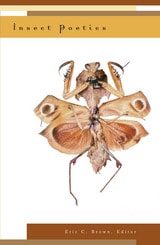
Insect Poetics
Eric C. Brown
University of Minnesota Press, 2006
In Insect Poetics, the first book to comprehensively explore the cultural and textual meanings of bugs, editor Eric Brown argues that insects are humanity’s “other.” In order to be experienced, the insect world must be mediated by art or technology (as in the case of an ant farm or Kafka’s Metamorphoses) while humans observe, detached and fascinated.
In eighteen original essays, this book illuminates the ways in which our human intellectual and cultural models have been influenced by the natural history of insects. Through critical readings contributors address such topics as performing insects in Shakespeare’s Coriolanus, the cockroach in the contemporary American novel, the butterfly’s “voyage out” in Virginia Woolf, and images of insect eating in literature and popular culture. In surprising ways, contributors tease out the particularities of insects as cultural signifiers and propose ways of thinking about “insectivity,” suggesting fertile cross-pollinations between entomology and the arts, between insects and the humanities.
Contributors: May Berenbaum, Yves Cambefort, Marion W. Copeland, Nicky Coutts, Bertrand Gervais, Sarah Gordon, Cristopher Hollingsworth, Heather Johnson, Richard J. Leskosky, Tony McGowan, Erika Mae Olbricht, Marc Olivier, Roy Rosenstein, Rachel Sarsfield, Charlotte Sleigh, Andre Stipanovic.
Eric C. Brown is assistant professor of English at the University of Maine at Farmington. He has written previously about insects and eschatology in Edmund Spenser’s Muiopotmos.
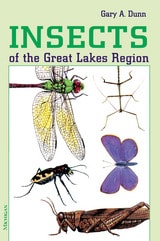
Insects of the Great Lakes Region
Gary A. Dunn
University of Michigan Press, 1996
The insects are the world's most amazing animals and comprise over eighty-five percent of the known animal species. Insects of the Great Lakes Region is the first comprehensive guide to document the rich and diverse insect fauna of the Great Lakes region. In Insects of the Great Lakes Region, educators, insect enthusiasts, and the general public will find high-quality, well-presented, easy-to-understand information with over 250 illustrations of the insects found in yards, gardens, fields, and forests. Among the topics discussed are the geological, biological, and entomological history of the Great Lakes region, the distributional patterns of insects in the Great Lakes region, and insect classification and identification. Appendixes guide the reader to entomological organizations, entomological periodicals, public insect collections, regulations on collecting insects from public lands in the Great Lakes region, as well as rare, threatened, and endangered insects. This guide shows the amateur entomologist everything he needs to know, from where to collect milkweed bugs to how often to feed his pet tarantula.
Gary Dunn is Executive Director and Editor, Young Entomologists' Society, Inc., International Headquarters, Lansing, Michigan.
Into Africa
Craig Packer
University of Chicago Press, 1994
As in the works of George Schaller and Cynthia Moss, Packer transports us to life in the field. He is addicted to this land—to the beauty of a male lion striding across the Serengeti plains, to the calls of a baboon troop through the rain forests of Gombe—and to understanding the animals that inhabit it. Through his vivid narration, we feel the dust and the bumps of the Arusha Road, smell the rosemary in the air at lunchtime on a Serengeti verandah, and hear the lyrics of the Grateful Dead playing off bootlegged tapes.
Into Africa also explores the social lives of the animals and the threats to their survival. Packer grapples with questions he has passionately tried to answer for more than two decades. Why do female lions raise their young in crèches? Why do male baboons move from troop to troop while male chimps band together? How can humans and animals continue to coexist in a world of diminishing resources? Immediate demands—logistical nightmares, political upheavals, physical exhaustion—yield to the larger inescapable issues of the interdependence of the land, the animals, and the people who inhabit it.
Iowa Birdlife
Gladys Black
University of Iowa Press, 1992

Iowa Breeding Bird Atlas
Laura Spess Jackson
University of Iowa Press, 1996
The Iowa Breeding Bird Atlas—the first comprehensive statewide survey of Iowa's breeding birds—provides a detailed record of the composition and distribution of the avifauna of the Hawkeye State. The atlas documents the presence of 199 species, 158 of which were confirmed breeding. This landmark volume will alert Iowans to the limited distribution of numerous species and serve as a guide to the management practices—such as forest and wetland management, set-aside programs, reduction in farm chemical use, and crop diversity—which could help insure that many future changes are positive ones. The Iowa Breeding Bird Atlas provides a welcome and much-needed baseline for future comparisons of changes in Iowa's birdlife and, by extension, the lives of all animals in the state.
Iowa's Changing Wildlife
Three Decades of Gain and LossJames J. Dinsmore
University of Iowa Press, 2023
Is Anyone Listening?
What Animals Are Saying to Each Other and to UsDenise L. Herzing
University of Chicago Press, 2024
If you could pose one question to a dolphin, what would it be? And what might a dolphin ask you? For forty years, researcher and author Denise L. Herzing has investigated these and related questions of marine mammal communication. With the assistance of a friendly community of Atlantic spotted dolphins in the Bahamas, Herzing studies two-way communication between different dolphin species and between humans and dolphins using a variety of cutting-edge experiments. But the dolphins are not the only ones talking, and in this wide-ranging and accessible book, Herzing explores the astonishing realities of interspecies communication, a skill that humans currently lack.
Is Anyone Listening? connects research on dolphin communication to findings from Jane Goodall on chimpanzees, Dian Fossey on mountain gorillas, Cynthia Moss on African elephants, and others driving today’s exploration of possible animal languages. Although humans have long attempted to crack animal communication codes, only now do we have the advanced machine-learning tools to help. As Herzing reveals, researchers are finding fascinating hints of language in nonhuman species, including linguistic structures, vowel equivalents, and complex repeated sequences. By looking at the many ways animals use and manipulate signals, we see that we’ve only just begun to appreciate the diversity of animal intelligence and the complicated and subtle aspects of animal communication.
Considering dolphins and other nonhuman animals as colleagues instead of research subjects, Herzing asks us to meet animals as both speakers and listeners, as mutually curious beings, and to listen to what they are saying.
Island Bats
Evolution, Ecology, and ConservationEdited by Theodore H. Fleming and Paul A. Racey
University of Chicago Press, 2010
The second largest order of mammals, Chiroptera comprises more than one thousand species of bats. Because of their mobility, bats are often the only native mammals on isolated oceanic islands, where more than half of all bat species live. These island bats represent an evolutionarily distinctive and ecologically significant part of the earth’s biological diversity.
Island Bats is the first book to focus solely on the evolution, ecology, and conservation of bats living in the world’s island ecosystems. Among other topics, the contributors to this volume examine how the earth’s history has affected the evolution of island bats, investigate how bat populations are affected by volcanic eruptions and hurricanes, and explore the threat of extinction from human disturbance. Geographically diverse, the volume includes studies of the islands of the Caribbean, the Western Indian Ocean, Micronesia, Indonesia, the Philippines, and New Zealand.
With its wealth of information from long-term studies, Island Bats provides timely and valuable information about how this fauna has evolved and how it can be conserved.