104 books match the query 'Animals & Nature' and 8 start with i
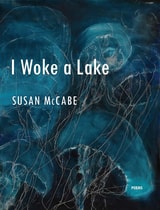
cover of I Woke a Lake

I Woke a Lake

Susan McCabe

University Press of Colorado, 2025
I Woke a Lake faces the anxieties of climate change, extinctions, and political chaos. Susan McCabe weaves together the fragile fabric of worlds imagined and lost, both palpable and present. Poised between reveries and ruins, the book traverses several layers: the Ice Age; the excavation of the oldest female body; ancient Los Angeles before humans; and, in Sweden (McCabe’s mother’s home country), the 377-million-year-old meteor-made Siljan lake, in conversation with the oldest tree alive. These channeled non-human voices, both whimsical and uncanny, animate more recent landscapes—such as Dalarna’s nearby seventeenth-century copper mine, now closed, along with a fantastical modern ice hotel in a state of meltdown. The landmarks of loss are sometimes dizzy-making as McCabe celebrates her childhood pantheism and queer development in West Hollywood, mourns dead relatives and lost habitats, and confronts her masculine lineage, blotted out through grief, addiction, and war. I Woke a Lake holds up an invisible telephone connecting recurrent locales, among them, blasted orchards, the Veterans’ Cemetery, Elizabeth Bishop’s childhood home in Great Village, grieving parties, and a cryopreservation site. These different layers reverberate with each other, taking on a haunted and haunting music, reaching toward an otherworldly, tender overhearing. 
 
[more]
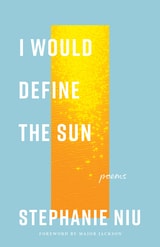
cover of I Would Define the Sun: Poems

I Would Define the Sun

Poems

Stephanie Niu; Foreword by Major Jackson

Vanderbilt University Press, 2025

Finalist for the Kate Tufts Discovery Award, 2026

Stephanie Niu’s I Would Define the Sun, awarded the 2024 Vanderbilt University Literary Prize, is a collection of poems that declare the impossibility of defining something as immense as the sun while striving toward that impossible act. In an era of planetary collapse, filled with bushfires, bleached coral, and burnout, Niu explores what love can do even through estrangement, even through being together at the end of the world. Recycling and folding language through duplexes, sestinas, and echoing couplets, this collection moves across great distances to include Christmas Island, Chinese-American immigration, and the precarity and abundance of the sea through formal and lyric poetry. Refitting the world into a size “made for [her] hands, [her] human tongue,” Niu propels readers into continuous motion as she searches for home.
[more]
cover of I Would Define the Sun: Poems

I Would Define the Sun

Poems

Stephanie Niu; Foreword by Major Jackson

Vanderbilt University Press, 2025

Finalist for the Kate Tufts Discovery Award, 2026

Stephanie Niu’s I Would Define the Sun, awarded the 2024 Vanderbilt University Literary Prize, is a collection of poems that declare the impossibility of defining something as immense as the sun while striving toward that impossible act. In an era of planetary collapse, filled with bushfires, bleached coral, and burnout, Niu explores what love can do even through estrangement, even through being together at the end of the world. Recycling and folding language through duplexes, sestinas, and echoing couplets, this collection moves across great distances to include Christmas Island, Chinese-American immigration, and the precarity and abundance of the sea through formal and lyric poetry. Refitting the world into a size “made for [her] hands, [her] human tongue,” Niu propels readers into continuous motion as she searches for home.

[more]
cover of Impastoral

Impastoral

Brandan Griffin

Omnidawn, 2022

Poems that blur the boundaries of language and species, inviting us to imagine a new world.

The expansive reworking of language in Impastoral flies through the possible voices of outsides and insides—slug, probe, horse carriage, sewer, potted plant, lab rat, vampire, bot fly, giant cow. Language, in Brandan Griffin’s poetry, is neither human nor nonhuman, and it undoes that very idea of these distinctions, so beings—slugprobe, pottedhorsesewer, telepathybarcode, mammaltexts—morph and change in between boundaries. 

Each of these poems is an organism, a collection of living connections, looped interiorities strung together in worlds tunneling through worlds. The poems’ composition becomes a decomposition of budding, breeding, and fluctuating. Reading this collection is an experience of becoming deformed and merged into the experiences of other beings; you are sea vent, microprocessor, cell gel, bug, a greenly translucent leaf typed half a sound at a time. Griffin invites us to imagine all possible beings and to hatch into a fresh world. 
 
Impastoral won the Omnidawn Open Book contest, selected by Brian Teare.
 
[more]
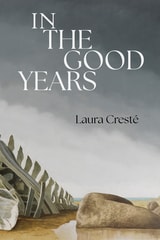
cover of In the Good Years

In the Good Years

Laura Cresté

Four Way Books, 2025
A high-lyric historian of the human project, Laura Cresté fixes her scrupulous gaze on the interwoven threads of this distressed anthropocene era, taking in the whole cloth of our globalized societies while recording the singular details of our individual lives and most intimate relationships—their intricate embroidery, characterizing stains, and fraying hems. In the Good Years confronts a painful family legacy, returning to the violent artistic censorship of Argentina's military dictatorship, her relatives' survival of a Dirty War death camp, and the scattered paths of their migration to safer ground. In reconstructing the past, Cresté resists the individualistic contraction of the coming of age model, not merely solidifying the psychological actualization of a single person as they enter adulthood but discursively expanding the notion of self, discovering the boundaries of identity as they overlay the seams of the broader world. These poems exist because of a narrowly avoided fate, and they bristle with the wild energy of improbable existence even as they touch on seemingly unrelated and often ordinary things: a roast chicken recipe, an aunt's questionable romantic advice, flea-ridden dogs, high school parties, waitressing at a dive bar, drowned newts in the swimming pool, unruly tomato plants, horseback riding. "Once saddled across a mare / named Ramona, I was afraid of the burden of my body," Cresté writes, fearful "that she would buckle—an animal once ridden into war." The sheer brilliance of this book's poetics manifest in lines like these, which bring political, personal, and ecological considerations to bear on the concept of weight in the space of a single sentence. What is the heft of a life that was nearly disappeared? How does a number become a weapon to enforce the gendered economy graphing desirability against power? What is the size of our footprint on this planet, and how heavy must our presence currently be as the animals and the land reach their breaking point? How much do you weigh? How much weight can you carry? "I was a teenager and jealous of the freedom / I imagined belonged to the thin," Cresté admits. "Now I know no one feels free, // not even the creature who devoured / the countryside, ravenous for the time / we were allowed in the field." This stunning debut champions that ravening, relishes the external and internal wilderness of the surrounding environment and our own human nature, and honors appetite as an opportunity to savor each bite for as long as we get to sit at the table. Throughout, these poems keenly subvert experience and memory, asking how we will remember this moment, and if the blessing of being here means we are somehow, even now in all the present's suffering, living in the good years.
[more]
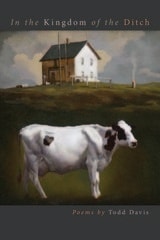
cover of In the Kingdom of the Ditch

In the Kingdom of the Ditch

Todd Davis

Michigan State University Press, 2013
In poetry that is at once accessible and finely crafted, Todd Davis maps the mysterious arc between birth and death, celebrating the beauty and pain of our varied entrances and exits, while taking his readers into the deep forests and waterways of the northeastern United States. With an acute sensibility for language unlike any other working poet, Davis captures the smallest nuances in the flowers, trees, and animals he encounters through a daily life spent in the field. Davis draws upon stories and myths from Christian, Transcendental, and Buddhist traditions to explore the intricacies of the spiritual and physical world we too often overlook. In celebrating the abundant life he finds in a ditch—replete with Queen Anne’s lace and milkweed, raspberries and blackberries, goldenrod and daisies—Davis suggests that life is consistently transformed, resurrected by what grows out of the fecundity of our dying bodies. In his fourth collection the poet, praised by The Bloomsbury Review, Arts & Letters, and many others, provides not only a taxonomy of the flora and fauna of his native Pennsylvania but also a new way of speaking about the sacred walk we make with those we love toward the ultimate mystery of death.
[more]
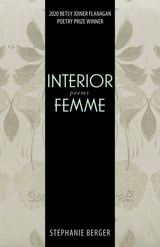
cover of Interior Femme: Poems

Interior Femme

Poems

Stephanie Berger

University of Nevada Press, 2022

In her debut collection, Stephanie Berger cracks the earth open and exposes the “woman inside.” In a sequence of poems that present variations on the Western feminine archetype, Interior Femme visits many unique locales, from cemeteries in Brooklyn to canyons in New Mexico to churches in San Diego, Paris, and Peru. Berger approaches her subjects—mothers, goddesses, whores, daughters, muses, and movie stars—from multiple angles, and through her poems she reveals historical, personal, social, environmental, and artistic viewpoints.

The poems offer layered perspectives fused with multiple versions of female representation, as if to underscore the burden of responsibility, inherited shame, and awesome power that comes with the position women have occupied throughout history. Berger reveals a woman critically wounded—representing the totality of the Western feminine imaginary. Lyrically complex, sometimes surreal, and often ekphrastic in style and content, Interior Femme simultaneously offers heartbreak, laughter, comfort, and empowerment.

 
[more]
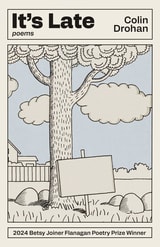
cover of It’s Late: Poems

It’s Late

Poems

Colin Drohan

University of Nevada Press, 2026

It’s Late approaches the world with openness and affection, prioritizing wonder about plants, animals, and other people, as well as individual and communal pasts, presents, and futures as a guiding force. The voices behind these poems dwell in a state of perpetual curiosity. Colin Drohan’s writing is full of awe but he also asks difficult questions about the world we inhabit and its present ecological crises, often discovering humor as a mechanism for real hope. It's Late imagines readers as close friends and confidants, written with a conversational quality that welcomes the absurdity of our daily lives.

[more]