Results by title
95 books match the query 'Arab-Israeli conflict' and 11 start with i

Imperial Israel and the Palestinians
The Politics of ExpansionNur Masalha
Pluto Press, 2000
Masalha argues that the heart of the conflict between Zionist immigrants/settlers and the native Palestinians has always been about land, territory, demography and water. He documents how Israeli policy has made it a priority to expel the Palestinians, either by war or peaceful measures. But these imperialist tendencies are not restricted to extremist zealots. The author uncovers the expansionist policies found in Labour Zionism and Kookist ideology.
Chapters cover the Whole Land of Israel Movement, Zionist Revisionism and the Likud Party, Gush Emunim and the religious fundamentalists, parties and movements of the far right and the evolution of Israeli Jewish public attitudes since 1967.
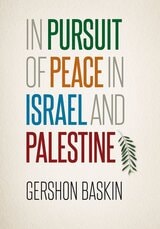
In Pursuit of Peace in Israel and Palestine
Gershon Baskin
Vanderbilt University Press, 2017
Despite the atmosphere of fear, Baskin found he could talk with both Jews and Palestinians, and that very few others were engaged in efforts at mutual understanding. At his initiative, the Ministry of Education and the office of right-wing prime minister Menachem Begin created the Institute for Education for Jewish-Arab Coexistence with Baskin himself as director. Eight years later he founded and codirected the only joint Israeli-Palestinian public policy think-and-do tank in the world, the Israel/Palestine Center for Research and Information. For decades he continued to cross borders, often with a kaffiyeh (Arab headdress) on his dashboard to protect his car in Palestinian neighborhoods. Airport passport control became Kafkaesque as Israeli agents routinely identified him as a security threat.
During the many cycles of peace negotiations, Baskin has served both as an outside agitator for peace and as an advisor on the inside of secret talks—for example, during the prime ministership of Yitzhak Rabin and during the initiative led by Secretary of State John Kerry. Baskin ends the book with his own proposal, which includes establishing a peace education program and cabinet-level Ministries of Peace in both countries, in order to foster a culture of peace.
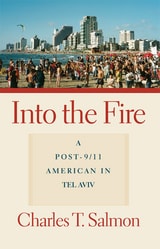
Into the Fire
A Post-9/11 American in Tel AvivCharles T. Salmon
Michigan State University Press, 2003
In the fall of 2001 Charles Salmon had a Fulbright fellowship in Israel. He was due to depart on September 12. Arriving in Israel a few weeks later, speaking no Hebrew and largely unfamiliar with Judaism and Israeli customs, he immersed himself in Israeli culture.
This collection of correspondence began as a weekly report to friends and was designed to offer an alternative to mainstream media. With the excitement of a tourist and the eagerness of an anthropologist, Salmon emerges as a modern Candide. He describes historical sites and a supermarket in Tel Aviv, discusses the differences between university students in Israel and America, and negotiates the purchase of food and the vagaries of the weather with humor and passion. The letters also discuss Israeli–Palestinian relations, and details terrorist events and responses to them.
This unique book focuses on how everyday hopes and fears transcend geopolitical boundaries and provides valuable lessons on how to thrive in these new and uncertain times.
Israel and Palestine
Competing HistoriesGreg Philo and Mike Berry
Pluto Press, 2006
Following on from their acclaimed book Bad News from Israel, Greg Philo and Mike Berry present a concise guide to the Israel-Palestine conflict. This uniquely accessible book will appeal to anyone looking for an approachable introduction. Uniquely, the authors show how there are many different, competing histories. They offer an overview of the wide range of contending viewpoints, and indicate those which are based on the most considered historical research.
The book covers key events in chronological order, in each case examining the varied historical accounts and presenting the beliefs of key thinkers across the ideological spectrum, from Edward Said to Binyamin Netanyahu. Starting the with emergence of the Zionist movement in the nineteenth century, and the figures who shaped it, the authors go on to cover the founding of Israel and its subsequent history, up to and including the 'roadmap for peace', the construction of the wall, the death of Arafat and the withdrawal from Gaza.
Israel and Settler Society
Lorenzo Veracini
Pluto Press, 2006
Veracini challenges two important myths: firstly, that the Israeli-Palestinian dispute is unique and defies comparative approaches; and secondly that the struggle is mainly based in nationality and religion and therefore different to typical colonial conflicts. On the contrary, Veracini shows how Israeli society is organised along apartheid lines -- and that apartheid was not unique to South Africa, but a common feature of colonisation. He examines wars of decolonization, and conflicts where whole native populations were all but eradicated -- as in Australia. Comparing and contrasting these with the more recent history of Israel and Palestine, he offers a critical perspective on colonialism as well as important new insights into patterns of imperialism today.
Israel, Jordan, and Palestine
The Two-State ImperativeAsher Susser
Brandeis University Press, 2011
Israel/Palestine and the Queer International
Sarah Schulman
Duke University Press, 2012
As Schulman learns more, she questions the contradiction between Israel's investment in presenting itself as gay friendly—financially sponsoring gay film festivals and parades—and its denial of the rights of Palestinians. At the same time, she talks with straight Palestinian activists about their position in relation to homosexuality and gay rights in Palestine and internationally. Back in the United States, Schulman draws on her extensive activist experience to organize a speaking tour for some of the Palestinian queer leaders whom she had met and trusted. Dubbed "Al-Tour," it takes the activists to LGBT community centers, conferences, and universities throughout the United States. Its success solidifies her commitment to working to end Israel's occupation of Palestine, and it kindles her larger hope that a new "queer international" will emerge and join other movements demanding human rights across the globe.
Israel
A HistoryAnita Shapira
Brandeis University Press, 2014
Israel
Politics, Myths and Identity CrisesAkiva Orr
Pluto Press, 1994
Israeli Rejectionism
A Hidden Agenda in the Middle East Peace ProcessZalman Amit
Pluto Press, 2011
Itineraries in Conflict
Israelis, Palestinians, and the Political Lives of TourismRebecca L. Stein
Duke University Press, 2008
Combining vivid ethnographic detail, postcolonial theory, and readings of Israeli and Palestinian popular texts, Stein considers a broad range of Israeli leisure cultures of the Oslo period with a focus on the Jewish desires for Arab things, landscapes, and people that regional diplomacy catalyzed. Moving beyond conventional accounts, she situates tourism within a broader field of “discrepant mobility,” foregrounding the relationship between histories of mobility and immobility, leisure and exile, consumption and militarism. She contends that the study of Israeli tourism must open into broader interrogations of the Israeli occupation, the history of Palestinian dispossession, and Israel’s future in the Arab Middle East. Itineraries in Conflict is both a cultural history of the Oslo process and a call to fellow scholars to rethink the contours of the Arab-Israeli conflict by considering the politics of popular culture in everyday Israeli and Palestinian lives.