Results by title
57 books match the query 'Aztecs' and 3 start with i
In the Palace of Nezahualcoyotl
Painting Manuscripts, Writing the Pre-Hispanic Past in Early Colonial Period Tetzcoco, MexicoBy Eduardo de J. Douglas
University of Texas Press, 2010
Around 1542, descendants of the Aztec rulers of Mexico created accounts of the pre-Hispanic history of the city of Tetzcoco, Mexico, one of the imperial capitals of the Aztec Empire. Painted in iconic script ("picture writing"), the Codex Xolotl, the Quinatzin Map, and the Tlohtzin Map appear to retain and emphasize both pre-Hispanic content and also pre-Hispanic form, despite being produced almost a generation after the Aztecs surrendered to Hernán Cortés in 1521. Yet, as this pioneering study makes plain, the reality is far more complex.
Eduardo de J. Douglas offers a detailed critical analysis and historical contextualization of the manuscripts to argue that colonial economic, political, and social concerns affected both the content of the three Tetzcocan pictorial histories and their archaizing pictorial form. As documents composed by indigenous people to assert their standing as legitimate heirs of the Aztec rulers as well as loyal subjects of the Spanish Crown and good Catholics, the Tetzcocan manuscripts qualify as subtle yet shrewd negotiations between indigenous and Spanish systems of signification and between indigenous and Spanish concepts of real property and political rights. By reading the Tetzcocan manuscripts as calculated responses to the changes and challenges posed by Spanish colonization and Christian evangelization, Douglas's study significantly contributes to and expands upon the scholarship on central Mexican manuscript painting and recent critical investigations of art and political ideology in colonial Latin America.
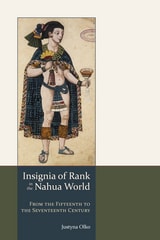
Insignia of Rank in the Nahua World
From the Fifteenth to the Seventeenth CenturyJustyna Olko
University Press of Colorado, 2014
This significant work reconstructs the repertory of insignia of rank and the contexts and symbolic meanings of their use, along with their original terminology, among the Nahuatl-speaking communities of Mesoamerica from the fifteenth through the seventeenth centuries. Attributes of rank carried profound symbolic meaning, encoding subtle messages about political and social status, ethnic and gender identity, regional origin, individual and community history, and claims to privilege.
Olko engages with and builds upon extensive worldwide scholarship and skillfully illuminates this complex topic, creating a vital contribution to the fields of pre-Columbian and colonial Mexican studies. It is the first book to integrate pre- and post-contact perspectives, uniting concepts and epochs usually studied separately. A wealth of illustrations accompanies the contextual analysis and provides essential depth to this critical work. Insignia of Rank in the Nahua World substantially expands and elaborates on the themes of Olko's Turquoise Diadems and Staffs of Office, originally published in Poland and never released in North America.
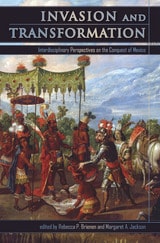
Invasion and Transformation
Interdisciplinary Perspectives on the Conquest of MexicoRebecca P. Brienen
University Press of Colorado, 2020
Was Moteuczoma really as weak as history portrayed him? As Susan D. Gillespie instead suggests in "Blaming Moteuczoma," the representation of Moteuczoma as a scapegoat for the Aztec defeat can be understood as a product of indigenous resistance and accommodation following the imposition of Spanish colonialism. Chapters address the various roles (real and imagined) of Moteuczoma, Cortés, and Malinche in the fall of the Aztecs; the representation of history in colonial art; and the complex cultural transformations that actually took place.
Including full-color reproductions of seventeenth-century paintings of the Conquest, Invasion and Transformation will appeal to scholars and students of Latin American history and anthropology, art history, colonial literature, and transatlantic studies. Contributors include Rebecca P. Brienen, Louise M. Burkhart, Ximena Chávez Balderas, Constance Cortez, Viviana Diáz Balsera, Martha Few, Susan D. Gillespie, Margaret A. Jackson, Diana Magaloni Kerpel, Matthew Restall, Michael Schreffler.