Results by title
101 books match the query 'Behavior' and 6 start with i

If You Tame Me
Understanding Our Connection With AnimalsLeslie Irvine, foreword by Marc Bekoff
Temple University Press, 2004

In a Desert Garden
Love and Death among the InsectsJohn Alcock
University of Arizona Press, 1999
As Alcock studies the plants in his yard, he shares thoughts on planting, weeding, and pruning that any gardener will appreciate. And when commenting on the mating rituals of spiders and beetles or marveling at the camouflage of grasshoppers and caterpillars, he uses humor and insight to detail the lives of the insects that live in his patch of desert. Celebrating the virtues of even aphids and mosquitoes, Alcock draws the reader into the intricacies of desert life to reveal the complex interactions found in this unique ecosystem. In a Desert Garden combines meticulous science with contemplations of nature and reminds us that a world of wonder lies just outside our own doors.
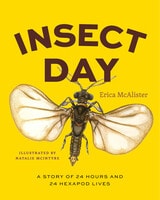
Insect Day
A Story of 24 Hours and 24 Hexapod LivesErica McAlister
University of Chicago Press, 2026
An hourly guide that follows twenty-four insects as they find food, mates, and safety from predators.
In this short book, celebrated scientist and award-winning author Erica McAlister leads readers on a worldwide field trip in search of insects. Each chapter of Insect Day introduces a single insect during a single hour, highlighting how twenty-four different species spend their time.
Early in our day, we meet a cold Arctic bumblebee, basking among poppy flower petals to warm itself. Even when the world around her is very cold, she keeps remarkably warm simply by vibrating. Near midday, there is enough sunlight for the blue-winged helicopter, a damselfly, to navigate the forests for her prey. When our insect spots a spider web, she looks for its creator—one vicious hunter eyeing up another. The giant damselfly reverses away from the web and then launches into an attack, grabbing onto the spider with her forelegs. If successful (many spiders are dropped), she perches while feasting. And then, like the most fastidious of diners, she cleans off any gossamer threads with a good preen. In the dark, the dung beetle also looks to the sky, using the Milky Way to orient itself as it rolls a ball of dung—a future home for its offspring. And, as our day closes, a tiger moth escapes bat hunters by fighting sound with sound—jamming bats’ sonar with ultrasonic clicking noises.
For each chapter, artist Natalie McIntyre has depicted these insects in stunning illustrations, blending traditional scientific drawing methods with fine art techniques. Working together to narrate and illustrate these unique moments in time, McAlister and McIntyre have created an engaging read that is a perfect way to spend an hour or two—and a true gift for readers, amateur naturalists, and all insect lovers.

Insect Media
An Archaeology of Animals and TechnologyJussi Parikka
University of Minnesota Press, 2010
Through close engagement with the pioneering work of insect ethologists, including Jakob von Uexküll and Karl von Frisch, posthumanist philosophers, media theorists, and contemporary filmmakers and artists, Parikka develops an insect theory of media, one that conceptualizes modern media as more than the products of individual human actors, social interests, or technological determinants. They are, rather, profoundly nonhuman phenomena that both draw on and mimic the alien lifeworlds of insects.

Into Africa
Craig Packer
University of Chicago Press, 1994
As in the works of George Schaller and Cynthia Moss, Packer transports us to life in the field. He is addicted to this land—to the beauty of a male lion striding across the Serengeti plains, to the calls of a baboon troop through the rain forests of Gombe—and to understanding the animals that inhabit it. Through his vivid narration, we feel the dust and the bumps of the Arusha Road, smell the rosemary in the air at lunchtime on a Serengeti verandah, and hear the lyrics of the Grateful Dead playing off bootlegged tapes.
Into Africa also explores the social lives of the animals and the threats to their survival. Packer grapples with questions he has passionately tried to answer for more than two decades. Why do female lions raise their young in crèches? Why do male baboons move from troop to troop while male chimps band together? How can humans and animals continue to coexist in a world of diminishing resources? Immediate demands—logistical nightmares, political upheavals, physical exhaustion—yield to the larger inescapable issues of the interdependence of the land, the animals, and the people who inhabit it.
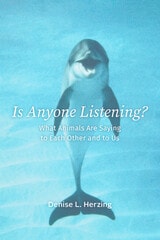
Is Anyone Listening?
What Animals Are Saying to Each Other and to UsDenise L. Herzing
University of Chicago Press, 2024
If you could pose one question to a dolphin, what would it be? And what might a dolphin ask you? For forty years, researcher and author Denise L. Herzing has investigated these and related questions of marine mammal communication. With the assistance of a friendly community of Atlantic spotted dolphins in the Bahamas, Herzing studies two-way communication between different dolphin species and between humans and dolphins using a variety of cutting-edge experiments. But the dolphins are not the only ones talking, and in this wide-ranging and accessible book, Herzing explores the astonishing realities of interspecies communication, a skill that humans currently lack.
Is Anyone Listening? connects research on dolphin communication to findings from Jane Goodall on chimpanzees, Dian Fossey on mountain gorillas, Cynthia Moss on African elephants, and others driving today’s exploration of possible animal languages. Although humans have long attempted to crack animal communication codes, only now do we have the advanced machine-learning tools to help. As Herzing reveals, researchers are finding fascinating hints of language in nonhuman species, including linguistic structures, vowel equivalents, and complex repeated sequences. By looking at the many ways animals use and manipulate signals, we see that we’ve only just begun to appreciate the diversity of animal intelligence and the complicated and subtle aspects of animal communication.
Considering dolphins and other nonhuman animals as colleagues instead of research subjects, Herzing asks us to meet animals as both speakers and listeners, as mutually curious beings, and to listen to what they are saying.