Results by title
277 books match the query 'Biology' and 10 start with i
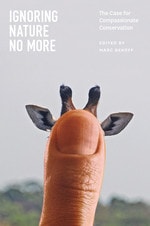
Ignoring Nature No More
The Case for Compassionate ConservationEdited by Marc Bekoff
University of Chicago Press, 2013
This collection of diverse essays is the first book devoted to compassionate conservation, a growing global movement that translates discussions and concerns about the well-being of individuals, species, populations, and ecosystems into action. Written by leading scholars in a host of disciplines, including biology, psychology, sociology, social work, economics, political science, and philosophy, as well as by locals doing fieldwork in their own countries, the essays combine the most creative aspects of the current science of animal conservation with analyses of important psychological and sociocultural issues that encourage or vex stewardship. The contributors tackle topics including the costs and benefits of conservation, behavioral biology, media coverage of animal welfare, conservation psychology, and scales of conservation from the local to the global. Taken together, the essays make a strong case for why we must replace our habits of domination and exploitation with compassionate conservation if we are to make the world a better place for nonhuman and human animals alike.
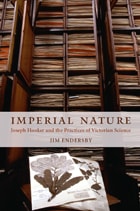
Imperial Nature
Joseph Hooker and the Practices of Victorian ScienceJim Endersby
University of Chicago Press, 2008
By analyzing Hooker’s career, Endersby offers vivid insights into the everyday activities of nineteenth-century naturalists, considering matters as diverse as botanical illustration and microscopy, classification, and specimen transportation and storage, to reveal what they actually did, how they earned a living, and what drove their scientific theories. What emerges is a rare glimpse of Victorian scientific practices in action. By focusing on science’s material practices and one of its foremost practitioners, Endersby ably links concerns about empire, professionalism, and philosophical practices to the forging of a nineteenth-century scientific identity.
Impure Cultures
University Biology and the World of CommerceDaniel Lee Kleinman
University of Wisconsin Press, 2003
How are the worlds of university biology and commerce blurring? Many university leaders see the amalgamation of academic and commercial cultures as crucial to the future vitality of higher education in the United States. In Impure Cultures, Daniel Lee Kleinman questions the effect of this blending on the character of academic science.
Using data he gathered as an ethnographic observer in a plant pathology lab at the University of Wisconsin–Madison, Kleinman examines the infinite and inescapable influence of the commercial world on biology in academia today. Contrary to much of the existing literature and common policy practices, he argues that the direct and explicit relations between university scientists and industrial concerns are not the gravest threat to academic research. Rather, Kleinman points to the less direct, but more deeply-rooted effects of commercial factors on the practice of university biology. He shows that to truly understand research done at universities today, it is first necessary to explore the systematic, pervasive, and indirect effects of the commercial world on contemporary academic practice.
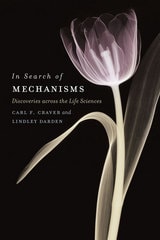
In Search of Mechanisms
Discoveries across the Life SciencesCarl F. Craver and Lindley Darden
University of Chicago Press, 2013

Infectious Disease
A Scientific American ReaderEdited by Scientific American
University of Chicago Press, 2008
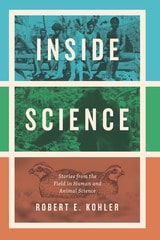
Inside Science
Stories from the Field in Human and Animal ScienceRobert E. Kohler
University of Chicago Press, 2019
Resident observing takes place across a range of sciences, from anthropology and sociology to primatology, wildlife ecology, and beyond. What makes it special, Kohler argues, is the direct access it affords scientists to the contexts in which their subjects live and act. These scientists understand their subjects not by keeping their distance but by living among them and engaging with them in ways large and small. This approach also demonstrates how science and everyday life—often assumed to be different and separate ways of knowing—are in fact overlapping aspects of the human experience. This story-driven exploration is perfect for historians, sociologists, and philosophers who want to know how scientists go about making robust knowledge of nature and society.
Instrumental Biology, or The Disunity of Science
Alexander Rosenberg
University of Chicago Press, 1994
In Instrumental Biology, or the Disunity of Science, Alexander Rosenberg argues that while physics and chemistry can develop laws that reveal the structure of natural phenomena, biology is fated to be a practical, instrumental discipline. Because of the complexity produced by natural selection, and because of the limits on human cognition, scientists are prevented from uncovering the basic structure of biological phenomena. Consequently, biology and all of the disciplines that rest upon it—psychology and the other human sciences—must aim at most to provide practical tools for coping with the natural world rather than a complete theoretical understanding of it.

Into the Cool
Energy Flow, Thermodynamics, and LifeEric D. Schneider and Dorion Sagan
University of Chicago Press, 2005
Working from the precept that "nature abhors a gradient," Into the Cool details how complex systems emerge, enlarge, and reproduce in a world tending toward disorder. From hurricanes here to life on other worlds, from human evolution to the systems humans have created, this pervasive pull toward equilibrium governs life at its molecular base and at its peak in the elaborate structures of living complex systems. Schneider and Sagan organize their argument in a highly accessible manner, moving from descriptions of the basic physics behind energy flow to the organization of complex systems to the role of energy in life to the final section, which applies their concept of energy flow to politics, economics, and even human health.
A book that needs to be grappled with by all those who wonder at the organizing principles of existence, Into the Cool will appeal to both humanists and scientists. If Charles Darwin shook the world by showing the common ancestry of all life, so Into the Cool has a similar power to disturb—and delight—by showing the common roots in energy flow of all complex, organized, and naturally functioning systems.
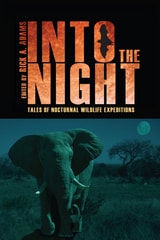
Into the Night
Rick Adams
University Press of Colorado, 2013
Contributors tell of confronting North American bears, cougars, and rattlesnakes; suffering red ctenid spider bites in the tropical rain forest; swimming through layers of feeding-frenzied hammerhead sharks in the Galapagos; evading the wrath of African bull elephants in South Africa; and delighting in the curious and gentle nature of foxes and unconditional acceptance by a family of owls. They describe “fire in the sky” across a treeless tundra, a sea ablaze with bioluminescent algae, nighttime earthquakes on the Pacific Rim, and hurricanes and erupting volcanoes on a Caribbean island.
Into the Night reveals rare and unexpected insights into nocturnal field research, illuminating experiences, discoveries, and challenges faced by intrepid biologists studying nature’s nightly marvels across the globe. This volume will be of interest to scientists and general readers alike.
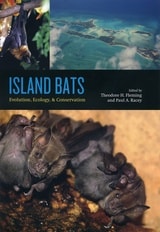
Island Bats
Evolution, Ecology, and ConservationEdited by Theodore H. Fleming and Paul A. Racey
University of Chicago Press, 2010
The second largest order of mammals, Chiroptera comprises more than one thousand species of bats. Because of their mobility, bats are often the only native mammals on isolated oceanic islands, where more than half of all bat species live. These island bats represent an evolutionarily distinctive and ecologically significant part of the earth’s biological diversity.
Island Bats is the first book to focus solely on the evolution, ecology, and conservation of bats living in the world’s island ecosystems. Among other topics, the contributors to this volume examine how the earth’s history has affected the evolution of island bats, investigate how bat populations are affected by volcanic eruptions and hurricanes, and explore the threat of extinction from human disturbance. Geographically diverse, the volume includes studies of the islands of the Caribbean, the Western Indian Ocean, Micronesia, Indonesia, the Philippines, and New Zealand.
With its wealth of information from long-term studies, Island Bats provides timely and valuable information about how this fauna has evolved and how it can be conserved.