Results by title
112 books match the query 'Body' and 5 start with i
Incarnation, Pain, Theology
A Phenomenology of the BodyEspen Dahl
Northwestern University Press, 2024
While the phenomenological tradition has carefully treated both the objective and the lived body, Espen Dahl explores a dimension of the body that does not fall neatly into either category, suggesting that philosophers should take account of the inner density of our organic, material body. By integrating the dimension of “flesh-and-blood” into the phenomenological notion of the body, Dahl argues that it is possible to reach a more adequate notion of human incarnation. The author explores the body in its subjectivity and its resistance, in activity founded on passivity, and in the ambiguous limits of its skin. The phenomenon of pain is given particular attention in this investigation, since pain is, as Dahl argues, what makes the body inescapably manifest in its otherwise hidden dimensions, including its ambiguity and vulnerability. Related to this focus, Dahl also engages with the Christian theological concerns of incarnation, pain, and hope. Phenomenologists have long drawn on this religious inheritance, particularly in what has been dubbed the French “theological turn.” In a similar manner, Incarnation, Pain, Theology: A Phenomenology of the Body draws on these theological sources while firmly holding to its philosophical commitments in methodological approach and analytic aims.
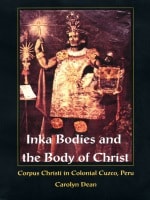
Inka Bodies and the Body of Christ
Corpus Christi in Colonial Cuzco, PeruCarolyn Dean
Duke University Press, 1999
As Dean clearly illustrates, the central rite of the festival—the taking of the Eucharist—symbolized both the acceptance of Christ and the power of the colonizers over the colonized. The most remarkable of Andean celebrants were those who appeared costumed as the vanquished Inka kings of Peru’s pagan past. Despite the subjugation of the indigenous population, Dean shows how these and other Andean nobles used the occasion of Corpus Christi as an opportunity to construct new identities through tinkuy, a native term used to describe the conjoining of opposites. By mediating the chasms between the Andean region and Europe, pagans and Christians, and the past and the present, these Andean elites negotiated a new sense of themselves. Dean moves beyond the colonial period to examine how these hybrid forms of Inka identity are still evident in the festive life of modern Cuzco.
Inka Bodies and the Body of Christ offers the first in-depth analysis of the culture and paintings of colonial Cuzco. This volume will be welcomed by historians of Peruvian culture, art, and politics. It will also interest those engaged in performance studies, religion, and postcolonial and Latin American studies.
Inside the Body of Black Feminism
Science, Race, CultureSamantha Pinto
Duke University Press, 2026
Inside the Body of Black Feminism charts a cultural genealogy of antiracist and feminist engagement with some of the most objectified internal “parts” of racist medical and scientific inquiry: bones and blood, brains and hearts, guts and wombs. In a move counterintuitive to Black feminism’s emphasis on externalized representations of the body, Samantha Pinto reinterprets the relationship between embodiment, health, and race through cultural archives that reimagine the inside of the Black body. Working through materials such as medical textbooks, memoirs, data visualizations, museum displays, speculative fiction, and horror films, Pinto explores how a visually inaccessible corporeal interior becomes discernible and racialized in the public sphere. Inside the Body of Black Feminism engages expressive cultural work to ask how we might know the inside of the Black body differently through Black feminist theory and how scientific and medical inquiry might enable us to understand political subjectivity anew.

Intangible Materialism
The Body, Scientific Knowledge, and the Power of LanguageRonald Schleifer
University of Minnesota Press, 2009
Taking as his point of departure Norbert Weiner’s statement that information is basic to understanding materialism in our era, Ronald Schleifer shows how discoveries of modern physics have altered conceptions of matter and energy and the ways in which both information theory and the study of literature can enrich these conceptions. Expanding the reductive notion of “the material” as simply matter and energy, he formulates a new, more inclusive idea of materialism.
Schleifer’s project attempts to bridge the divisions between the humanities and the sciences and to create a nonreductive materialism for the information age. He presents a materialistic account of human bodily experience by delving into language and literature that powerfully represents our faces, voices, hands, and pain. For example, he examines the material resources of poetic “literariness” as it is revealed in the condition of Tourette’s syndrome. Schleifer also investigates gestures of the hand in the formation of sociality, and he studies pain as both a physiological and phenomenological experience.
This ambitious work explores physiological analyses, evolutionary explanations, and semiotic descriptions of materialism to reveal how aspects of physical existence discover meaning in experience.
Intersexual Persons and Theology of the Body
A Limit Case for John Paul II's Theological AnthropologyBeth Zagrobelny Lofgren
Catholic University of America Press, 2026